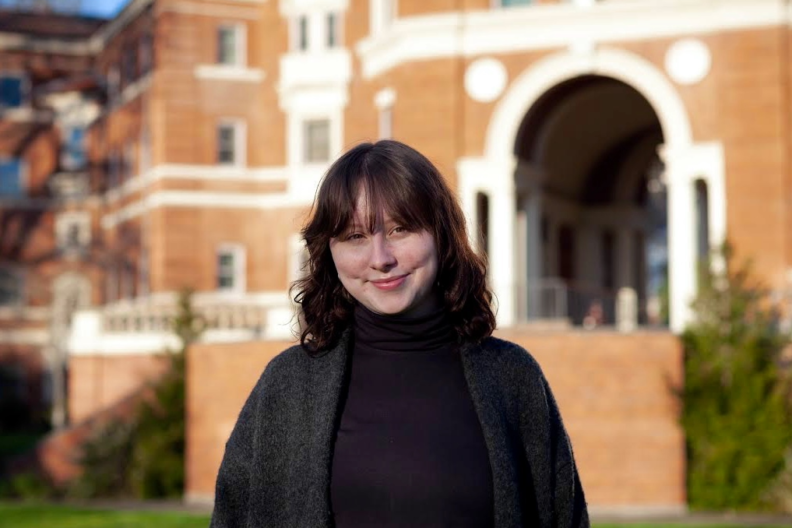
Kailie Franco is spearheading research to better understand how bacterial pathogens navigate the human GI tract. Her work has the potential to lead to new treatments and therapies.
Originally from Portland, Oregon, Kailie is pursuing a doctorate in Immunology and Infectious Disease under the mentorship of Dr. Arden Baylink, an assistant professor in the department of Veterinary Microbiology and Pathology.
Kailie earned dual Bachelor of Science in biochemistry/biophysics and chemistry from Oregon State University in 2022 and hopes to complete her graduate students in the spring of 2026. She is serving as the vice president of the College of Veterinary Medicine Graduate Student Association and is an ARCS fellow. The fellowship is awarded through Seattle chapter of the ARCS Foundation to outstanding students studying to complete degrees in science, technology, engineering, and mathematics.
She recently took some time to discuss her research and experiences in the College of Veterinary Medicine.
What inspired you to pursue your graduate studies at WSU?
I had a sort of untraditional route to WSU. Originally, I was not going to pursue graduate studies right after completing my BS, but that all changed when my PI was starting his lab at WSU, and I joined the lab and WSU as the Baylink Lab’s first student.
Can you describe your current research and its significance in your field?
Currently, my research focuses on understanding how bacterial pathogens navigate the human GI tract. Particularly, I study how the pathogen Helicobacter pylori senses and uses external reactive oxygen species derived from host immunity to make decisions on where to infect. This is significant to research as H. pylori infects roughly half of the world’s population and has been denoted as a priority pathogen for further research due to rising rates of antimicrobial resistance. We hope that through understanding how these pathogens make decisions, we can block that and develop new antimicrobial therapies.
How has your research evolved since you began your graduate studies?
My research has evolved significantly over the past few years – most obviously, I initially started studying the pathogen Salmonella enterica serovar Typhimurium, the bacteria that most commonly causessalmonellosis in the United States. This was a great introduction into culturing and understanding a more well-studied GI pathogen, yet as my studies progressed, I discovered that I wanted to focus more on the translational aspect to research, focusing more on targeting a less well studied system to develop antimicrobial therapies.
What role does collaboration play in your research, and how have you worked with other students and faculty?
Collaboration is a huge part of my research. In my lab, I am very reliant on my colleagues whether they be postdocs, other graduate students or undergraduates to help me learn a new technique or help me troubleshoot any issues that may arise as is common during research.
Additionally, there are some aspects to my research that both my PI and I do not have expertise in, so I have relied a lot on my committee members and other PIs to develop an understanding of these areas, such as histology or immunofluorescence.
What are your long-term career goals, and how is your current research helping you achieve them?
My long-term goal is to be able to facilitate a greater understanding of gastrointestinal disease amongst the general public. GI diseases, especially those caused by bacteria, are highly stigmatized due to the often sensitive nature of their symptoms, as well as the direct correlation to areas of lower socioeconomic status having higher rates of incidence. Perhaps through my current research, or research I am a part of in the future, I can help to develop treatments for bacteria-induced GI disease, lessening the mental and physical burden of those who suffer from these issues.
What has been your favorite thing about WSU and the College of Veterinary Medicine?
My favorite thing about WSU and the College of Veterinary Medicine is the amount of resources available to students. From the CVM Wellness Team being available to help students through tough events, to the events put on by the DEI Committee like the farm stands we had this past fall, I truly feel as though there is something for everyone here.