By Josh Babcock, College of Veterinary Medicine
Graduate student Charles Ugwu was unable to travel to his home country of Nigeria for Thanksgiving break, but that doesn’t mean he didn’t spend it with friends and family.
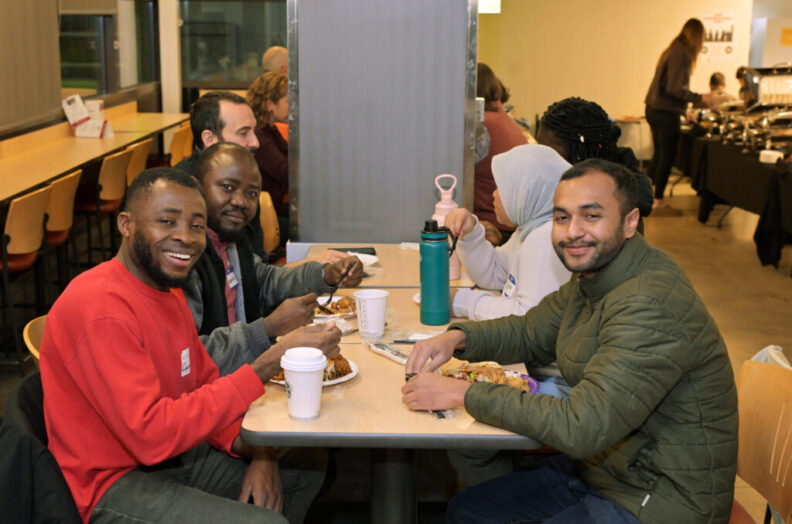
Inside the Mickelsen Lounge at Washington State University, Ugwu attended a warm celebration that featured dishes from around the world at the second annual Community Dinner potluck hosted by the College of Veterinary Medicine’s department of diversity, equity and inclusion.
“I couldn’t go home for Thanksgiving, I would love to, but one of the things I have learned in the past two years and four months that I’ve been here, is that actually home is more about people than a place, and I’ve met friends here in Pullman that have made me feel at home,” Ugwu said.
Largely advertised to those in the College of Veterinary Medicine, the Community Dinner is open to any students, faculty or staff on campus during Thanksgiving break.
Ugwu, a doctoral student in immunology and infectious disease, said conversations at last year’s first Community Dinner led to close friendships with people from varying backgrounds he didn’t even know attended the same college.
“You find yourself being lifted up and learning and growing in so many ways,” Ugwu said. “For some of us who are not close to our immediate families or biological families, the Community Dinner is a great alternative and some of us have found family here.”
The dinner is one of the latest efforts by the College of Veterinary Medicine to build community for underrepresented students, or anyone who doesn’t have aa social network.
Maurice Cottman, Director of Diversity, Equity and Inclusion at WSU’s College of Veterinary Medicine, said the college hasn’t done enough historically to build community for underrepresented students, faculty, staff, or anyone who may not have found a community here at WSU.
The Community Dinner is just one step toward building that community. Other efforts include mental health grab bags during finals week for any student who needs them, collaboration with the Community Action Center to provide a local farmstand with free locally sourced produce, and the CVM Connect series which brings the college together to discuss culture, power dynamics, and how to empower marginalized voices, to name a few.
Cottman said the Dr. Winfred A. Jordan Awards, which, in addition to students’ academic prowess, recognizes the hurdles those in underserved communities face in veterinary medicine and biomedical sciences, may be the project he is most proud of, but its day-to-day conversations with students that likely have the most impact on community.
“We talk about challenges, any problems that they have,” Cottman said.
Cottman said through events like these and the Community Dinner, he’s working to help everyone find community, but he’s starting with those who need it most – those who are unrepresented or marginalized.
“Sometimes it’s community sustaining, sometimes it’s community growth and development, and sometimes it’s just straight up building, but community is at the core of pretty much everything and I think that’s the most sustainable form of DEI work that I’ve seen,” said Cottman.