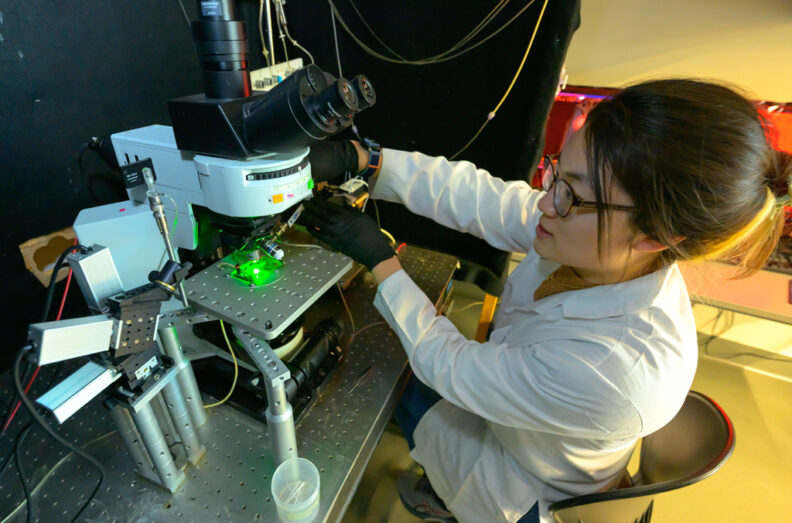
Neuroscience graduate student Sue Yu’s research into the effects of neuromodulators on intrinsically photosensitive retinal ganglion cells (ipRGCs) has the potential to lead to advancements in treating visual disorders.
She recently took some time to discuss her research and experiences at WSU.
What inspired you to pursue your graduate studies at WSU?
I was an undergraduate research assistant at WSU starting in my sophomore year. I always found preclinical research fascinating, especially research that translates into clinical applications.
Can you describe your current research and its significance in your field?
My current research focuses on understanding the effects of neuromodulators on a specific subtype of retinal ganglion cells known as intrinsically photosensitive retinal ganglion cells (ipRGCs). This research is significant because it could provide insights into how these cells contribute to visual and non-visual functions, potentially leading to advancements in treating visual disorders.
How has your research evolved since you began your graduate studies?
I discovered that the retinal neuromodulator adenosine affects the activity of intrinsically photosensitive retinal ganglion cells (ipRGCs) in the presence of light. Additionally, my findings suggest a potential interaction between dopamine and adenosine receptors in these cells. My dissertation will focus on understanding these interactions and exploring the possible heteromeric formation of adenosine and dopamine receptors in ipRGCs.
How has your mentor helped you in your journey?
I greatly appreciate Dr. Lane Brown’s support and mentorship. He provides valuable guidance for my experiments and helps with writing proposals. Additionally, he occasionally quizzes me to ensure I understand critical information for my research, broadening my understanding of the retina.
What are your long-term career goals, and how is your current research helping you achieve them?
One of my long-term goals is to attend medical school and bridge the gap between research, preclinical studies, and clinical settings. I believe understanding both research and medicine is crucial for effectively helping people and the community. Ultimately, I aim to conduct research in a biomedical setting.
What has been your favorite thing about WSU and the College of Veterinary Medicine?
My favorite aspect of WSU and the College of Veterinary Medicine is how approachable and supportive everyone is. I can comfortably seek help or guidance from PIs and fellow colleagues, fostering a family-like environment.
What has surprised you the most about WSU and the College of Veterinary Medicine?
The welcoming and supportive community at WSU and the CVM took me by surprise and has been a true blessing.
What would you say to prospective graduate students considering the College of Veterinary Medicine
I would tell prospective graduate students that the College of Veterinary Medicine at WSU offers a supportive and collaborative environment where you can thrive. The faculty are approachable and willing to help, the resources are top-notch, and there’s a strong sense of community that makes you feel like part of a family. If you are passionate about veterinary medicine and want to be in a place where you can grow both academically and personally, WSU is an excellent choice.