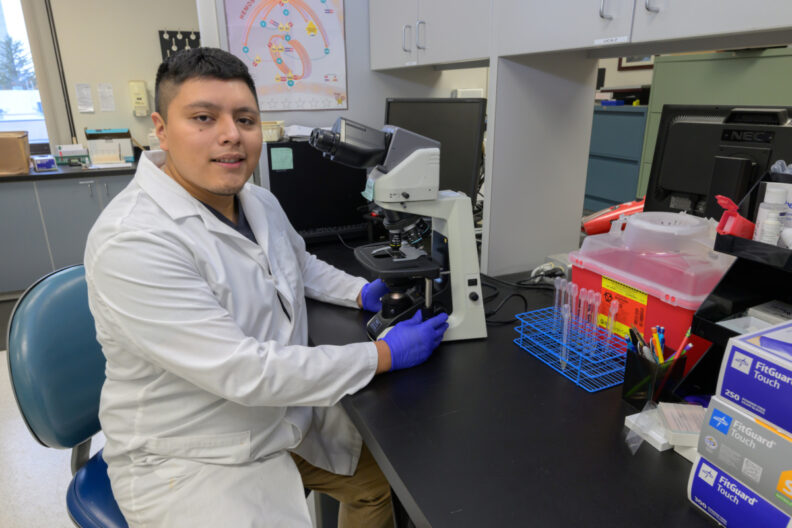
A first-generation college student, Angel Delgado didn’t know where to begin when it came to applying for college. It wasn’t something he even considered until two or three months before classes started.
“I could’ve followed in my family’s footsteps and worked full-time construction, full-time warehouse jobs. It just didn’t seem like it was for me,” Delgado said.
Foreign to the college application process and unsure of a major but set on helping people in whatever it was he planned to do, Delgado applied to Washington State University’s Pullman campus, where he would go on to earn his undergraduate degree in microbiology in 2023.
His hope: to attain his medical laboratory science certificate and give people – or even animals – critical test results that identify cancer, heart disease, and other medical conditions.
“I knew I probably wasn’t going to be a doctor, and I didn’t want to be one, but I found I can work in a lab and do what I like and still be able to help people,” he said.
Delgado earned his medical laboratory science certificate from Heritage University last spring and was hired in the fall to serve as a laboratory technician in the Clinical Pathology section at WSU’s Veterinary Teaching Hospital.
With a myriad routine and specialized tests available at the largest veterinary referral center in the Pacific Northwest, Delgado is often fixed under the microscope.
Analyzing blood, urine, and the occasional spinal fluid sample, he screens for a variety of diseases and infections ranging from anemia and urinary tract disease to hormonal disorders and cancers.
Unlike in human hospitals where most samples are run through an analyzer and processed automatically, Delgado processes each test in the Veterinary Teaching Hospital by hand.
He said the biggest challenge is understanding what “normal” looks like in the variety of animal species.
“It’s a lot because I went from learning what is normal for a human to working with dogs, cats, cows, horses, turtles,” he said. “Human red blood cells look different than red blood cells in other animals, and what may be normal in a human may not be normal in a cat or dog.”
In addition to pathology, Delgado is learning that helping people – and their pets – isn’t easy.
“It’s hard when you look up a patient and it says that they didn’t make it,” he said. “That’s part of the job, though – not everyone’s going to make it.”
But for every patient with problematic test results, Delgado is more eager to assess the next and, unlike in human hospitals, he occasionally will get to meet the animal patients.
“Some of the nurses that work here will come and bring patients around, so we get to see them,” he said. “It’s quite rewarding that you get to see some of the dogs or cats that you’re doing tests on.”
Delgado said his love for working in the lab may have never been discovered without his professor and undergraduate mentor, Heather Koehler.
“The moment that I started working there, I learned I really liked working in a lab,” he said. “I wasn’t so sure about going into the research side, but she really pushed me to pursue my passion of working in a lab. So big shout out to Heather. She was very inspiring and helpful along the way.”
Growing up on a farm outside Yakima, Washington, with a variety of animals, Delgado’s new role at WSU’s Veterinary Teaching Hospital combines his long love for animals and his newfound love, lab work.
“It’s nice to do what you love and know that I am helping people by giving them these results,” he said. “It’s a sweet gig.”