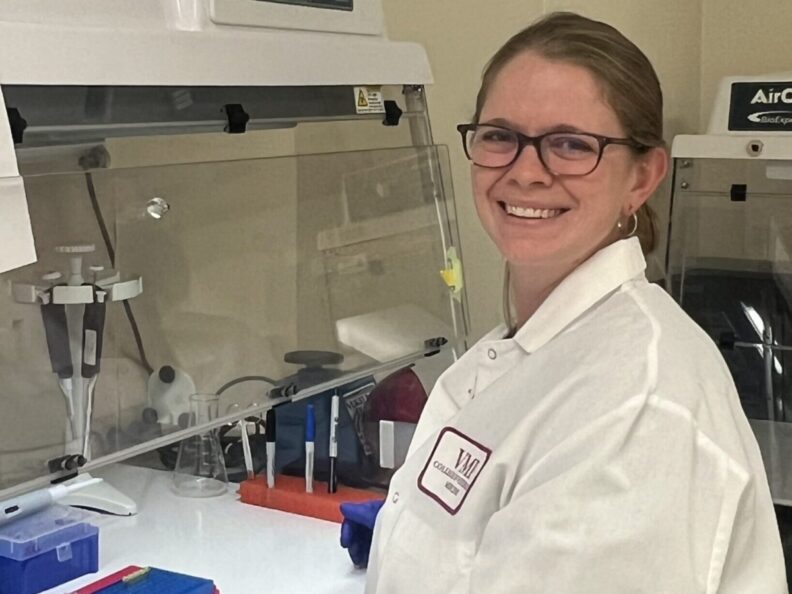
Chelsea Weeks, a PhD student in the WSU College of Veterinary Medicine’s Multidisciplinary Program in Infectious Disease, is pursuing her passion for aquatic animal health under the mentorship of Dr. Thomas Waltzek. From Orofino, Idaho, Chelsea earned a B.S. in biology from Lewis-Clark State College in Lewiston, Idaho, followed by an M.S. in biology and a Postbaccalaureate Certificate in zoo and aquarium studies from Western Illinois University. Drawing on her early experience at the Idaho Fish Health Center where she discovered her fascination with how pathogens influence aquatic ecosystems, Chelsea is now working to better understand and control viral diseases affecting sturgeon populations. She expects to complete her doctoral studies in fall 2028.
Chelsea is one of WSU’s prestigious ARCS scholars. ARCS, a national organization established and operated entirely by women, is committed to the advancement of science in the United States by financially supporting distinguished graduate students in science, technology, engineering and medical research disciplines at its partner institutions. She is also a proud AmeriCorps alum and continues to volunteer to support AmeriCorps programs in the region.
She recently took some time to discuss her research, experiences, and goals.
What inspired you to pursue your graduate studies at WSU?
I found my passion for aquatic animal health while working at the Idaho Fish Health Center while completing my undergraduate degree. Working with regional hatchery and wild fish, I was fascinated by how the presence or absence of pathogens can have ecosystem-wide management implications. The Multidisciplinary Program in Infectious Disease and the budding Aquatic Animal Health Program in the College of Veterinary Medicine were a perfect fit for my research interests and career goals.
Can you describe your current research?
My current research focuses on characterizing viruses that affect sturgeon, specifically a novel herpesvirus found in lake sturgeon and a unique strain of white sturgeon iridovirus, which has been linked to mortalities in an endangered population of white sturgeon of the region. Sturgeon are important aquaculture species due to their cultural significance, economic value of caviar and fillets, and prominence as a sport fish. These pathogens can cause significant mortality in juvenile fish, raising concerns in the aquaculture industry. My work will include genomic and phylogenetic analyses, as well as the development and validation of molecular diagnostic assays for detection. These tools will be important for reducing sturgeon mortality and controlling these viruses in production facilities.
What role does collaboration play in your research?
Collaboration will be a key component of my research projects, both within WSU and more broadly, working with regional stakeholders. As part of my research, I will work with the Aquatic Molecular Physiology Lab in the School of Biological Sciences to investigate the use of CRISPR as a diagnostic tool. I will also work with fish pathologists and genome sequencing experts at WADDL for the formal diagnosis and sequencing of field samples. Additionally, collaboration with fish hatcheries and fish health programs in the region is essential to this work. A major goal of my research is to develop tools and provide information to support the rearing and care of sturgeon in managed settings. Therefore, collaborating with hatcheries and fish health specialists will be important as I complete my research.
What are your long-term career goals?
Upon completing my doctoral work, I would like to study emerging pathogens affecting farmed and wild fish, working in an aquatic animal health program in the region. I am interested in the differing pressures faced by hatchery and wild populations, specifically, the impact infectious disease can have in these different settings. My current research will provide me with in-depth knowledge of molecular diagnostic assay development, which will be important for my future research on emerging pathogens. Also, my research will allow me to learn more about aquaculture practices, helping me bridge the gap between laboratory diagnostics and aquaculture to support both conservation and commercial hatcheries.
What would you say to prospective graduate students considering the College of Veterinary Medicine?
I highly encourage any students thinking about the College of Veterinary Medicine to visit or set up a video chat to talk with someone! Everyone is so nice and supportive, always happy to answer questions and help. The College of Vet Med is a great place to be, not only for vet students, but also for researchers interested in animal health.