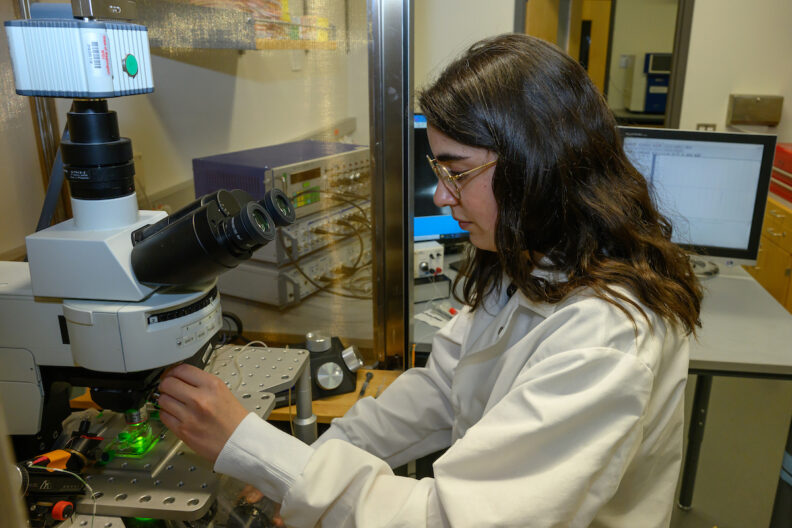
Originally from Valdivia, Chile, Jo Jara is a PhD student in neuroscience in the College of Veterinary Medicine’s Integrative Physiology and Neuroscience program, where she studies how gut-brain communication influences feeding behavior. She earned her bachelor’s degree in biochemistry from Pontificia Universidad Católica de Chile and is expected to complete her PhD in August 2029. Working under the mentorship of Dr. Suzanne Appleyard, she investigates how specific neural circuits respond to signals from the body to shape eating patterns.
What inspired you to pursue your graduate studies at WSU?
I’ve been fascinated by how the brain controls behavior since I was young, particularly how biological systems shape how we act and make decisions. During the final stage of my undergraduate training, I had the opportunity to join a neuroscience lab focused on energy regulation and food intake. As I began exploring graduate programs, Washington State University stood out because of its strong group of researchers working on the neural regulation of feeding.
Can you describe your current research?
My research focuses on how the brain regulates food intake through gut-brain communication. Specifically, I study a population of neurons in the hindbrain (NTS-NPY neurons) that, contrary to most neurons in this region, appear to promote feeding at the beginning of a meal. My work aims to determine how these neurons are activated by signals from the gut, their connections to other brain areas, and how they influence feeding behavior over the course of a meal. To address this, I combine electrophysiology and behavioral assays to measure neural activity and feeding behavior. My overall goal is that my findings contribute to developing better strategies to treat both over- and undereating.
How has your mentor helped you in your journey?
Suzy has been instrumental in helping me develop as a researcher, especially in learning how to think more independently. One thing I’ve really appreciated is that she trusts me to come up with my own experiments and take ownership of my project, but she’s always there to guide me when I get stuck or to help me think through new ideas I hadn’t considered before. She’s also been a huge help in developing my writing and communication skills; how to clearly present my research for different audiences, identify what the main takeaways are, and how to structure my ideas effectively. Her support has really helped me grow in confidence, both in how I approach different challenges and in trusting my ability to work through them independently.
What are your long-term career goals?
My long-term goal is to lead my own research laboratory focusing on understanding how neural circuits control behavior, specifically in feeding. I’m interested in how internal physiological signals are translated into decisions, and how those processes can become dysregulated, especially in environments where high-calorie foods are easily accessible. I also see mentorship and teaching as an important part of that path, and I’d like to build a lab environment that’s collaborative and supportive for students and trainees, much like the labs I’ve had the pleasure of working in.
What has surprised you the most about WSU and the College of Veterinary Medicine?
I think what has surprised me the most is how supportive the environment is. I’ve had an incredible cohort, learned a lot from senior graduate students, and benefited from the input and guidance of multiple faculty members here. Everyone has been very welcoming and genuinely invested in helping you succeed, which has made a big difference in my experience here.
What would you say to prospective graduate students considering the College of Veterinary Medicine?
I would say this is a really collaborative and supportive environment where you’re not limited to just interacting with your lab. You can learn and get input from different perspectives and build connections across the college and from different programs in the Integrated Program in Biomedical Sciences (iPBS) umbrella. Graduate school is a different kind of challenge to undertake, but here I’ve found the perfect environment and guidance that have helped me grow and keep moving forward to reach my goals.