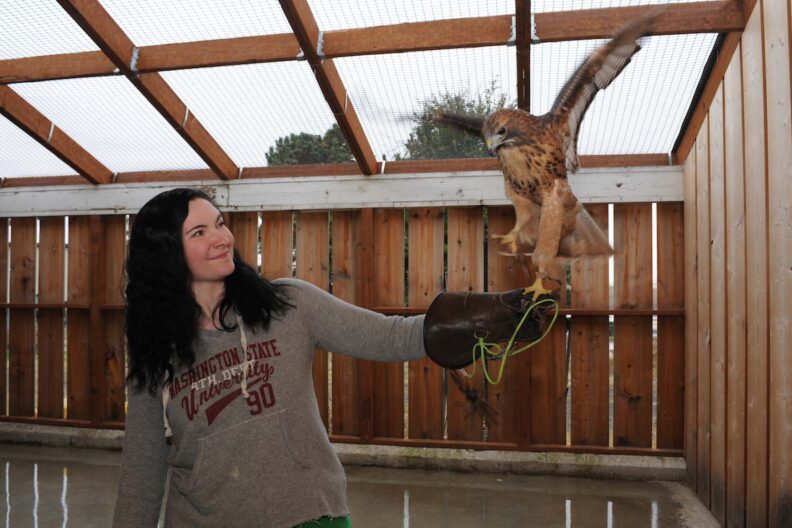
Ordered by date of death or transfer to another location. See current raptor residents
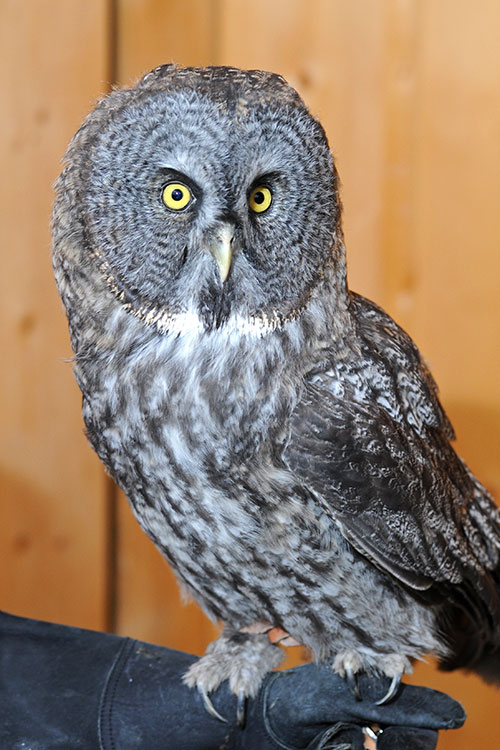
GUS
Resident: 2009-2024
Gus was a great gray owl (Strix nebulosa) who came to the WSU Veterinary Teaching Hospital in September of 2009. He was found on a driveway in someone’s yard near Spokane, unable to fly due to a fractured right wing. When he arrived at the vet hospital, the attending veterinarian determined that the wing was so badly fractured that it could not be saved. The veterinarian made the decision to amputate his wing at the elbow. This proved very fortunate for Gus, since amputations above the elbow tend to cause major difficulties for captive birds; without extenuating circumstances, euthanasia is mandated by law for such birds, in the interest of their own welfare. Gus’s amputation was just below this threshold, allowing him to remain healthy in captivity. Since he could no longer fly, Gus spent the remainder of his life in captivity.
Gus died in December of 2024.
SPRITE
Resident: 2007-2024
Sprite was a male great horned owl (Bubo virginianus) that came to the WSU Veterinary Teaching Hospital in the winter of 2007. He had a fractured right wing and could not fly properly. We were unsure what caused his injury, but nevertheless, knew he was non-releasable. It was likely Sprite suffered some neurological damage, as his behavior does not resemble a normal great horned owl. However, the extent of this damage was almost impossible to test.
Sprite died in February of 2024.

EVERETT
Resident: 2008-2021
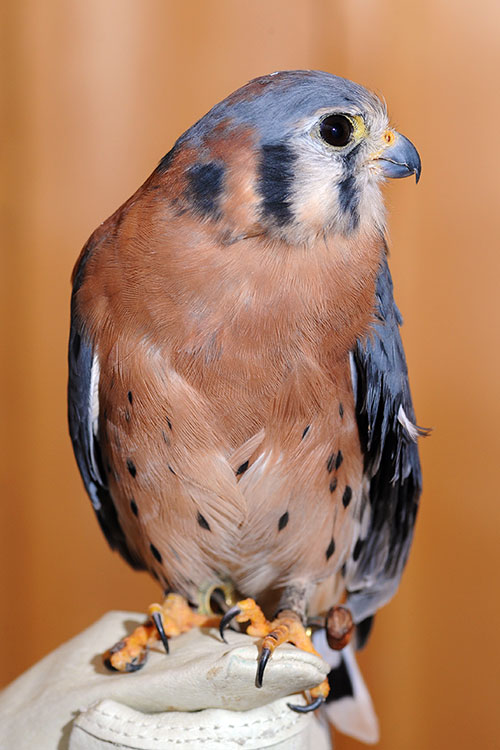
Everett was a male American Kestrel (Falco sparverius) who came to the WSU Raptor Club on July 29th, 2008 from Cat Tales Zoological Park. He was with us because he was unable to fully extend his left wing. Everett had dislocated his left shoulder and that injury has left him unable to fly, so he could never be released back into the wild. While we don’t know exactly what injured him, it’s suspected that he was hit by a car.
Everett died in July of 2021, at the age of 17.
WIDGET
Resident: 2008-2020
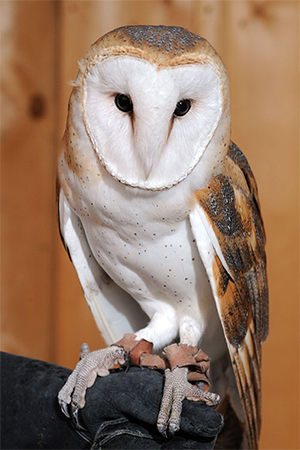
Widget was a male Barn Owl (Tyto alba) who joined our club in the spring of 2008 as a young owlet. His nest was accidentally knocked off of a stack of baled hay while they were being moved out of a barn. He was the only owlet in his nest to survive the fall. He has no physical injuries keeping him from being released, but he has unintentionally “imprinted” on humans. This means that he is too comfortable around humans to act like a normal Barn Owl, and therefore would not be able to live in the wild on his own.
Widget died in September of 2020.
CHARLIE
Resident: 1981-2014
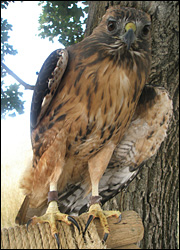
Charlie was a male Red-tailed Hawk (Buteo jamaicensis). He was brought to the WSU Veterinary Teaching Hospital in May of 1981 as a 3-month-old fledgling after he was hit by a car. He suffered a skull fracture and a left shoulder injury which made it impossible for him to fly. Charlie had a special place in our hearts as our first and oldest resident. He made headlines as one of the oldest recorded red-tailed hawks in captivity.
Charlie died August 1, 2014.
PILOT
Resident: 2011-2014
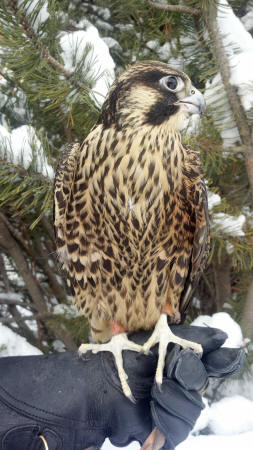
Pilot was a male Peregrine Falcon (Falco peregrinus) who came to the Veterinary Teaching Hospital from Albion in September of 2011. One of the essential ligaments in his left wing was completely severed, most likely caused by barbed wire, an attack by another raptor, or prey that fought back. Because of this, he can no longer use the wing well enough to fly. He was very young when he came in – just a few months old – and adapted very well to living with people.
2014 – Pilot was transferred to Biology Integration and Outreach for Science Education (BIOSE) in Kentucky.
GWENDOLYN
Resident: 2004-2013
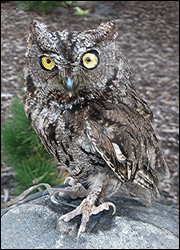
Gwendolyn, or Gwen, is a female Western Screech-owl (Megascops kennicottii). She came into the WSU Veterinary Teaching Hospital in June 2004 with extensive injuries to her eyes. She was most likely hit head-on by a car. The damage to her eyes caused blindness in the left one and severely limited vision in the right, making it impossible for her to live on her own in the wild.
Gwendolyn died in 2013.
RADAR
Resident: 2008-2013
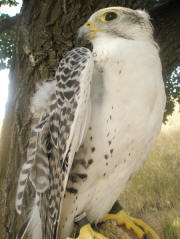
Radar was a male Gyrfalcon (Falco rusticolus), pronounced “jeer-falcon,” and prairie falcon (Falco mexicanus) hybrid. Radar was born in captivity. For the first ten years of his life, he was owned and flown by a devoted falconer, but in 2008 was attacked by another bird being kept by the falconer at the time. The other bird attempted to pull Radar underneath the door of his enclosure, in the process scalping Radar and damaging his right wing severely enough that he could no longer fly well enough to hunt. The falconer, unable to give him the care he required, surrendered him to the club.
Transferred to Wings of Discovery in California on December 15, 2013
WINDSONG
Resident: 1999-2012
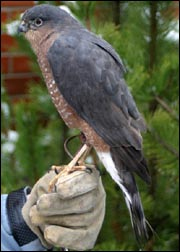
Windsong was a female Sharp-shinned Hawk (Accipiter striatus). She came to us in March of 1999 from Quinalt, Washington. She was witnessed to have flown into a fence and was in a coma for 3 days. When she was brought in, it was obvious that she had sustained head trauma resulting in the loss of her right eye. Windsong’s left eye was also injured and she is nearly completely blind. It was thought that she may have been able to see shadows, but could not see well enough to be released.
Windsong died in 2012.
DALTON
Resident: 2003-2011
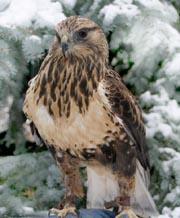
Dalton was a female Rough-legged Hawk (Buteo lagopus) who was brought to us in March of 2003 after sustaining gunshot wounds to her right wing. Part of her wing was removed by the individual who found her as it was barely attached any longer. She lost her primary feathers and could no longer fly. Dalton was DNA-sexed and we discovered that she was not male as we had originally thought. Even though her name may be confusing, we will keep her name as Dalton.
Dalton died in 2011.
CUARE
Resident: 2005-2010
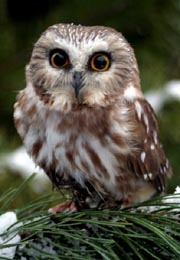
Cuare was a Northern Saw-whet Owl (Aegolius acadicus). We were under the assumption that he was a male because he was so small. However, after a DNA test, it was discovered that Cuare is in fact, female. She came to us in January 2005 from Oaksdale, Washington after sustaining a wing injury caused by a cat. She had muscle and nerve damage and could not extend her right wing. Since Cuare came to us as an adult, we are unsure of her age.
Cuare died in June of 2010.
PIPER
Resident: 2004-2010
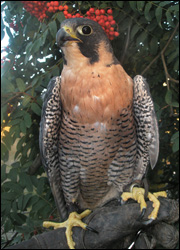
Piper was a female Peregrine Falcon (Falco peregrinus). She was originally bred in captivity for falconry purposes, but she was congenitally blind in her right eye, making her unsuitable for falconry. She joined the WSU Raptor Club in 2004.
Piper died in June of 2010.
RIO
Resident: 2008-2010
Rio was a male Swainson’s Hawk (Buteo swainsoni) who joined our club in the summer of 2008 from Oaksdale, WA. He had a left carpal fracture and was believed to have been shot as evidenced by bullet fragments on his radiograph. We do not know his age as he came in as an adult.
Rio died November 2010.
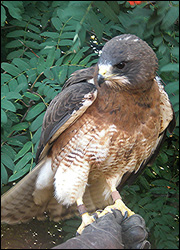
TOBY
Resident: 2006-2010
Toby was a female Great Horned Owl (Bubo virginianus). She came to the WSU Veterinary Teaching Hospital in 2006 from the greater Pullman area. She was diagnosed with head trauma which was thought to be caused by getting hit by a car. She didn’t act like a normal Great Horned Owl should, which would include aggression and defensiveness towards people. Some of her reactions were delayed giving the impression of at least some brain damage. However, most would agree that she was smarter than she appeared to be. She also could not move one of her ear tufts giving her a lop-sided look.
Toby recovered from previous neuro deficits enough to be released back to the wild on Janary 15, 2010.
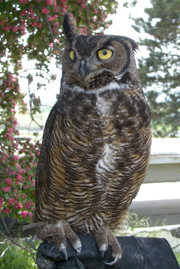
DOT
Resident: 2007-2008
Dot was a female Western Screech Owl (Megascops kennicottii, formerly Otus kennicottii) who came to the WSU Veterinary Teaching Hospital in the spring of 2007. She was probably hit by a car. She was blind in her left eye and suffered from a left humeral fracture, and could not fly well enough to be released. She had an interesting personality as she liked to “hoo-hoo-hoo” at our larger raptors. She would also change shapes when she saw certain things.
Dot died in December of 2008.
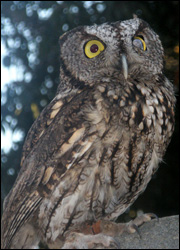
PACO
Resident: 2004-2007
Paco was a Great Horned Owl (Bubo virginianus). He came to the WSU Veterinary Teaching Hospital in January of 2004 with severe head trauma, most likely due to colliding with a car. His injuries were so severe that he was completely blind. Over time, he has regained some of his eyesight but he cannot see well enough to survive on his own.
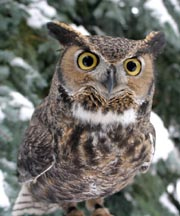
STEVIE
Resident: 1985-2007
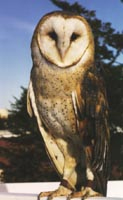
Stevie was a male Barn Owl (Tyto alba) that came to us as a nestling in 1985. He was found on the road by a passing motorist. Stevie was diagnosed to be blind and could not be released. Stevie was used for presentations until 2003 when he was retired. He lived in the exotics ward full time.
Stevie died at the age of 24 years old in 2007.
TARO
Resident: 1992-2007
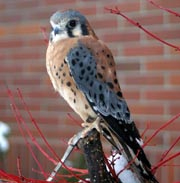
Taro was a male American Kestrel (Falco sparverius). He was brought to the WSU Veterinary Teaching Hospital in 1992 as a nestling after his nest tree was blown over in a windstorm. He was brought in along with his nest mates but he was the only survivor. Taro suffered a shoulder injury as a result of the fall from his nest which could not be repaired. Taro could not be released because he was imprinted as well as not being able to fly well enough. Imprinting occurs in animals raised by humans. Taro had no fear of people and may not have even realized that he is a kestrel. He did not get along with our female kestrel.
KRINGLE
Resident: 2004-2006
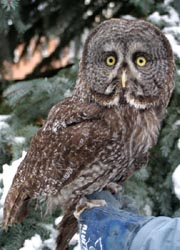
Kringle was a male Great Grey Owl (Strix nebulosa) who was brought to us from Pierce, Idaho on November 29, 2004. He suffered injuries to his left radius and ulna after either being hit by a car or getting caught up in barbed wire. His injuries were such that he was unable to fully extend his wing and could not fly.
Kringle was transferred to Cascades Raptor Center in Oregon on May 16, 2006.
OPHELIA
Resident: 2005-2006
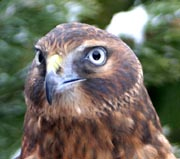
Ophelia was a Northern Harrier (or Marsh Hawk) (Circus cyaneus). She came to us as a fledgling, just learning how to fly, in the summer of 2005 after she had been found on the ground bleeding from her wing. After stabilizing her, she was found to have severe damage to her wing. It is not known what happened but injury by the cutting blades of a combine or haying machine is suspected. Regardless of the cause of the injury, the end of her wing required amputation and she was never be able to fly.
Ophelia died in February of 2006.
QUIGGLY
Resident: 2004-2006
Quiggly was a Red-tailed Hawk (Buteo jamaicensis). He came to us as a nestling after the tree his nest was in was cut down. During the fall he suffered fractures to both wings and one leg as well as damage to one eye. All of his fractures healed, but he could not fly and was never able to be released. Quiggly was raised by people so he imprinted and could also never be released because of this. He was a temporary resident looking for a placement with another educational facility. Quiggly had the characteristic red tail of a two-year-old bird when he was one year old. This was because he grew a second set of tail feathers his first year, due to his first set being lost while he was in his bandages.
Quiggly died in July of 2006.
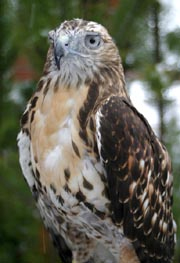
CASPER
Resident: 2004-2005
Casper was a female adult Flammulated Owl (Otus flammeolus) of unknown age. She was found near the Seattle area in April of 2004 and spent two months with a veterinarian there because of a wing injury. When she was well enough, she was flown to us via Horizon Air. We are uncertain how she sustained her injury but her left wing droops and she cannot fly.
November 2005 Casper became a resident in an education program outside of WSU.
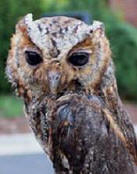
SOVAH
Resident: 2003-2005
Sovah was a Barred Owl of unknown sex and age who came to us as an adult in November of 2003 from Whidbey Island. He was rather small in comparison to other Barred Owls, so we consider him to be male. Sovah was found sitting on the ground, most likely as a result of being hit by a car. He suffered severe head trauma, and as a result, his left retina was detached and his right eye was also compromised.
Sovah was released back to Whidbey Island in February of 2005 after it was determined that he could see much more than we initially thought!
TIKI
Resident: 2003-2005
Tiki was a male common Barn Owl (Tyto alba) who joined the club in 2003. Due to his close contact with humans at a young age, Tiki became imprinted upon humans, meaning he was too comfortable around humans to be returned to the wild, as he never learned the survival techniques necessary to do so.
In 2005, he died suddenly of an unknown cause.
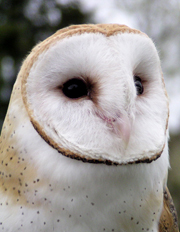
LADY WINSTON
Resident: 1999-2004
Lady Winston was a female Great Horned Owl. She was small for a female and for her first few years in the club she sported the name Sir Winston because we thought she was a male. She was eventually DNA sexed and discovered to be a female. Lady Winston came to the WSU Veterinary Teaching Hospital as a nestling on April 17, 1999. She was found in the Pullman cemetery after having fallen out of her nest. She was discovered to have degenerative cataracts in both eyes and lost most of her eyesight. She was somewhat imprinted on humans.
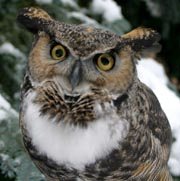
SAGE
Resident: 2003-2004
Sage was a Ferruginous Hawk of unknown sex and age who came to us in February of 2003 from Ephrata, Washington, with a right wing fracture, and his wing had to be amputated. This fracture was caused by a gunshot wound, as bullet fragments were seen on the radiograph. Sage wass at least 2 years old and is rather small for his species, so we consider him to be male. Ferruginous Hawks are listed as threatened in the state of Washington.
Sage was relocated to Snowden Wildlife Refuge in McCall, Idaho, in December of 2004, where he will enjoy a much larger enclosure.
SARAH
Resident: 1994-2004
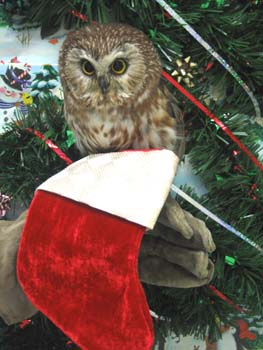
Sarah, a Saw-Whet Owl, was a WSU resident for about 10 years, following being windswept by a car and breaking her wing.
Sarah died shortly after this picture was taken in December 2004.
SERENA
Resident: 2003-2004
Serena was a female Barn Owl who came to us in May of 2003 as a fledgling. She was found in a barn soaking wet, suffering from hypothermia. Her right leg was broken, and although it healed, she became severely imprinted on humans and did not know how to survive in the wild.
Serena was transferred to the Point Defiance Zoo’s raptor program in Tacoma, Washington in the summer of 2004.