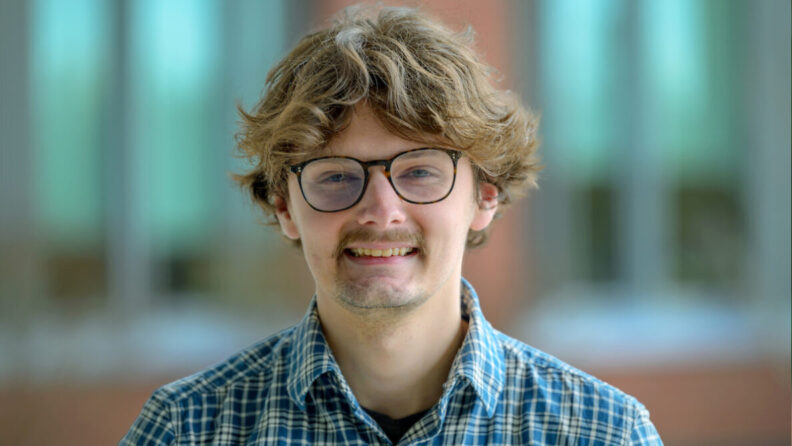
After earning his bachelor’s degree in neuroscience from Washington State University, Cooper Christensen chose to continue his education in Pullman as a doctoral student in neuroscience. Mentored by Dr. Gary Wayman, the Tri-Cities, Washington, native is expected to complete his PhD in spring 2030.
He recently reflected on the supportive research community within Integrative Physiology and Neuroscience, the mentorship that has shaped his graduate experience and the advice he would offer students considering a graduate degree in the College of Veterinary Medicine.
What inspired you to pursue your graduate studies at WSU?
One of the major reasons I decided to pursue graduate studies at WSU was the community with Integrative Physiology and Neuroscience that fosters incredible communication between peers and mentors. I was fortunate enough to experience these relationship dynamics during my undergraduate career at WSU.
What resources or facilities at WSU have been most valuable to your research?
One of the best resources that is available is that of the microscopy core held within IPN. Having access to advanced microscopy has allowed me to visualize and better understand my samples at a level that wouldn’t be possible with standard laboratory techniques alone.
How has your mentor helped you throughout your graduate school journey?
Dr. Gary Wayman has played a really important role in my growth throughout graduate school. He has given me the independence to develop as a researcher while also being there to provide guidance and perspective when I need it. One of the things I’ve appreciated most is that he encourages me to think critically about my research rather than simply giving me the answers. That has helped me become more confident in troubleshooting problems, developing new ideas, and taking ownership of my work.
What has been your favorite thing about WSU and the College of Veterinary Medicine?
My favorite thing about WSU and the College of Veterinary Medicine has been the sense of community. Everyone comes from different backgrounds and has different areas of expertise, but there is a shared passion for research, animal health, and making a meaningful impact. I’ve really enjoyed being surrounded by people who are willing to share their knowledge, help troubleshoot a problem, or simply take the time to talk through an idea.
What has surprised you most about WSU and the College of Veterinary Medicine?
What surprised me most about graduate school was how much ownership you really have over your research. I expected to spend most of my time following experiments and learning techniques, but as I’ve progressed, I’ve realized that a big part of being a graduate student is learning how to think like a scientist or to decide what questions are worth asking, how to approach them, and what to do when the results don’t match your expectations.
What would you say to prospective graduate students considering the College of Veterinary Medicine?
My biggest advice to new graduate students would be to give yourself time to adjust and not feel like you need to have everything figured out right away. Graduate school is a big transition, and there’s a learning curve not only with your research, but also with figuring out what kind of scientist you want to become. I would also encourage students to take advantage of the people and resources around them. Ask questions, try things outside of your comfort zone, and don’t be afraid to learn from experiments that don’t go as planned. Your graduate experience is about more than completing a project or getting a paper.