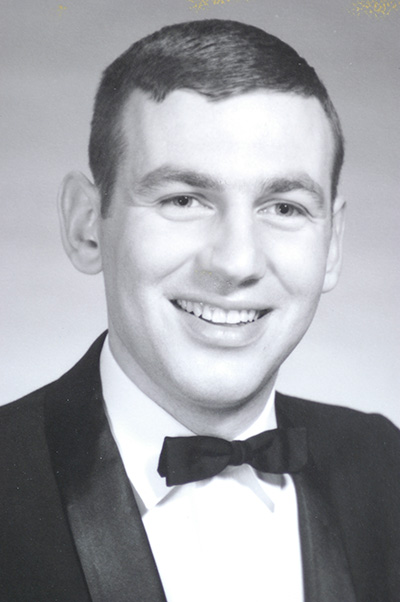
Dr. Rocky Crate, a Washington State University College of Veterinary Medicine alumnus and dedicated conservationist, left an enduring legacy through his $1.5 million endowed chair supporting wild sheep disease research.
Crate, a 1969 WSU veterinary alumnus, made the donation from his estate in 1998 before his death due to cancer in 1999. The gift established the first endowed chair in the College of Veterinary Medicine’s history.
“A year before, there was no way I could have imagined I’d be giving more than a million dollars to something like this,” Crate said after making the donation. “I thought some rich bugger would step up and fund the proposal. But you know things change, the government isn’t fair, and life has a way of making some decisions for you. As it turns out, I stepped up because no one else had.”
The endowed chair proposal, originally crafted for The Foundation for North American Wild Sheep (FNAWS), recognized WSU’s unparalleled research contributions. Dr. Bill Foreyt of WSU’s Veterinary Microbiology and Pathology Department had published more refereed journal articles on wild sheep diseases than all other universities combined. The university’s proximity to Hells Canyon — an ideal natural laboratory — further reinforced its leadership in the field.
Crate was a direct descendant of Washington pioneers and former owner of Crate Veterinary Hospital in Spanaway, Washington. His passion for wild sheep began unexpectedly in 1988 during a Dall sheep hunt in the Yukon.
“Up until that time, I’d lived a life of very hard work and long hours,” he recalled. “I was recovering from my third back surgery and on a lark, really, I booked a Dall sheep hunt. The guide just happened to mention FNAWS at the time, too. I’ll tell you, I was hooked.”
Crate became a founding member of the Washington chapter of FNAWS, the world’s leading wild sheep conservation organization, which annually donates millions of dollars to conservation efforts. His commitment to the sport and its challenges fueled his dedication. An athlete and shooting sports enthusiast, he embraced the physical and mental demands of sheep hunting. To train for his near-annual excursions — yielding eight trophies in 10 trips — he often jogged at night carrying rocks and fertilizer bags on a pack frame, guided only by flashlight.
His tenacity extended beyond hunting. Crate and partner Larry Schorno gained an international reputation for excellence in the air transportation of horses and cattle with their enterprise Schorno Agri Business.
“We were the first to fly full loads of horses and cattle too, for that matter, on Boeing 747s,” Crate said. “We’ve put more dairy cattle in Iran, Korea, and China than anyone else. We’ve shipped full loads to Japan, Turkey, and Taiwan, too. In fact, we’ve never failed to put animals on the plane and deliver them on time and that’s generally working within only a 30-day time frame most of the time.”
The high-stakes industry presented challenges, such as navigating geopolitical upheaval. When the Shah of Iran fell, Schorno Agri Business had 10,000 cattle ready for shipment. Rather than absorb crushing losses, they swiftly redirected the livestock to other countries, ensuring successful deliveries.
In 1998, Dr. Crate was diagnosed with cancer, including a lung tumor and multiple brain malignancies. Brain surgery at the University of Washington and daily radiation therapy slowed the disease’s progression but took a toll on his vitality. Despite this, he remained determined to embark on another sheep hunt that fall and was optimistic about his gift’s impact at WSU.
“What I’d really like to see is WSU and FNAWS find a way to prevent the contraction and spread of pneumonia in wild sheep, their number one killer,” he said. “That’s it, that’s what I want, because hunting is not just about killing. I get a kick out of just watching sheep, and I want to know they are out there. It’s all about putting more sheep on the mountain.”
He also had a simple message for other potential donors: “If you can afford it and there is a need, just do it!”
Dr. Rocky Crate passed away in 1999, but his passion for wildlife conservation and veterinary excellence continues to shape WSU’s research and impact. His generosity ensures that future generations of scientists and conservationists can work toward preserving wild sheep populations for years to come.