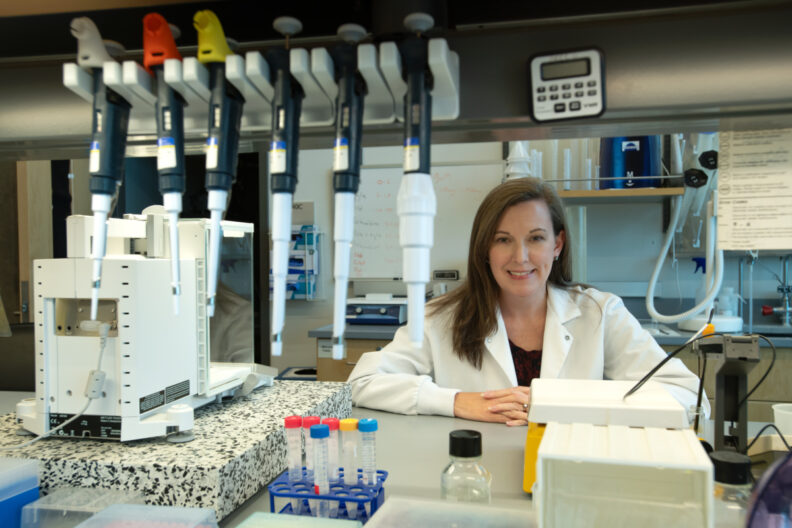
Dr. Emily Qualls-Creekmore believes science should be accessible to all students, regardless of their backgrounds or majors, which is why she decided to join the growing list of researchers participating in the College of Veterinary Medicine’s EschLEAD (Learn, Experience, Apply, Deliver) program.
The program gives WSU undergraduates opportunities to step out of the classroom and into the lab, where they gain the kind of hands-on research experience that sets them apart in graduate school, professional programs, and the workforce. Designed to be open to students from all backgrounds, experiences, and academic disciplines, EschLEAD places undergraduates directly into the college’s leading labs, where they work side by side with faculty mentors on real-world problems. The program not only builds technical skills but also helps students develop confidence, critical thinking, and professional networks that carry them forward in their careers.
Dr. Qualls-Creekmore joined the college in 2021 as an assistant professor in the Department of Integrative Physiology and Neuroscience, where her research focuses on the neurobiology of stress and how it shapes both behavior and physiology.
What are your current research interests and what attracted you to that area?
My research focuses on the neurobiology of stress and how it shapes both behavior and physiology. I am particularly interested in why different types and intensities of stress can produce such varied outcomes, from resilience to vulnerability. Currently, my lab is pursuing two main lines of investigation. The first examines how stress alters motivated behaviors, and the neural circuits and neurotransmitters that drive these changes. This work has important implications for understanding how stress contributes to conditions such as substance use disorders, feeding disorders, and depression. The second area of our research explores how stress affects gastrointestinal function through the gut-brain axis. Because stress is a key factor in disorders like irritable bowel syndrome and inflammatory bowel disease, uncovering how the central nervous system contributes to these processes could lead to new avenues for treatment. Finally, I am deeply committed to addressing the long-standing gap in our knowledge of sex differences in stress responses. Females have historically been underrepresented in preclinical research, leaving critical questions unanswered. In my lab, we study both males and females, and we are developing models that better capture the female experience of stress as it occurs in humans. Together, these efforts aim to build a more complete picture of how stress influences health and disease.
Why did you decide to participate in the EschLEAD program?
I decided to participate in the EschLEAD program because it provides an incredible opportunity for students to experience hands-on research, often for the first time. One of my goals as a mentor is to make science accessible to students from all backgrounds and majors, and EschLEAD’s structure helps open those doors. By combining skill-building, mentorship, and real lab experience, the program gives students the confidence and tools they need to thrive in research settings. I see it as a way not only to support the next generation of scientists, but also to bring fresh perspectives and energy into my lab.
What do you hope students will get out of participating in EschLEAD and by training in your lab?
I hope students come away from the EschLEAD experience with a stronger sense of confidence in themselves as scientists and problem-solvers. Classroom learning provides the essential foundation but applying that knowledge in a real research setting allows students to see the concepts come to life. In my lab, I want them to not only practice techniques and build new skills, but also to recognize how the material they are studying connects directly to discovery and innovation. By bridging classroom learning with hands-on research, my goal is for students to leave with both the technical ability and the self-assurance to pursue whatever academic or career path excites them next.
What advice would you give to younger people considering a career in science?
My advice to younger people considering a career in science is to stay curious and not be afraid of the unknown. Science is built on asking questions and being willing to follow the evidence, even when the answers are not clear right away. It is also important to remember learning happens just as much from experiments that do not go as planned as from the ones that succeed. Finally, seek out mentors and communities that support you because science is a collaborative endeavor and having people who encourage and challenge you makes all the difference. If you keep your curiosity, resilience, and sense of wonder, a career in science can be incredibly rewarding.