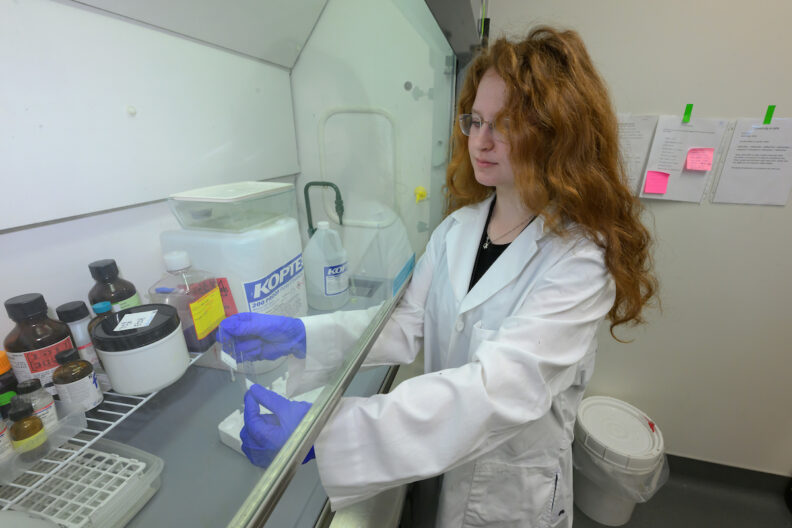
As an EschLEAD scholar, neuroscience major Katy Touretsky is working in the lab of Dr. Kristen Delevich and leading her own research project exploring the long-term neurobiological and behavioral changes caused by chronic adolescent vapor cannabis exposure.
Established through a generous donation by Robert Esch (’75 BS, ’78 MS) and Katherine Esch, the EschLEAD (Learn, Experience, Apply, Deliver) program is pioneering initiative — open to WSU undergraduate students from all backgrounds, experiences, and academic disciplines — designed to provide undergraduates with immersive, hands-on learning in real-world research environments in the college’s leading labs. EschLEAD combines skill-building, real-world applications, and mentorship to empower students to explore, grow, and create their own paths to success.
Katy recently discussed her experiences in the program.
Which lab or labs have you worked with and what sort of projects and research have you been involved with?
I work at Dr. Delevich’s lab, where I lead my own project examining whether chronic adolescent vapor cannabis exposure induces long-term neurobiological and behavioral changes. My research focuses on sex-specific vulnerability to anxiety, region-specific microglial activation affecting brain development, and cannabis tolerance. In addition to my primary project, I collaborate with other undergraduates on a study exploring how hormonal, metabolic, and behavioral changes during menopause in mice are influenced by both chronic and acute exposures to cannabis vapor.
Can you describe a specific project or activity that challenged or excited you?
One aspect of my project that truly challenged and excited me was the final part, which involved perfusing the mice, collecting their brains, sectioning them, and then performing DAB staining followed by microscopy and analysis of micrgolia in two specific regions of the brain. The entire process was incredibly engaging, from the careful sectioning of the brains to the precise staining techniques. What made it particularly thrilling was the level of detail and precision required at each step. Some of the brains were more difficult to extract, and others were deformed, which presented unexpected challenges. However, overcoming these difficulties heightened my sense of accomplishment. Each part of the process — whether ensuring the tissue was properly preserved or achieving the perfect stain for clear visualization — demanded perfection and meticulous attention to detail. Seeing the results under the microscope and analyzing them after all the hard work was immensely rewarding. This hands-on experience brought the significance of precision in scientific research to life and deepened my appreciation for its meticulous nature.
Has participating in the program changed how you view science and research?
Participating in the program has definitely changed how I view science and research. It taught me how collaborative science is — not just within a single lab but across different disciplines and institutions. I’ve come to appreciate how much teamwork, communication, and shared problem-solving go into making scientific discoveries.
I also realized that research is not a linear process; experiments often fail, and unexpected results can lead to new questions and breakthroughs. It takes patience, creativity, and resilience to navigate challenges and push the boundaries of knowledge.
How do you see the EschLEAD program shaping your future career goals?
The EschLEAD program is shaping my future career goals by boosting my confidence in research and deepening my appreciation for the scientific process. Through hands-on experience, I’ve gained a greater understanding of how research is conducted, from designing experiments to analyzing results, reinforcing my passion for discovery. Additionally, the program has taught me invaluable collaboration skills, showing me the importance of teamwork in advancing science not just in the same discipline but with others as well. Learning to work with others, communicate ideas effectively, and train others in research techniques has been a key part of my growth. These experiences will be essential as I continue to develop my career in science.
What are your plans after graduation?
After graduation, I’m still weighing my options between pursuing a PhD in neuroscience or going to medical school to focus on patient care — possibly both since I’ve grown to love research. EschLEAD has been beneficial in shaping my perspective by giving me hands-on experience of constructing and leading my own experiments and exposing me to the collaborative and innovative aspects of scientific discovery. During my time in the program, I have developed critical skills in problem-solving, data analysis, construction of protocols, microscopy, immunohistochemistry, aseptic surgical techniques, behavioral assays, grant writing, training, teamwork, and scientific communication. These skills will be valuable regardless of the path I choose. Working alongside experienced researchers and mentors has also given me insights into various career paths, helping me envision the possibilities ahead. This experience has been an excellent foundation for planning my future, and I look forward to continuing to explore both fields.
What advice would you give to future students interested in undergraduate research and/or joining the EschLEAD program?
For future students interested in undergraduate research or the EschLEAD program, stay open-minded and proactive. Curiosity and persistence matter more than prior knowledge, so don’t hesitate to ask questions or seek guidance from mentors and peers. Collaboration is essential in research, and challenges can enhance your critical thinking skills. Lastly, take full advantage of the program’s resources and networking opportunities.