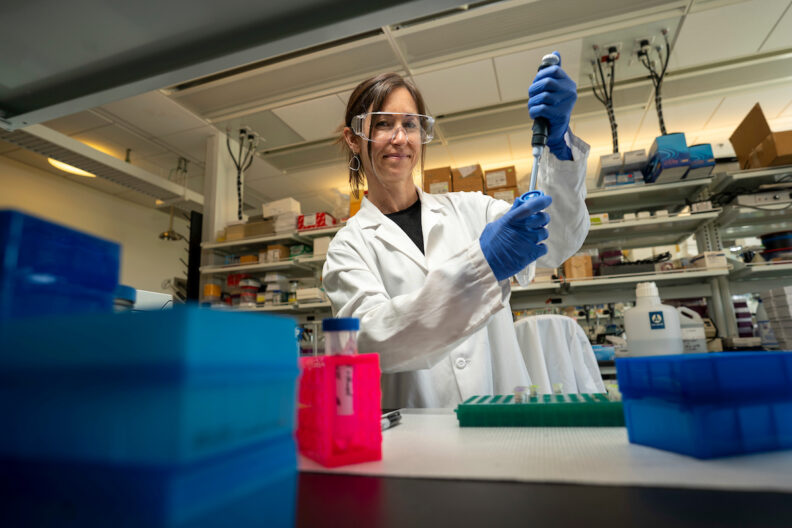
Erika English is investigating how microbes and their byproducts influence sleep — a line of research that could one day lead to new treatments for sleep disorders and other complex health conditions. A doctoral student in Washington State University’s School of Molecular Biosciences, Erika works under the mentorship of Regents Professor James M. Krueger in the Department of Integrated Physiology and Neuroscience. Originally from rural northern Vermont, she moved to Spokane in 2018 and joined WSU in 2020. She expects to complete her degree in the summer of 2025. She is grateful to have been a recipient of the Poncin and Gibbons Fellowships, the Lynn A. George, and Arturs Vitums Scholarships.
What inspired you to pursue your graduate studies at WSU?
When I was working at the University of Vermont in the Department of Microbiology and Molecular Genetics, I made the decision to apply to graduate school so that I could pursue my love of learning and someday become an independent researcher. As an undergraduate, I was introduced to research and really became enamored with the entire process of conducting research in a molecular biology laboratory. I found the creative processes involved in the research process combined with the intellectual aspects to be so satisfying. After gaining a molecular biology and microbial genetics skill set, I decided I wanted to expand my skillsets and explore new areas of research. I applied to WSU with the goal of exploring the interface between microbes and their host organisms to better understand the roles microbes play in health and disease.
Can you describe your current research?
The overall goal of my current projects is to better understand the connections between sleep and microbes, i.e., identifying a role for microbes and their products in sleep regulation. I am describing the dynamics of sleep-inducing bacterial cell wall components, specifically peptidoglycans, in the brain. In addition to asking questions about the dynamics of these bacterial products in the brain, in the context of sleep-wake cycles of the host, I am investigating how bacterial cell wall components are detected in the brain. To tie these aspects together, following detection of peptidoglycans in the brain, I am interested in the associated downstream signaling events which ensue.
What resources or facilities at WSU have been most valuable to your research?
I am incredibly grateful to have been a recipient of the Poncin and Gibbons Fellowships, the Lynn A. George, and Arturs Vitums Scholarships, as well as receiving support from the Office of Research. The CVM fellowships and scholarships allowed me to continue with my studies while support from the Chancellor’s office provided me the opportunity to attend a Microbiota and the Brain course with the Neuroscience School for Advanced Studies in Venice, Italy, last spring. In addition to financial support, the Spokane campus animal facility, the Spokane genomics core, and the Laboratory for Biotechnology and Bioanalysis have been crucial for my work. These facilities and the people who make these facilities run each day are an incredible resource to researchers at WSU. I am so grateful for the financial and technical help and support I have received over the years.
What role does collaboration play in your research?
My project, which stemmed from a W.M. Keck Foundation grant, has provided me the opportunity to work with faculty outside WSU and outside the CVM. Given the interdisciplinary nature of the grant and my project, and the multiple PIs involved, I have worked closely with Ilia Karatsoreos at UMass Amherst to design and execute experiments and share ideas and findings. I have also had the opportunity to collaborate with Alex Panchenko and Alex Dykhovychnyi from the mathematics department to utilize novel approaches for analyzing gene expression data. I continue to learn from these collaborations both in the context of the projects and in an intellectual sense, i.e., having the opportunity to gain experience from people outside my lab by exploring science and sharing ideas. This collaboration is a true manifestation of the idea that science is not done in isolation, and that discovery is greatly enhanced through joining a diverse group of researchers with different backgrounds, perspectives, experience, and skills.
How has your mentor helped you in your journey?
My mentor has allowed me the space to develop my scientific independence, both technically and intellectually. He has given me the freedom to pursue my work and follow my ideas and thoughts without hindrance while at the same time, sharing knowledge and providing guidance and support. When I came to WSU to pursue graduate studies, I was interested in the space between microbes and their hosts, specifically, how this space defines microbes, the complex organisms they inhabit, and the collective holobiont. Working with Dr. Krueger has given me a place to explore the complex connections between microbes and their hosts in the context of the brain and to ask questions about how this relates to sleep regulation.
Unfortunately, during my years at WSU, I have had to navigate multiple research disasters including a flood in our research building and multiple freezer breakdowns. This caused me to lose an entire inventory of samples and cost me a huge amount of time. Through these challenges, Dr. Krueger was beyond supportive. He fought tirelessly to make sure I would have what I needed to continue my work and to succeed while simultaneously providing encouragement and of course, offering plenty of good stories to keep me going through tough times. I feel so lucky to have found such a wonderful mentor here at WSU.
What are your long-term career goals?
I plan to become an independent researcher knowledgeable in the fields of sleep, neurobiology, and the microbe-gut-brain axis. My work has provided opportunities to meet some remarkable researchers who are asking similar questions about how microbes and the brain work together to influence health and disease. It is my hope that these connections I have made with researchers around the world will turn into research collaborations and job opportunities. Ultimately, I would like my work to lead to developing new avenues for treatment and interventions of complex health disorders such as the myriad sleep disorders affecting people worldwide.
What has been your favorite thing about WSU and the College of Veterinary Medicine?
WSU is in a beautiful part of the country. Being from the other side of the country, I have really enjoyed finding time to explore the Inland Northwest and getting acquainted with all that WSU, Washington, and the surrounding area have to offer.
What would you say to prospective graduate students considering the College of Veterinary Medicine?
If you are looking for a supportive group of faculty, staff, and researchers to help guide you along in your graduate studies, WSU, the CVM, and School of Molecular Biosciences have a remarkable group of people, with a wide range of scientific interests, who work very hard to support the students and help them accomplish their research and professional goals. In addition, the campuses are in an area of the country that offers lots of outdoor activities and adventure (to keep you sane while working extremely hard).