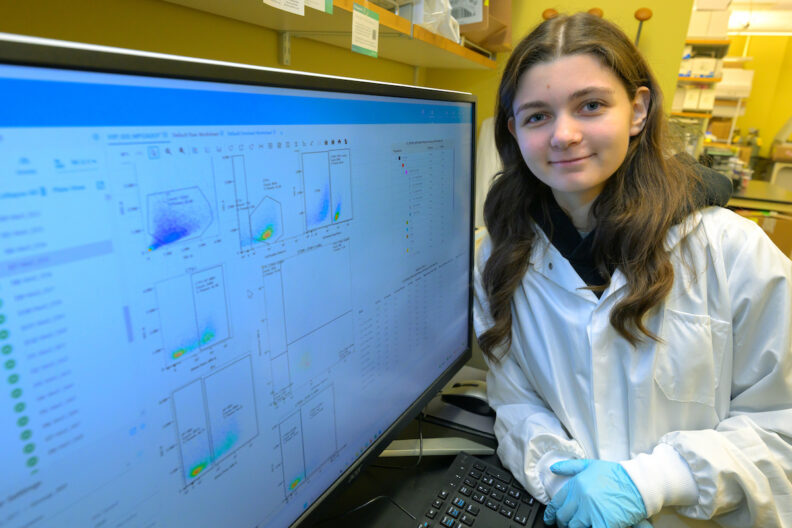
Originally from Tacoma, Washington, Xenia Tregubov is a graduate student in Washington State University’s Multidisciplinary Program in Infectious Disease and a trainee in the NIH Biotechnology Training Program. She earned her undergraduate degree in biomedical sciences from the University of Washington and is on track to complete her graduate studies in spring 2029. Tregubov conducts her research under the mentorship of Dr. Bronwyn (Bonnie) Gunn in the College of Veterinary Medicine.
Tregubov’s research focuses on Rift Valley fever virus, an emerging zoonotic pathogen that poses serious risks to both public health and the agricultural economy. Through her work, she is studying antibody responses beyond traditional neutralization, with the goal of improving understanding of immune protection against RVFV and informing future therapeutic and vaccine strategies.
What inspired you to pursue your graduate studies at WSU?
Since I was little, I had a big interest in biology and how we work overall. As time went on, I was set on going into medical school. I had applications filled out, letters of recommendations in, MCAT completed, and personal statements written, but I just could not press the apply button. I kept thinking about how this is not what I truly want to do and that was all thanks to my undergraduate research mentor. He helped show me there is this big world of research behind medicine. That we can look into the details of us more than a medical doctor ever could. Additionally, after being able to grow cells, then infect them with a virus for the first time and see the results the virus had on cells through plaque assays, I knew I wanted to go into infectious disease research. WSU had a great program that provided rotations in different programs which was great as I wanted variations in the labs that I could rotate in.
Can you describe your current research?
My current research is focused on Rift Valley Fever Virus (RVFV). It is an increasingly prevalent zoonotic arbovirus that was initially associated only with livestock, and later led to outbreaks in Kenya, resulting in numerous fatalities among humans, significantly threating public health. Although RVFV is a significant threat to public health and the economy, there are no FDA-approved treatments or vaccines. This virus is especially dangerous to pregnant animals and women, causing high levels of miscarriages. My work focuses on studying antibodies, specifically their Fc effector functions, because while neutralizing antibodies (nAbs), against Glycoprotein N and C (Gn, Gc), have been heavily researched in the field, protection against RVFV extends beyond nAbs and these viral proteins.
What role does collaboration play in your research?
Collaboration plays a big role in my research. The viruses that we receive are from collaborators that help us with providing and/or creating the psuedovirus for us. The patient samples I use are also kindly given to us by collaborators from Global Health Kenya WSU who go out to the RVFV outbreaks and collect samples from those who were infected. I am beyond thankful to have these collaborations and to be able to work personally with some of our collaborators.
How has your mentor helped you in your journey?
Dr. Gunn has been a wonderful mentor. She provides guidance and helps me grow in my laboratory skills and as a scientist. She always offers to help if you feel stuck in experiments by either sitting down and talking it over with you or going into the lab and helping with the experiment itself. If there are new skills you need to learn, she will always help. She also gives many opportunities to meet and collaborate with other researchers to both grow your connections and learn new skills. I am very thankful that she accepted me into her lab and I would have made the same choice again.
What are your long-term career goals?
After completing my doctorate, my plans are to go into academia and hopefully start my own lab. My current research is helping me to learn new techniques and skills, as well as being able to think through all my experiments by understanding the reason, goal, and ultimately the data for the experiment itself. Additionally, it helps me with learning more about immunology and infectious diseases as I want to steer my future lab in that direction.
What would you say to prospective graduate students considering the College of Veterinary Medicine?
To prospective graduate students considering the College of Veterinary Medicine I would say that it is a great school, with amazing research and researchers. CVM provides a feeling of not everybody for themselves but as if everyone is part of a family. Even with the different programs you still get to know and meet those outside of your program through classes and events hosted by CVM. I have also been able to meet a lot of great people, and we have monthly get togethers as well as weekly lunches that help a lot in talking through graduate school. Overall, I really enjoy the community that CVM offers.