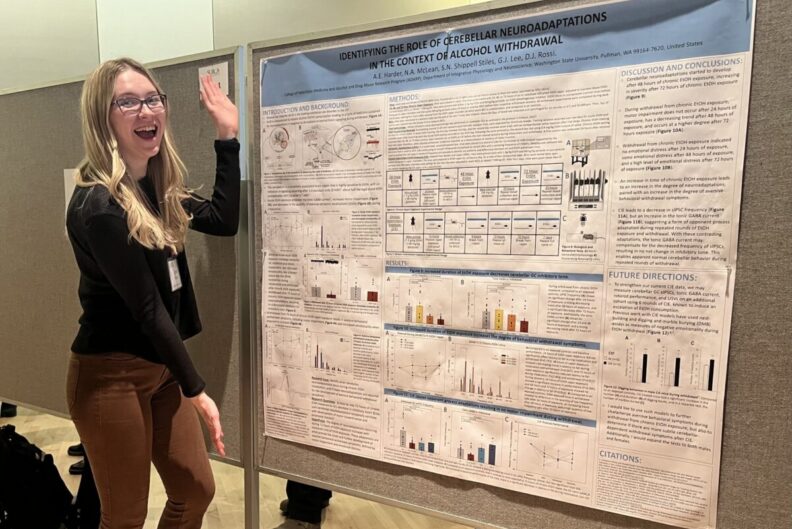
When Mill Creek, Washington, native Aspen Harder discovered WSU’s neuroscience program in the Department of Integrative Physiology and Neuroscience, she knew she had found her ideal fit. Now a senior in the program, Aspen is gaining hands-on experience as an undergraduate researcher in the Rossi lab, where she studies the relationship between alcohol and the cerebellum.
Beyond the lab, Aspen is deeply involved in the WSU community. She serves as a mentor in the Team Mentoring Program, helping support fellow students in the sciences, and is the public relations officer for the Neuroscience Club. She’s also a writer for the WSU chapter of HerCampus.
What initially drew you to your major?
Originally, I was going to major in microbiology with a minor in psychology. When I found out that WSU had a neuroscience program, I felt that I had found the perfect degree for me. In my senior year of high school, my two favorite classes were biotechnology and AP psychology. These made me fall in love with laboratory work and psychology, which is a huge part of the neuroscience field. While I would have still enjoyed a degree in microbiology, I am so incredibly happy in the neuroscience program!
Who has been the most influential mentor or professor during your time at WSU?
The most influential mentor I have had at WSU has been Nadia McLean, a neuroscience PhD candidate and my graduate student mentor in the research lab. Initially, Nadia was my TA for Biology 107 at the beginning of my sophomore year. She then connected me to the Rossi lab, where she is pursuing her PhD. She has mentored me in so many different ways, including teaching me laboratory techniques, helping me submit research materials, and assisting me in executing my own successful research project.
Have you had any opportunities to work in a lab or conduct research while at WSU?
I have had a lot of valuable experience working in a lab and even heaving my own research project while at WSU! I am an undergraduate researcher in the Rossi lab in the Department of Integrative Physiology and Neuroscience, researching the relationship between alcohol and the cerebellum. Working in this lab has given me a chance to use what I learn in my classes to think like a scientist and apply it to my project. I have gained so many connections and made so many friends through this research lab and wouldn’t trade it for anything!
What advice would you give to someone thinking about majoring in a field within the College of Veterinary Medicine?
I would say to find what you’re passionate about and really stick to it. Additionally, I would try your best to make friends with people in your major. The neuroscience program is very small, so we end up having some tight-knit groups that are wonderful for studying. I have found that it is super helpful to make friends with those in your major because you often go through the same stuff together and can study with each other.
What’s your favorite thing about WSU?
My favorite things about WSU are the support system and the welcoming community. I have found that it is hard not to have “a place” here. There are so many different communities on the Pullman campus with people from many different backgrounds. I really found a place in the lab setting and in the neuroscience program because we all share the same love for science and the brain. If you were to tell me that I would gain so many friendly faces through the laboratory and I even made friends with the graduate students!
What are your post-graduation plans?
After graduation, I plan to apply to graduate school to either go into preclinical biomedical research or to become a physician assistant. I am currently searching for and applying to post-bacc programs, specifically in neuroscience, to continue gaining experience in the field. I will be applying to graduate school during the next cycle, and I hope to continue to grow as a student and a scientist through then.
What hobbies or extracurricular activities have you enjoyed at WSU?
Aside from working in the laboratory, I have also really enjoyed working as a mentor in the Team Mentoring Program. Through TMP, I have gained connections to other people in the neuroscience program, been introduced to peers in other programs in the sciences, and networked with professors and other faculty. As a mentor, I have been able to work on skills such as communication, outreach, event planning, and networking, which will all be valuable skills for me to use in the professional workforce.
What’s a fun or surprising fact about you that most people wouldn’t guess?
One fact about me that most people wouldn’t guess is that I am a certified Challenge Course Practitioner through the Association for Challenge Course Technology (ACCT)! I work at a ropes course in Everett during the summer, so I have acquired rescue certification for the course. This means that I am trained in specific rescue exercises, such as rescuing someone who is stuck on the zipline, lowering someone in medical distress from the obstacles, and assisting climbers in the course when they are in emotional distress or need extra help with the obstacles.