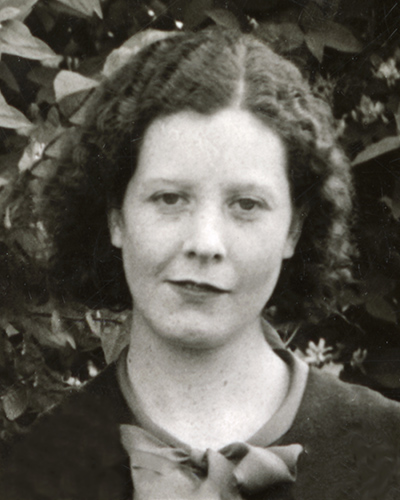
Catherine Roberts
In June 1933, Dr. Catherine Roberts became the first woman to earn a Doctor of Veterinary Medicine degree from Washington State University, breaking barriers in a male-dominated field. She didn’t stop there—Dr. Roberts went on to become the first woman to pass the California veterinary board exam, setting a record for the highest score ever achieved at the time.
Decades later, in 1977, Lorain Miller, a high school student from Burien, Washington, and aspiring veterinarian, reached out to Dr. Roberts to document her story for the National Organization for Women’s essay contest on American women pioneers. Dr. Roberts responded with a detailed 10-page letter, typed out with care, offering a rare firsthand account of her groundbreaking achievements. Miller’s essay won first place in her school district, earning her a $1,000 award.
Today, Lorain Miller—now Dr. Lorain Abel—is a proud 1987 graduate of Washington State University and has been practicing veterinary medicine for nearly 40 years. Her award-winning essay, along with Dr. Roberts’ letter, remains a vital record of Washington’s first female pioneer in veterinary medicine, preserving a legacy of resilience and excellence.
The field of veterinary medicine was once considered a profession for men only. Now many women are “invading” what used to be a man’s occupational realm. Currently, there are approximately 1,500 women veterinarians practicing in the United States.¹ There had to be a woman pioneer of veterinary medicine in Washington since Washington State University has a college of veterinary medicine. This pioneer was Catherine Elizabeth Frasier (Roberts), who graduated in June of 1933 from then, Washington State College. She led a very historically significant life and was able to overcome odds and be accepted into veterinary school, graduate, and later practice her profession.
Catherine was born on July 17, 1907, in Eureka, California. Her father was a newspaper man and because of his health, he bought a ten-acre farm which had a three-acre strawberry field, a raspberry field, some fruit trees, and some empty rabbit hutches. Catherine received her first experience caring for animals when her grandmother gave her a pair of rabbits. Soon, she was “the proud possessor of 250 of the miserable things which had to be fed and watered twice daily.”² Along with that, her father purchased a Jersey cow with a heifer calf. These animals also required care, so as the only child, Catherine got the responsibility. She got to the point where she even began to hate her own dog and cat (and…strawberries also)!
Even with all this work, plus piano lessons, Catherine managed to maintain above-average grades. She had many things in her favor when she did start school. Catherine had learned to read and write before kindergarten age and had read all the classics by age ten. She also had a photographic memory and was very gifted in writing. Accordingly, she was quite successful in grade school and in junior high school.
Just before high school, however, a crisis struck Catherine’s family. This event probably changed her whole life. Catherine’s father died of an accidental gunshot wound he received while cleaning his gun. This event created some hard times, but within a few years, Catherine’s family was on their feet again.
After high school graduation, Catherine thought she was in love. So, because she was sick of school and didn’t want to go to college, she decided to marry. She soon saw her mistake and went to business college in Seattle to get away from her husband. While in Seattle, Catherine’s mother remarried. She married the veterinarian who was the most influential and most responsible for Catherine’s becoming one later on. While in Seattle, Catherine worked in a clinical laboratory as a secretary and there she got her urge to study medicine. Just before entering the University of Washington in their medical program, Catherine went home for a visit. When she got there, her step-father tried to persuade her to enter the profession of veterinary medicine. Her step-father, Dr. A.F. Hanna, had no successor to his profession and wanted Catherine to succeed him. Another reason he used was that the Depression was just beginning and to get a medical degree it took close to eight years, whereas a veterinary degree took only four years. So, upon her return to Washington, Catherine found herself enrolled in the veterinary program at Washington State University at Pullman, Washington.
Surprisingly enough, Catherine’s problems were not in entering the college, or from the men, but from the Dean of Women, Dean Annie. Dean Annie had the idea that women belonged home raising a family. Since Catherine had already had six miscarriages, she did not feel that idea was for her. When Catherine finally got admitted, Dean Annie still tried to find some way of barring Catherine’s study of veterinary medicine. This constant static was all Catherine needed to stay on with her studies until she got her degree.
To Catherine, schooling itself was the easiest. The men were used to having women in their high school classes and the professors were pleased to have a woman in their class. There was no embarrassment as Dean Annie had predicted. After Catherine’s freshman year, Dean Annie gave up her quest to have Catherine removed from the program because she received all A’s in her classes. During her summers, Catherine added more practical knowledge from her step-father who was rated one of the best veterinarians in the state of California.
As Catherine continued her schooling, a few other women tried to become veterinarians. She never knew any of them personally except Mary Donworth, who became her roommate in her senior year. Unfortunately, only one of these ladies went on to graduate and become a veterinarian.
Finances were never much of a problem for Catherine because she would take notes during the lectures in shorthand and then type and sell them to the men. According to Catherine, the men seemed to have the majority of their problems in Chemistry and English. So tutoring and selling lecture notes was Catherine’s main source of income until her senior year when the Women’s Auxiliary of the American Veterinary Medical Association granted Catherine a scholarship.
Catherine’s senior year was the most profitable. At the end of it, Catherine was asked to become a member of the Alpha Psi, the National Veterinary Honorary Fraternity. No woman had ever been accepted and finally, after a great deal of controversy, Catherine was invited to this honor.
Graduation for Catherine was emotionally difficult. There were only 13 members in her class, and they all felt like a family because they had studied together and worked side by side. However, to add to this sorrow, Catherine’s family told her they would not be able to come up for her graduation because they could not spare the time or the money. This was a bitter disappointment to Catherine, for this was an important achievement for her.
After graduation in 1933 came the Washington State Exams for licensing. Every member of the class passed with flying colors, and the examiners showed no reluctance to grant a license to a woman. Later came the State Board Exams for the state of California, where Catherine wanted to practice. There was a good deal of friction between the two examiners. No one from Washington had been able to pass these exams the first time. Catherine was not intimidated by this previous record, though. After the results were in, Catherine had passed the exam with the highest score ever recorded. California made such a commotion over the test results that the Associated Press picked up the story, and Catherine received a great deal of fan mail, including a marriage proposal from an Australian sheep-herder. With national recognition, Catherine began her practice.
After serving an internship with her step-father for several months, Catherine began her own practice in her hometown of Eureka, California. The people there accepted her; she never had to hide the fact she was a woman. Being as Eureka was Catherine’s hometown, she received much respect and was accepted both socially as well as professionally.
Catherine’s personal life had some difficulties in the beginning with a couple of marriages that ended in divorce, however, she remarried in 1936. This was the right husband at last, and they just celebrated their 40th wedding anniversary in 1976 at the Grange they were married at. Her husband is not ashamed of the fact that his wife is not lady-like, on the contrary, he is proud to have a veterinarian for his wife.
Catherine had to leave her profession because of bursitis in her shoulder; however, she resumed her practice after World War II. This time she worked for Swift and Co. doing poultry inspection. She had to leave again due to another attack of bursitis, and this time it was for good.
Catherine is still alive and living in California. Her advice to anyone who wants to become veterinarians is: Examine your motives first, and if that’s what you really want, put your whole heart into it. In other words, don’t become a veterinarian just because you love animals. That is one of Catherine’s pet peeves because she feels that is the worst reason to become a veterinarian. To be a veterinarian, you have to have the brains to learn, the compassion and empathy for the animals, and the knowledge to know what is best for them.
All colleges accept women on an equal basis as men. The enrollment has tripled in recent years. Anyone who is interested can, like Mrs. Frasier, become a veterinarian. She did indeed pave the way for all prospective women veterinarians. Indeed, she contributed a great deal to the future success of women veterinarians.
Bibliography
- Correspondence from the American Veterinary Medical Association received on April 15, 1977.
- Personal Correspondence from Mrs. Catherine Elizabeth Frasier, D.V.M. received on April 15, 1977.
- “Today’s Veterinarian,” American Veterinary Medical Association, 1977, p. 12.
- “Veterinary Medicine as a Professional Career for Women,” Women’s Veterinary Medical Association, pp. 1-3.
- “Women as Veterinarians,” American Journal of Veterinary Medicine, 1915, p. 740.