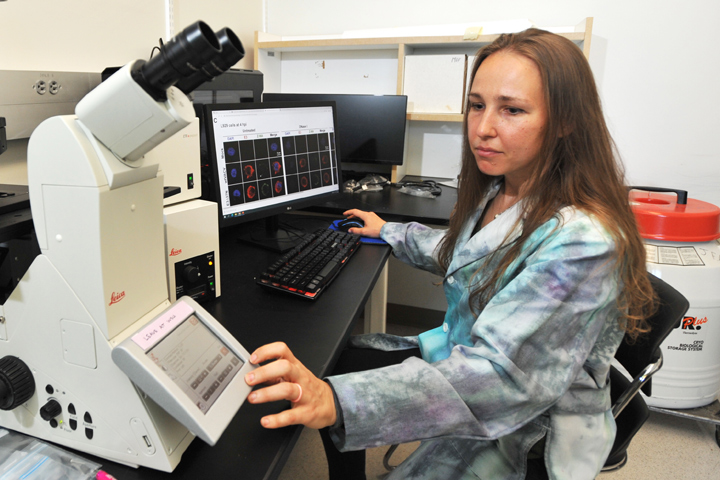
Dr. Heather Koehler is an assistant professor in the WSU College of Veterinary Medicine’s School of Molecular Biosciences and an EschLEAD faculty member. The EschLEAD (Learn, Experience, Apply, Deliver) program is pioneering initiative — open to WSU undergraduate students from all backgrounds, experiences, and academic disciplines — designed to provide undergraduates with immersive, hands-on learning in real-world research environments in the college’s leading labs.
Koehler completed her postdoctoral fellowship in 2021 at Emory University School of Medicine and her doctorate in 2016 at Arizona State University. Koehler received her Doctor of Naturopathic Medicine in 2013 at Southwest College of Naturopathic Medicine and her Bachelor of Science in 2009 at Florida Gulf Coast University. Her research interests include programmed cell death pathways that dictate infectious outcomes, innate immune sensing pathways that drive activation, and viral-host interactions and the competition that shapes infections.
What does it mean to you to be part of EschLEAD and why is it important?
To me, being part of EschLEAD means contributing to a cycle of mentorship and hands-on training that is fundamental to the essence of science and its purpose to benefit humanity. This program provides an exceptional platform to open our labs to students who represent the future of our field, offering them the chance to cultivate their potential and drive. Personally, I know I am where I am today because someone believed in me and gave me an opportunity. Being part of EschLEAD allows me to pass that gift forward—to open my lab as a space for students to not only build technical skills but to foster a deep passion for science. I am honored to be in a position to help these students on their journey, as they are the ones who will carry science forward.
What are your current research interests and what attracted you to that area?
I study viral-host interaction in DNA viruses. One of my favorite families to study is the orthopoxvirus which included notable members like monkeypox virus, variola virus (smallpox virus) and vaccinia virus (smallpox vaccine). This family of viruses have co-evolved with humans and have developed many ways of preventing the host antiviral defense mechanism. We can use the viral defense mechanisms to drive or suppress the host’s immune system. Many of our therapies stem from past studies of the ways viruses block an antiviral defense mechanism to activate the immune system. I believe we can learn the most about humans and diseases when we can specifically trigger a host response and studying viruses that have co-evolved with humans give us great tools to accelerate medical breakthroughs.
What do you ultimately hope to accomplish with your research?
I want to understand how to use viruses as tools in human healthcare. Many viruses can be used as vaccines. I believe that if we understand the specific details of how viruses activate the immune response, we can engineer highly effective and safe vaccines that help prevent disease.
How can your research help or impact people?
We will never live in a world without viruses and we have all experienced the impact viruses have on people. We have seen first-hand what happens when we don’t understand a virus but also how powerful knowledge of the virus and immune system is in developing medical treatments. Continued research in viruses that impact our lives is essential.
What advice would you give to younger people considering a career in science?
Do it because you love it! Careers in science are both highly rewarding but also demanding. You have to have a passion for exploring the unknown and finding answers. It is a field of work driven by questions that sometimes are not easy to answer so persistence, problem solving, and creative thinking are key skills to be successful. Find a way to develop these skills and never stop learning!
Why did you choose to come to WSU?
WSU stands out from many places because there is a unique pairing of humanity and drive in science. The combination of the supportive environment and commitment to excellence results in an environment where young scientists can thrive.