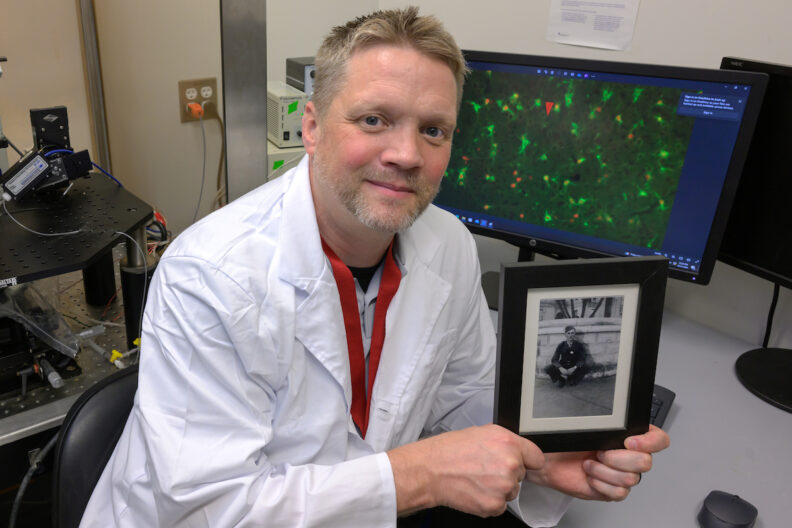
Dr. Travis Brown is working to help unravel the complex interplay between addictive drugs like cocaine and morphine and the brain’s reward circuitry, with the goal of identifying potential targets for therapeutic intervention in substance use disorders.
Dr. Brown earned his doctorate from WSU in 2008 before stints at Brown University and the University of Wyoming. In 2018, he returned to WSU, where he now holds the rank of associate professor in the department Integrative Physiology and Neuroscience.
He recently took some time to discuss his research and other experiences.
What are your current research interests and what attracted you to that area?
My fascination with neuroscience was kindled by a deeply personal experience: witnessing my grandfather’s battle with Parkinson’s disease. As I observed the relentless progression of his symptoms, I became determined to unravel the underlying pathophysiology of this devastating condition. This early exposure to the profound impact of brain dysfunction on human life ignited my passion for exploring the intricate workings of the nervous system.
Upon joining the WSU graduate program, I was afforded the opportunity to rotate through numerous labs conducting diverse research. It was during this exploration that I found my home in Dr. Barbara Sorg’s lab, where the focus was on deciphering the neural underpinnings of drug addiction. This serendipitous encounter resonated deeply with me, as I had personally witnessed the far-reaching effects of substance abuse on families.
The parallels between my initial interest in neurodegenerative disorders and the complex challenges posed by addiction were striking. Both fields demanded a deep understanding of brain function and dysfunction, albeit in different contexts. Recognizing the urgent need for advances in addiction research, I made the pivotal decision to dedicate my career to unraveling its intricate mechanisms.
After nearly 15 years of dedicated research, my lab continues to investigate the fundamental neurobiological mechanisms through which drugs like cocaine and morphine alter brain function, ultimately driving the maladaptive seeking behaviors characteristic of addiction. Our ongoing work seeks to unravel the complex interplay between these substances and the brain’s reward circuitry, with the goal of identifying potential targets for therapeutic intervention in substance use disorders.
When your career is over, what do you want to be remembered for?
As a scientist, I aspire to be remembered for my rigorous, trustworthy work that serves as a foundation for future research. Yet, I would take even greater pride in being recognized as a supportive colleague and mentor, always there for my students and peers.
What do you enjoy about working with students?
I cherish the energy and curiosity that students bring to their work. The most rewarding moments in my life occur when I witness a student’s excitement and passion unfolding before me; it’s truly inspiring to see their enthusiasm for learning.
What motivates you outside of work?
I enjoy spending time with my family and friends, and I find great fulfillment as a high school basketball coach at Pullman High School. Being around young athletes who are discovering their identities and the opportunities that await them after graduation is incredibly rewarding. My son plays basketball for Idaho State, and my wife and I eagerly anticipate following him on his journey to chase his dreams. Recently, I’ve also developed a passion for pickleball and try to play as often as my body allows.
What advice would you give to younger people considering a career in science?
Find a passion and embrace it wholeheartedly, never forgetting what inspired you to pursue it. While you may encounter challenges along the way, the joyful moments will always far outweigh the difficulties. Finally, find balance in work and life. I don’t think you truly can have a feeling of fulfillment without an appreciation for both work and your life outside the lab.
Why did you choose to come to WSU?
As a proud Cougar from a family with deep WSU roots, I was drawn to the university’s pioneering undergraduate neuroscience program. The exceptional faculty ignited my passion for the field, leading me to pursue graduate studies in neuroscience at WSU. Under the mentorship of Dr. Barbara Sorg, I completed my PhD before embarking on a postdoctoral fellowship at Brown University. Despite spending a decade at the University of Wyoming, my connection to the Palouse remained strong. When the opportunity arose to return to WSU and contribute to the program that had shaped my career, I eagerly embraced it. Now, I have the privilege of collaborating with my former mentors while forging new professional relationships and friendships.