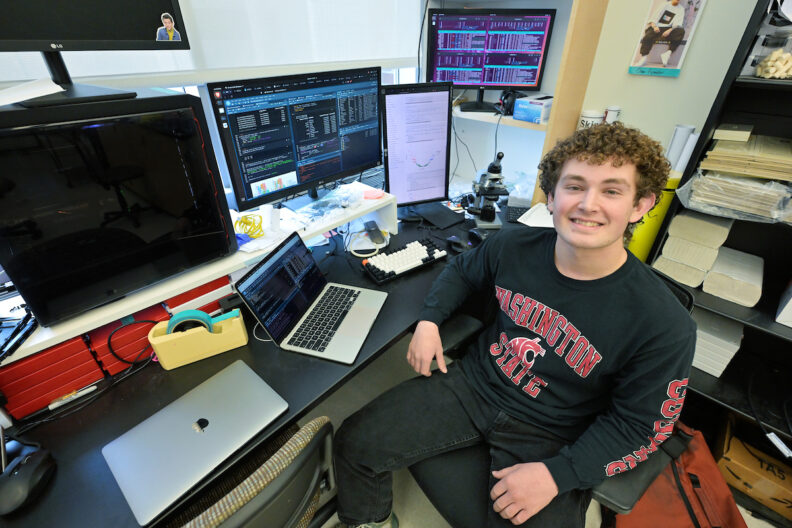
As an undergraduate student, Mason Matich is already gaining valuable research experience in Dr. Ryan Driskell’s Fibroblast and Skin Regeneration Laboratory in the School of Molecular Biosciences and the through the College of Veterinary Medicine’s EschLEAD program.
The EschLEAD (Learn, Experience, Apply, Deliver) program is pioneering initiative — open to WSU undergraduate students from all backgrounds, experiences, and academic disciplines — designed to provide undergraduates with immersive, hands-on learning in real-world research environments in the college’s leading labs. EschLEAD combines skill-building, real-world applications, and mentorship to empower students to explore, grow, and create their own paths to success.
As an EschLEAD scholar, Mason, a genetics and cell biology major, has had the opportunity to work on various projects, such as using computer vision models to quantify mouse hairs, performing histological staining to examine mouse skin, and analyzing single-cell RNA sequencing data to study skin biology. Soon after joining the lab, he began helping a PhD student with their project using a deep learning-based computer vision model to measure single-hair phenomes of mouse fur. Despite having no previous laboratory experience at the time, his continued efforts in lab eventually earned him authorship on the resulting research paper.
How is the EschLEAD program influencing your undergraduate career?
I feel that participating in research in the Driskell Lab has really enriched my time as an undergraduate. While working in the Driskell Lab, I’ve had the chance to learn many interesting and relevant research techniques that aren’t taught in my undergraduate classes. When I first enrolled at WSU, I didn’t have a very clear idea of what I would do with my degree after graduation, and participating in research has helped me learn about interesting career options while growing my resume.
What has been the most valuable experience in the EschLEAD program so far?
One experience that I really value was learning single-cell RNA-sequencing analysis. I had the opportunity to analyze scRNA-seq data for a research project focused on why wound healing ability in mice decreases with age. Together, three other undergraduates and I made a poster about our research and presented it at the WSU College of Veterinary Medicine’s research symposium. I really enjoyed learning and implementing a computational biology approach to learn about skin biology and getting to present my research to faculty members and other undergraduates.
How has your involvement in the program connected you with other students, faculty, alumni, or professionals in the field?
Being a part of the EschLEAD program, and working in the Driskell Lab, has connected me with lots of undergraduates who share the same interest in research as me. It has been really inspiring to see other undergraduates assisting in graduate-level research or pursuing their own research interests independently. I have also had the opportunity to get to know and collaborate with multiple research faculty members who have taught me a lot about skin biology and research in general.
How has EschLEAD helped you develop new skills that are valuable for your future career?
Through my volunteering in the Driskell Lab, I’ve gained hands-on experience with specialized laboratory techniques, such as H&E and Herovici histology staining, tissue sectioning with a microtome, and single-cell RNA sequencing analysis. Building these field-specific skills has been incredibly rewarding, as they are applicable to a range of science-based careers. Another skill I’ve developed is science communication. Talking about in-depth research can be challenging, but observing how other students discuss their work has taught me effective ways to convey my own research. With the support of my mentors, I’ve had the opportunity to present my research to university faculty twice, strengthening my ability to communicate scientific findings clearly and confidently.
What are your plans after graduation, and how is the program helping you prepare for them?
Currently, I’m still deciding whether to pursue a career as a medical laboratory scientist or continue my education with a master’s or PhD program. Participating in research through the Driskell Lab and working closely with numerous graduate students has given me a real look into what a career in research looks like, while also providing me with technical skills that will be valuable no matter which direction I take in the future.