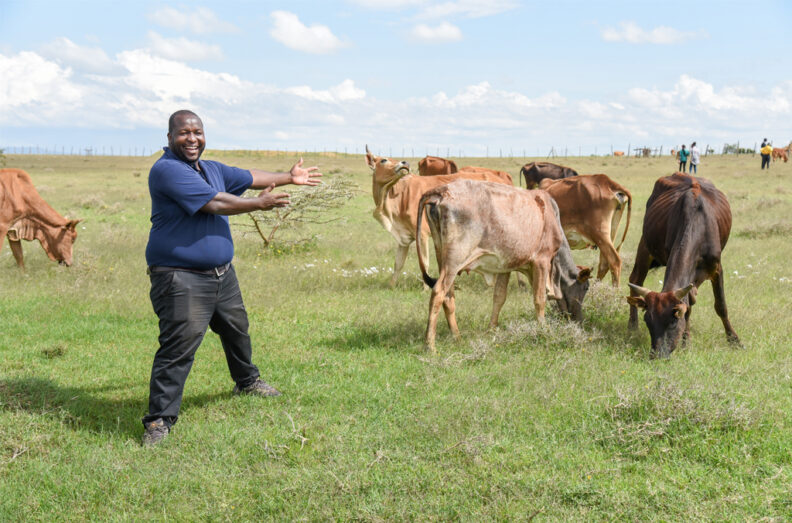
By Sharon Wanga, Joy Wanja Muraya and Josphat Muema
Growing up in a humble home under the care of his grandmother, mother, and cousins in Kenya’s expansive and towering Cherangany Hills, he knew early on that a nourishing meal wasn’t just about abundance—it was about balance.
From an early age, Hillary Wakhungu understood the importance of a balanced meal and that it did not have to be expensive to be nutritious and balanced.
Even when his peers ridiculed classmates for being malnourished and suffering from marasmus or kwashiorkor, both diseases caused by poor diets, his grandmother’s words on the importance of a good, simple, well-balanced meal remained steadfast.

This early foundation and exposure to a nutrition-sensitive lifestyle shaped him into the dedicated nutritionist he is today, driven by a passion for transforming people’s understanding of nutrition and making balanced eating accessible to all.
Today, as a PhD Fellow in Applied Human Nutrition at The University of Nairobi, he has dedicated the last four years to understanding how, by prioritizing nutrition, we can harness its power to foster a healthier society.
“East Coast Fever is a disease that attacks cattle, one of the livestock that human beings depend on for milk and meat, and when the animals fall sick because of East Coast Fever, it reduces their productivity in milk and meat and can also die,” he explains.
Further, he says this often leads to malnutrition, and the death of the animal means the nutritional source has been completely wiped out. The loss of income from death of cattle will also lead to malnutrition as households will have limited disposable income to buy other nutritious foods.
His PhD in Applied Human Nutrition under the Feed The Future Innovation Lab for Animal Health programme has led him to Narok County, where he has worked with mothers of reproductive age from 15 to 49 and children between 6 months and 59 months.
Together with other researchers, Wakhungu, who is almost finished with his doctoral work, is one of 10 PhD Fellows focusing on the multidisciplinary effects of East Coast Fever on the people of Narok County. His focus is on the consumption of animal-source foods and its impact on the nutrition of children and mothers.
The Feed the Future Innovation Lab for Animal Health is a five-year cooperative agreement funded by the USAID Bureau for Resilience, Environment, and Food Security.
According to him, healthy animals will be able to live longer and produce more milk, meat, and other resources when they are sold, which will trickle down to the nutrition of the mother and child in that they can use these products from a healthy animal for their food and also income that they can get from milk and selling of surplus milk or selling the animals to diversify their diet.
Children’s nutrition is critical in the first 1,000 days of life, and any faltering at this point will lead to future repercussions such as poor mental development, lower educational output, and general wellbeing.
According to UNICEF, at least one in three children under the age of 5 suffers from malnutrition in its most visible forms, which is undernutrition or overweight.
In his study, Wakhungu focused on the consumption of animal-sourced foods as a strategy to combat undernutrition or malnutrition in children and mothers.
“We looked at how we can improve the consumption of animal-sourced foods by coming up with a social behaviour change communication strategy, which was our intervention to improve nutrition,” he says who is also a BSc in Food Science and Nutrition and a Master’s in Community Nutrition graduate.
This was based on the fact that having plenty of healthy animals and animal-sourced foods does not mean that the mothers and children were consuming animal-sourced foods; hence, there was the need to investigate the barriers and enablers influencing animal-source food consumption.
Wakhungu explains that this was because he found out that the mothers and children consumed variable amounts of animal-sourced foods below the recommended levels.
During our research, we also noted that the prevalence of stunting in the study area (24.0%) is significantly higher than the national average (18%), highlighting a substantial burden of chronic malnutrition. We observed that boys are disproportionately affected, with nearly 30% stunted compared to 18.7% of girls. Furthermore, the higher rates of moderate stunting (16.4%) and severe stunting (7.5%) point to long-term nutritional deficits, which are more pronounced among boys,” said Wakhungu.
Therefore, he put in place mechanisms to address the levels of malnutrition by helping the mothers understand the importance of consuming animal-sourced foods.
Through a questionnaire, he learned that some women had some knowledge of why they needed to eat animal-soured foods but did not do it because their culture favours men over women and children, and men get to eat high-quality cuts of meat as they get what is left.
“Before putting in place the mechanisms, we found out that mothers and children from pastoral farming systems were most affected with low uptake of iron and zinc, unlike those in the agro-pastoral farming systems, but that has since changed. We also found that their calcium uptake was met because of their milk consumption as it is their primary source of animal-sourced foods,” he adds. Thus, to improve iron and zinc levels, among other key micronutrients, mothers, and children need to enhance dietary diversity by incorporating more animal-source foods and micronutrient-rich fruits and vegetables into their diets.
Wakhungu is one of the ten fully sponsored PhD fellows under the Feed the Future Innovation Lab for Animal Health (AHIL) program. This program is being implemented in 600 households in Narok County in Kenya to improve human nutrition, economic welfare, and resilience by removing cattle health and production constraints in Kenya and the East Africa region.
Washington State University leads the AHIL consortium with Kenya-based partners, including the University of Nairobi, the International Livestock Research Institute, and Scientists from the Kenya Medical Research Institute and Kenya Agricultural and Livestock Research Organization.
The five-year program combines laboratory and field intervention studies to improve the uptake of animal health interventions and measure the impact on household well-being and the nutritional status of women and children.
His mother, Florence Mutenyo, is his first mentor and appreciates academicians’ instrumental roles, such as Prof George Abong, Dr. Muthike Caroline, Dr. Zipporah Bukania, Dr. Mutono Nyamai and Dr Mulei Muema.
Away from research, Wakhungu enjoys watching football and is a massive fan of AFC Leopards and Manchester United.
He also loves taking nature walks and effortlessly prepares a tasty meal of chapati enriched with pumpkins or carrots.
For Wakhungu, every improved meal and every empowered family are testaments to the power of nutrition and the impact one can have when one believes in the strength of a simple, balanced meal.
East Coast Fever fact sheet
- Due to cattle illness and deaths, ECF imposes a substantial economic burden in several parts of sub-Saharan Africa.
- East Coast Fever, ECF, a cattle disease informally known as ‘cattle malaria,’ is extensively spreading in farming communities.
- ECF is a tick-transmitted disease caused by the protozoan parasite Theileria parva. It kills cattle within three weeks of infection through a fluid build-up in their lungs, otherwise called pulmonary edema, drowning the animals.
- ECF is common in central, eastern, and southern Africa and has been reported in 12 countries in the region: Burundi, Comoros, Democratic Republic of Congo (DRC), Kenya, Malawi, Mozambique, Rwanda, southern Sudan, Tanzania, Uganda, Zambia, and Zimbabwe. It kills at least 1 million cattle annually.