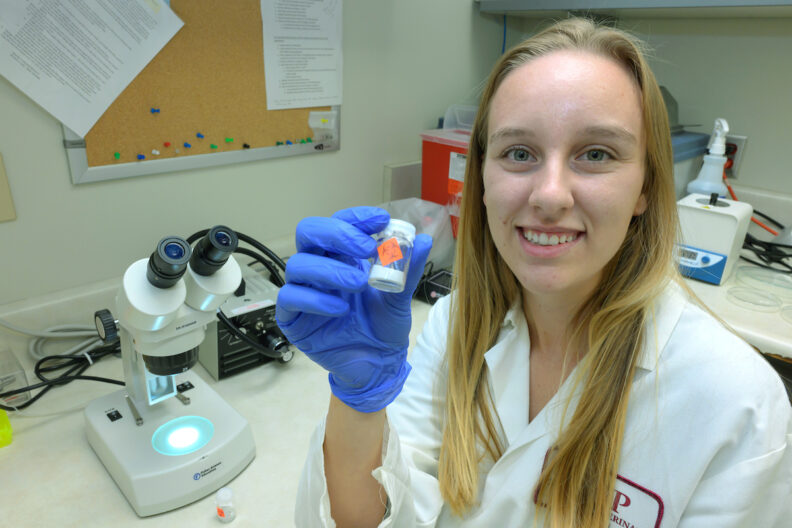
College of Veterinary Medicine graduate student Kaylee Vosbigian’s research is helping science to better understand how pathogens survive in ticks despite immune signaling. Working under the mentorship of Dr. Dana Shaw, Kaylee is now in her fourth year of the college’s Immunology and Infectious Diseases PhD program, a research intensive program designed to train students in immunology, host-pathogen interactions, and population biology of bacterial, parasitic, and viral infectious diseases in animals and humans. She hopes to graduate in the spring of 2026.
From Brentwood, California, Kaylee attended Cal Poly San Luis Obispo and earned a degree in microbiology while minoring in science and risk communications.
What inspired you to pursue your graduate studies at WSU?
One of the first things that stood out to me about WSU when applying to graduate school was that they had a PhD program specifically for immunology and infectious diseases. After interview weekend, I was encouraged by how friendly and welcoming the graduate students and faculty were (even despite it being over Zoom my year!). The exciting research opportunities in both the Veterinary Microbiology and Pathology Department and the Allen School for Global Health along with the collaborative environment ultimately led to my decision of pursuing my PhD at WSU.
Can you describe your current research and its significance in your field?
In the Shaw lab, we study how ticks acquire, maintain, and transmit pathogens. In the United States, tickborne diseases make up most of all vector-borne cases reported to the Centers for Disease Control and Prevention. Our lab studies Ixodes scapularis, the North American deer tick, which can transmit seven different pathogens. Tick-borne pathogen-host interactions have been primarily studied in mammals but little is known about how ticks harbor pathogens. My research focuses on characterizing two avenues of the tick’s cellular response to infection and how they support Anaplasma (causative agent of Anaplasmosis) in the cell. This work contributes to understanding how pathogens survive in ticks despite immune signaling.
How has your research evolved since you began your graduate studies?
Working with non-model organisms can be challenging. During my time researching the tick-pathogen interface, I have had to get creative with how I approach my research questions. For instance, we had preliminary data showing two transcription factors were active during infection of multiple pathogens, however, there were limited resources available to predict what these transcription factors were regulating in ticks. So, I learned to code in R to develop a custom search of tick promoters for consensus binding sites to predict downstream regulated genes. Additionally, using tools such as Alphafold to predict tick protein structures, has been beneficial in finding orthologs in better characterized model organisms such as humans or fruit flies. This has taken my project in an unexpected direction, complementing bench work with in silico predictions.
What role does collaboration play in your research?
I am very fortunate in that the Shaw lab is one of many vector-borne disease research labs at WSU. We have a group meeting with several of these labs twice a month. This has led to numerous opportunities for collaboration from exchanging protocols on experimental techniques to gaining valuable insight on next steps in my research project.
How has your mentor helped you in your journey?
I am very grateful to be mentored by Dr. Dana Shaw. She has been a great mentor and role model for me. While under her guidance, I have grown exponentially as a scientist. She encourages me to think critically of experimental results and next steps in my project. She has been supportive through all the ups and downs of research whether its help with troubleshooting an experiment or getting hyped up about an exciting result.
What are your long-term career goals?
I have always been drawn to the investigative nature of science. Throughout my PhD, I have been growing in my abilities to critically think about approaches to research questions and the scope of the research. These skills are important for my development as a scientist. Additionally, I have always been passionate about getting others excited about science, which is why, down the road, I plan to pursue a faculty position that includes both research and teaching.
What has been your favorite thing about WSU and the College of Veterinary Medicine?
My favorite thing about WSU and CVM is the encouraging community of people. The collaborative environment among faculty, staff, and students makes CVM a great place to do research!
What has surprised you the most about WSU and the College of Veterinary Medicine?
It is commonly known that grad school can be an isolating experience. However, what has surprised me the most is all of the great friends I have made at WSU. The community I have found here has helped me tremendously through the difficulties of grad school.
What would you say to prospective graduate students considering the College of Veterinary Medicine?
If you are considering CVM for graduate school, I would encourage you to scope out the many different research labs CVM has to offer. As I have mentioned already, CVM is a friendly community of people so don’t be afraid to reach out to graduate students in your program of interest to get a better idea of what it is like to do grad school here!