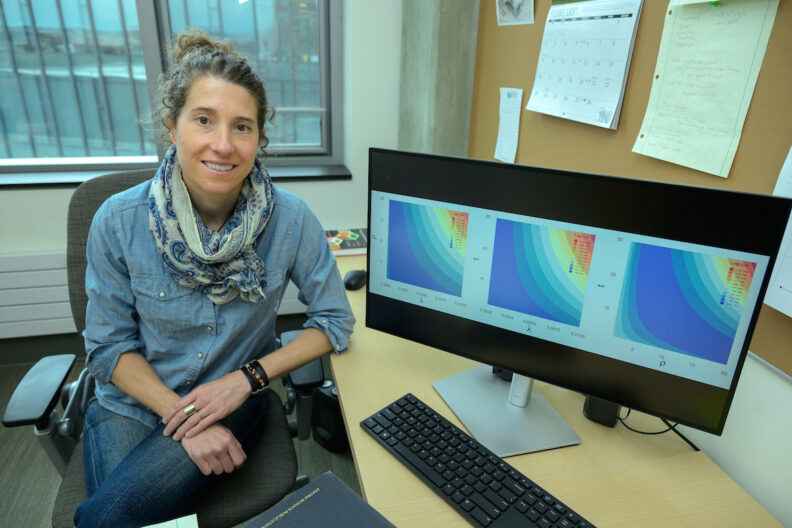
Dr. Erin Clancey is a research assistant professor in the Department of Paul G. Allen School for Global Health and a quantitative biologist whose research focuses on using mathematical and statistical models to understand complex biological processes. Her research interests include modeling disease transmission, disease ecology, predicting disease spillover, host-pathogen coevolution, and statistical methods.
She earned a doctorate in biology from the University of Idaho in 2012 before completing a postdoc at WSU in 2018. She then completed a second postdoc while also obtaining a master’s degree in statistical science at the UI in 2021.
She recently took some time to discuss her experiences and research at WSU.
What are your current research interests and what attracted you to that area?
My research focuses on using mathematical and statistical models to study the spread of infectious disease. I currently focus on studying epidemics in structured populations and zoonotic spillover at the wildlife-livestock-human interface. As a quantitative biologist with an interest in applied statistics, I am attracted to research in these areas because modeling with data allows me to ask and then answer new questions about disease transmission in humans and wildlife.
How can your research help people and animals?
My research can help people and animals because I aim to make predictions about where to find diseases in space and how disease transmission is changing over time. This knowledge, for example, can inform disease mitigation efforts and optimize disease surveillance strategies.
What do you enjoy about working with students?
I really enjoy connecting with students through the process of learning. I often end up teaching graduate students about math, statistics, or programing, which are concepts they sometimes find inaccessible. Helping a student understand and learn something new and potentially challenging is a fun and joyful experience.
What advice would you give to younger people considering a career in science?
Take statistics! It is not just about how to analyze your data; it teaches you about the overall scientific process. Continue taking statistics course throughout your education, the insights you will gain from statistics will change as you develop as a scientist.
Why did you choose to come to WSU?
I chose to come to WSU because of the opportunities to focus on the role animals play in global health. With my diverse array of collaborators in the College of Veterinary Medicine here at WSU, I have ongoing projects in global health that involve human, domestic animals and wildlife.