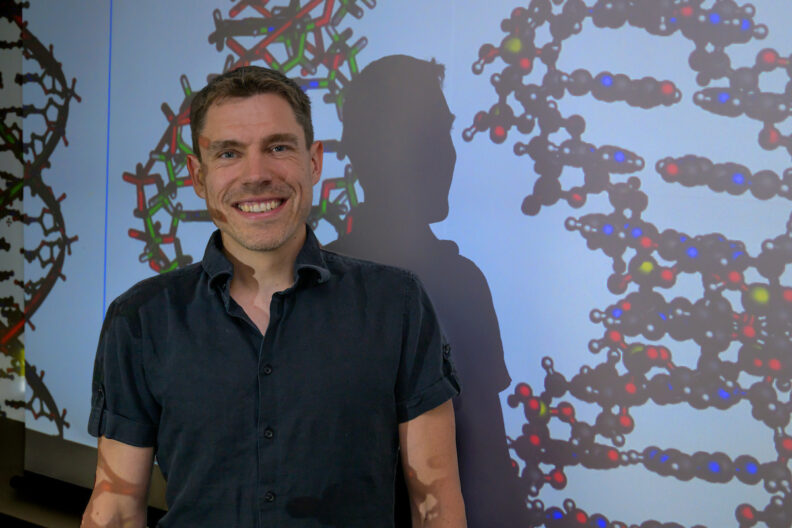
With the ultimate goal of understanding why individuals exhibit varying susceptibility to illness or respond differently to treatment, Dr. Sascha Duttke, assistant professor in Washington State University’s School of Molecular Biosciences, is studying how the same DNA can be interpreted in different ways depending on when and where it’s read by the body.
Through his work in nascent transcriptomics, Dr. Duttke’s lab investigates how gene regulatory programs interpret DNA differently across cells and conditions — insights that could help shape the future of personalized medicine for both humans and animals.
Dr. Duttke earned his doctorate in biochemistry and molecular biology at UC San Diego, where he remained for his postdoctoral training, first as a Cancer Research Institute research fellow and subsequently under a K99 Pathway to Independence Award from the National Institutes of Health.
What fascinates you about research?
The sheer vastness of what we don’t know truly fascinates me. Sir Humphry Davy, a science legend, captured this feeling well: “The more we know, the more we feel our ignorance, the more we feel how much remains unknown … .” I’m constantly in awe of life’s unimaginable complexity, and it feels like a true privilege to have the opportunity to explore it. In much the same way as Lewis, Clark, or Boone explored new territories, research is modern-day exploration. Research investigates new frontiers – in our case uncovering life’s building blocks and patterns. It’s mesmerizing, humbling, and incredibly exciting. Even better, all is experienced from the safe and comfortable space of the laboratory.
What do you ultimately hope to accomplish with your research?
We know DNA holds the blueprints for life and how it encodes its building blocks, the genes. But a big mystery remains: How does it encode when and where they are active? This control is absolutely critical for health. Misregulation of gene activity is a hallmark of many diseases ranging from neurodegenerative diseases to cancer.
On the fundamental science side, we work on deciphering the “rules” governing gene activity. For instance, we recently identified a new “grammar” in our DNA that dictates how proteins that regulate gene activity function. This discovery will require notable updates of current textbooks, and I hope we will continue to contribute to breakthrough discoveries.
On the application side, we aim to translate this understanding into practical tools for medicine. Think of the way DNA is activated as a pattern that determines what cells are doing and will do – especially highly dynamic cells like immune cells. By learning to read these patterns I envision a future – maybe 10 to 20 years from now – where doctors can use a simple blood test to get a detailed readout of your immune system’s acute state and trajectory. This could revolutionize how we predict, diagnose, and treat diseases by providing a personalized, real-time picture of our health and leveraging our own immune system’s state to combat diseases.
When your career is over, what do you want to be remembered for?
Haha, ideally no one will remember. That would be true success. Because if we did our job right, all those brilliant upcoming scientists will have made such incredible discoveries that our best own work naturally becomes just a foundational layer they launched from.
What are you most proud of in your career to this point?
The obvious answer should be our discovery of the spatial grammar in our DNA. But in truth, I believe it’s the little impact I had here on there on students’ life and growth. They are the future of science. And I am proud that I have daily opportunities to contribute to their growth.
What advice would you give to younger people considering a career in science?
First, like any career path, find something you’re genuinely excited about, something you believe is truly important, and something that contributes positively beyond just yourself – that’s the key to turning work into passion. Specifically for a career in science, I’d emphasize celebrating your successes. Science is tough and advances can sometimes feel few and far between.Embrace failure as normal and don’t take it personally; setbacks aren’t just possible in science; they’re a regular part of the discovery process. Also challenge the “impossible:” saying it can’t be done usually means it can be done! Indeed, that’s the exciting frontier waiting for someone determined.
Why did you choose to come to WSU?
The people. Everyone was so nice and friendly, and the collaborative spirit and the vision of the leadership here really convinced me. On a practical level, it’s also important to acknowledge my salary support of Washington State’s taxpayers – thank you! This support reduces grant writing pressure and in turn, allows more bold explorations and more time to follow my passion of nurturing the next generation of scientists.
What do you enjoy doing when you’re not in the lab?
I’m a happy husband and dad of two kids who I not only love, but also truly like! I enjoy cooking, spending time outdoors, yoga, and finding ways to give back to our wonderful Pullman community – whether that’s through kids’ activities, lending a hand, or sharing wildflower seeds.