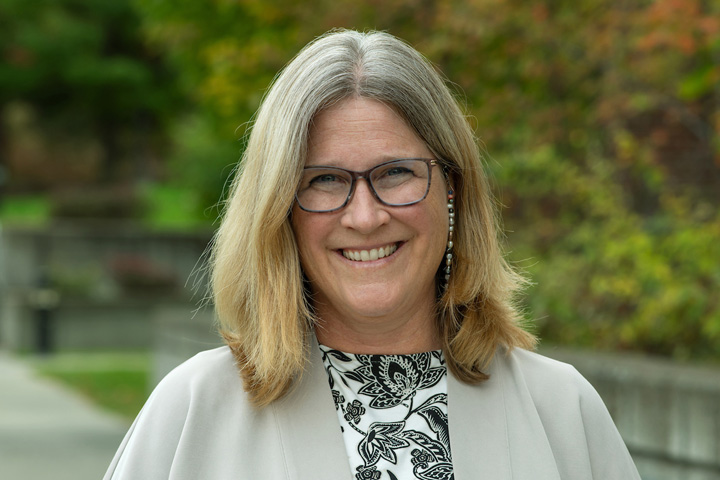
I am often asked a variation of the question, “Did you always know you wanted to be a dean?” Like most leaders I know, I never aspired to be a dean … but step-by-step, I was compelled into leadership. My journey started with a heart forward and enduring love of animals. This shifted to helping animals through clinical medicine, which then segued into a passion for science and discovery. Discovery, when most effectual, leads to engaged program building. And, at some point, that shifted to a deep joy in supporting others in discovery and medicine. For all the challenges in academia, the freedom to discover, collaborate, teach and grow in such a rich environment of students, staff and faculty can and does support an amazing career and incremental discoveries that add up to transformative knowledge – in our case, at our college, biomedical solutions for animals and people.
But academic communities still have an image problem (ivory tower) and a communications problem — made particularly apparent by artificial intelligence (AI) tools and a predilection of parts of our society to be fundamentally suspicious of scientific inquiry. Some specific examples.
We have faculty engaged in research that looks at “sex steroids” (for example, testosterone and estrogen) and how they impact the teenage brain and the chemicals that regulate emotions and motivation (I suspect we all know the teenage brain is different from the adult brain 😊). We also have faculty looking at “sex differences” in the brain injury that occurs after a stroke that can help protect women, especially post-menopausal women, and men at different life stages. Anyone who has a child or a parent or a sister or a wife knows, intuitively and practically, that different life stages bring different challenges (bone health, energy, metabolism, focus). But when AI is used to scan grants with the term “sex” in the title, this is what we hear (and I quote): “this application responded to a discontinued program that no longer effectuated National Institutes of Health priorities which included elements based primarily on artificial and non-scientific categories, including amorphous equity objectives, are antithetical to the scientific inquiry. … Worse, so-called diversity, equity and inclusion studies are often used to support unlawful discrimination … which harms the health of Americans.” End quote.
My heart goes out to faculty members caught in the crosshairs of AI and this particular sociopolitical backlash. It is a fast-paced frenzy where genuine research questions long ignored — like how do children, teenagers, women and men differ in basic biologic responses to drugs or injury — get vilified. We, academic institutions, need to do better to break down silos, tell our stories and re-imagine our place in our communities. And, in the near term, we will develop ways to “gap” fund these critical questions that very much support the health and well-being of all members of our community. I don’t yet know the name for this fund …I am pondering, but it will be good. And, of course, you are welcome to help.
Happy mid-summer from the Palouse!
If you’d like to know more, you can always read the latest stories from our college on our news page. For even more content, follow us on Facebook, Instagram, and TikTok. Be safe, healthy, happy, and stay hopeful.
Take care & Go Cougs, Dori Borjesson