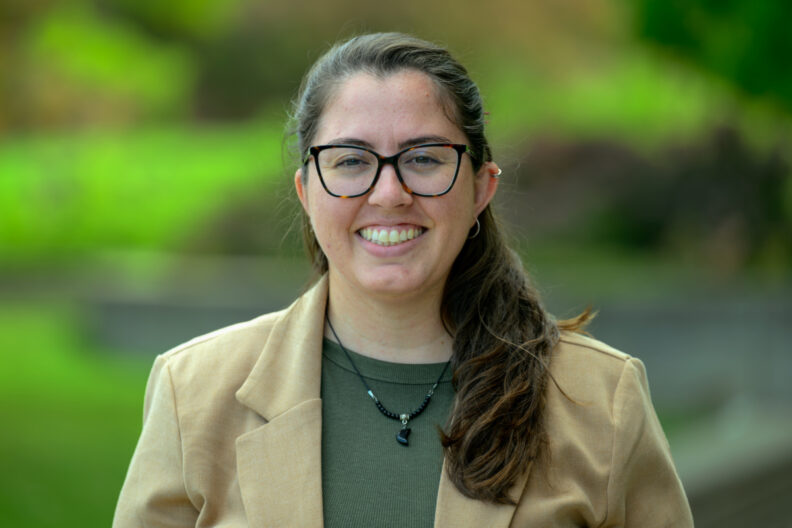
With an interest in animal welfare and pain assessment and management, Dr. Rubia Tomacheuski is a new clinical assistant professor of anesthesiology at the WSU College of Veterinary Medicine. Dr. Tomacheuski has spent much of her career working with animals in all life’s settings – agricultural, companion and laboratory. Beginning her veterinary education in Brazil, where she graduated from Faculdades Integradas do Iguaçu in 2015, Dr. Tomacheuski was awarded a scholarship to study at Murdoch University in Perth, Australia. She completed her Master of Science at Maringá State University in 2017 and her PhD in anesthesiology at São Paulo State University in 2022 and comes to WSU after recently serving as a postdoctoral researcher at North Carolina State University where she continued her work in pain management.
What has been your academic/career path leading up to WSU?
It has been an incredibly beautiful and challenging journey that began in Brazil, where I graduated with a degree in veterinary medicine. During vet school, I was awarded a life-changing scholarship to study at Murdoch University in Perth, Australia.
After graduation, I worked in general practice and emergency care. I then pursued a master’s degree in sustainable production and animal health at Maringá State University, where I conducted my first research project on the attitudes of Brazilian scientists toward pain assessment and management in laboratory animals. This work was published in the journal of Veterinary Anesthesia and Analgesia.
Subsequently, I completed a PhD in anesthesiology at São Paulo State University, Brazil, with part of my research conducted at the University of Montreal in Canada. My focus was on pain assessment in farm animals, particularly developing pain scales for beef and dairy cattle. This work resulted in several published manuscripts in high-impact journals. During this period, I also worked in private veterinary clinics and hospitals in Brazil, specializing in anesthesiology.
Later, I served as a professor of anesthesiology at Paulista University and as an invited professor of pain physiology and management at Maringá State University. I then spent two years as a postdoctoral researcher at North Carolina State University, where I also served as social chair for the Postdoctoral Association. In my first year, I focused on animal welfare and pain in farm animals. In the second year, I worked in the Translational Research in Pain Laboratory, studying chronic pain and osteoarthritis in dogs — this was just before coming to WSU.
Q: What drew you to WSU’s College of Veterinary Medicine?
What drew me to WSU’s College of Veterinary Medicine is my longstanding dream of becoming a professor at a renowned institution. My passion for teaching, research, and anesthesia has always been the driving force behind my career. The dynamic environment at WSU, coupled with the exceptional professionals I collaborate with, makes it an inspiring place to work. Additionally, the team at the anesthesia service not only motivates me to grow as a person but also provides the unwavering support I need as I step into this new position.
Q: What drew you into pain research?
While I was still in veterinary school, I developed an interest in researching pain to improve farm animal welfare. As a result, my final internship as a veterinary student was focused on anesthesia and integrative medicine at UNESP-Botucatu. I aimed to deepen my understanding of chronic (maladaptive) pain assessment and management, as well as anesthesia, which plays a crucial role in treating acute (adaptative) pain. During this time, my supervisor, Dr. Stelio Luna, professor of anesthesiology and a leading expert in pain research for animals, became the first person to inspire me to pursue a career in anesthesia. He later became my PhD supervisor, a friend, and a lifelong mentor. Another key mentor was Dr. Marilda Taffarel, also a professor of anesthesiology, who was my master’s supervisor. She has been and is still an invaluable guide and friend throughout my journey — sometimes I joke with her that she is my “eternal mentor.”
Q: What about your research work are you most excited for/proud of and why?
My most recent publication, the Bovine Pain Scale, is an open access article at PLOS ONE. It was one of the projects I developed during my PhD. This study aims to guide decision-making on pain management for cattle with acute pain, and I hope it will contribute to improving their welfare in the long run. Cattle are often neglected or underdiagnosed for pain, which results in many cases being undertreated. This project was particularly challenging as it was conducted during the COVID-19 pandemic, an experience that taught me resilience. Another piece of work I’m proud of is my Systematic Review on Pain Scoring Systems for Farm Animals. The study revealed that much remains to be done for these species, as very few pain assessment tools have strong scientific evidence and validation. Many species still lack validated pain scoring instruments. Pain scales — whether based on behavior or facial expressions — are crucial for veterinarians to assess pain more accurately and improve pain management.
Q: What’s something most people don’t know about you?
Most people don’t know that I’m a farmer at heart and was once a rodeo champion. Growing up, I spent a lot of time on the farm, and that connection to the land has stayed with me. The rodeo experience taught me a lot about resilience, discipline, and taking risks — qualities that have shaped both my personal and professional life.