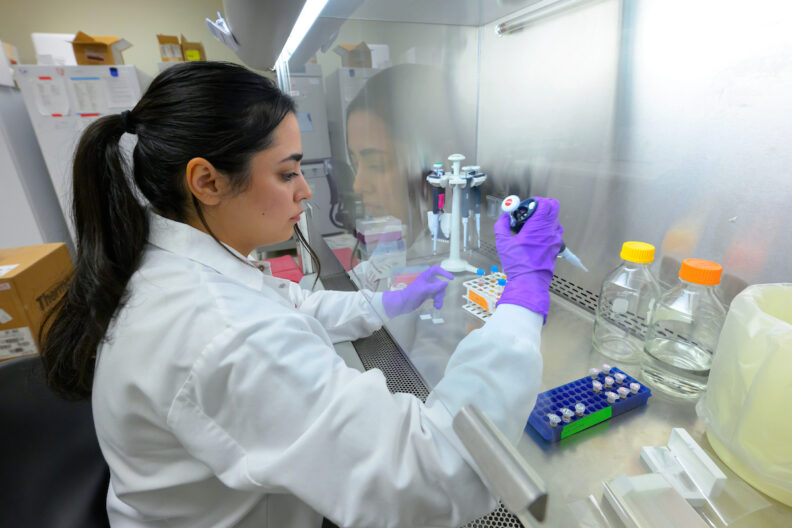
Nafise Noroozi is a PhD student in the WSU College of Veterinary Medicine’s Department of Veterinary Microbiology and Pathology, where she is part of the Immunology and Infectious Diseases graduate program. Her research focuses on Lyme disease and the immune responses involved in persistent infection.
Originally from Iran, Noroozi completed her veterinary training before moving to the United States to continue her academic and research career. She earned her Doctor of Veterinary Medicine degree from Islamic Azad University in Karaj, Iran, through a seven-year veterinary program that begins immediately after high school.
At WSU, Noroozi conducts research under the mentorship of Dr. Troy Bankhead and expects to complete her PhD by the end of 2027. She recently took some time to answer questions about her research, graduate experience, and what drew her to WSU.
What inspired you to pursue your graduate studies at WSU?
I wanted to pursue advanced research training in immunology and infectious diseases in a strong veterinary research environment. WSU stood out because of its reputation in veterinary medicine, the depth of its research programs, and the opportunity to work with faculty whose work closely aligns with my interests. The collaborative culture and focus on meaningful, translational research were also important factors for me.
Can you describe your current research?
My research focuses on Lyme disease and the bacterium that causes it, Borrelia burgdorferi. I study how this pathogen interacts with the host immune system and how it uses small regulatory molecules to adapt, survive, and persist during infection. My work aims to improve our understanding of pathogen survival strategies and identify potential targets for better diagnostics and therapeutic interventions.
How has your mentor helped you in your journey?
Dr. Troy Bankhead has been an exceptional mentor throughout my graduate training. He is always there when I need guidance and is incredibly patient, especially when I’m working through difficult experiments or unexpected results. He consistently brings new ideas to the table and is deeply involved in troubleshooting, which has made a huge difference in my progress. His constant support and genuine investment in my success have shaped my experience as a graduate student in the best possible way.
What are your long-term career goals?
My long-term goal is to pursue a research-focused career in immunology and infectious diseases, where I can contribute to advancing animal and, potentially, public health. My current training at WSU is helping me build strong experimental, analytical, and problem-solving skills that are essential for a career in academic or research-driven environments.
What has been your favorite thing about WSU and the College of Veterinary Medicine?
My favorite thing about WSU and the College of Veterinary Medicine is the people. The staff and my fellow students are incredibly friendly and always helpful, and the faculty are kind, approachable, and genuinely willing to support you. From day one, the entire department and college have gone out of their way to make me feel welcome. It truly feels like a place where people care about you and want you to succeed, and I honestly can’t imagine a better environment to be in.
What has surprised you the most about WSU and the College of Veterinary Medicine?
I was pleasantly surprised by how accessible faculty members are and how much time they dedicate to mentoring students. The level of engagement and encouragement has exceeded my expectations.
What would you say to prospective graduate students considering the College of Veterinary Medicine?
I would encourage them to consider WSU if they are looking for strong research training in a collaborative and supportive environment. It is a place where students are challenged but also guided and encouraged to grow both scientifically and professionally.