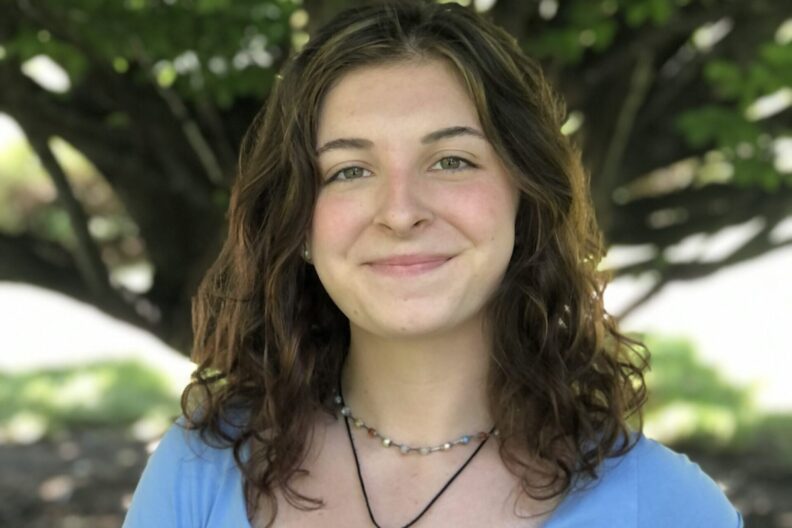
Hometown: Mountain View, California
Major: Neuroscience and Psychology
Expected Graduation Date: Spring 2026
Maddie Muir’s fascination with the brain began long before college, but it was at Washington State University and in the College of Veterinary Medicine’s Integrative Physiology and Neuroscience where that interest took shape through hands-on research and mentorship. A neuroscience and psychology major from Mountain View, California, Muir will graduate in spring 2026 and has worked in multiple research labs while exploring how neuroscience and psychology intersect in clinical practice. Along the way, she has found balance through community, collaboration, and even helping start WSU’s powerlifting club.
What initially drew you to your major?
I had the privilege of attending high school neuroscience programs at Stanford University, specifically the Neuroscience Foundation Exploratory Program, the Clinical Neuroscience Immersion Experience, and a Stanford Medicine Neurology/Genetics high school summer camp. Through these programs I was able to explore neuroscience at an early age and learn about the different types of research and careers related to neuroscience and psychology. I quickly became fascinated by the brain and decided I wanted to study neuroscience in college.
Who has been the most influential mentor or professor during your time at WSU?
I can’t choose just one so two of the most influential mentors during my time at WSU have been Dr. Brown and Dr. Henricks. Dr. Brown made a lasting impact by taking the time to slowly walk me through challenging concepts and encouraging curiosity, both in the classroom and through my work in his lab, where I learned molecular research techniques and worked on projects. Dr. Henricks had an equally meaningful influence by welcoming me into her lab as a freshman with no prior research experience, giving me hands-on experience and helping me build my confidence in my ability to conduct research. Together, their mentorship helped me believe in my ability to learn difficult material, take initiative, and approach new challenges with confidence and curiosity.
Have you had any opportunities to work in a lab or conduct research while at WSU?
I have had the opportunity to work in two research labs during my time at WSU, which has had a significant impact on my studies. I spent two years in the Behavioral Alcohol Research (BAR) lab with Dr. Henricks, where I gained a strong foundation in behavioral neuroscience research that helped me better understand research methods in courses like affective neuroscience (409) and other behavior-focused classes. I also currently work in Dr. Brown’s lab studying intrinsically photosensitive retinal ganglion cells, where I have learned molecular neuroscience research techniques that directly supported my learning in neurobiology (403) and neurophysiology (430). Together, these experiences exposed me to different areas of neuroscience and psychology and provided hands-on context that strengthened my understanding of the material I was learning in the classroom.
What advice would you give to someone thinking about majoring in a field within the College of Veterinary Medicine?
The advice I would give would be that most of the classes will be somewhat difficult, and it really helps if you approach each class with a sense of curiosity. When classes or topics are difficult it can be easy to automatically assume that they are too hard or that it just isn’t work trying to struggle to understand. However, when you approach the class with a sense of curiosity, it turns into a puzzle that you work toward solving, or even a game. With this perspective, it is easier to appreciate each “puzzle piece” that you find and add it to your puzzle to begin to see the bigger picture. Often it is the complexity that makes fields within the College of Veterinary Medicine so interesting!
What’s your favorite thing about WSU?
My favorite thing about WSU is the strong sense of community, especially within the academic environment. My professors and graduate student mentors have been incredibly supportive, not only in teaching course material but also in helping me develop research skills and think critically about different career paths. At the same time, my peers have played a huge role in my experience at WSU by holding one another accountable, working through challenging topics together and supporting each other’s growth in research and learning. The collaborative culture has made WSU feel both academically challenging and supportive.
What are your post-graduation plans?
My post-graduation plans are to gain hands-on clinical experience while continuing to explore both medicine and clinical psychology as potential future careers. I want to better understand the training, daily responsibilities and the impact of each field. My education at WSU has played an important role in preparing me for this next step by providing academic and advising resources that outline the graduate school requirements and career pathways. My classes and professors have also been instrumental in learning about subfields on neuroscience and psychology and I have been able to discover what truly interests me and how these interests can be included in a future career.
What hobbies or extracurricular activities have you enjoyed at WSU?
One of the most meaningful extracurriculars I have been involved in at WSU is powerlifting. In 2023, I helped start the powerlifting club, which gave me the opportunity to learn more about the sport while also building something lasting on campus. Through the club, I became a part of a diverse and welcoming community from many different backgrounds and roles at WSU. Powerlifting provided me with a consistent outlet during stressful periods of school and other responsibilities, helping me maintain balance while fostering friendships and personal growth.
What’s a fun or surprising fact about you that most people wouldn’t guess?
A surprising fact about me that most people wouldn’t guess is that I am very allergic to most animals, even though I am a huge animal lover and have quite a few pets back home.