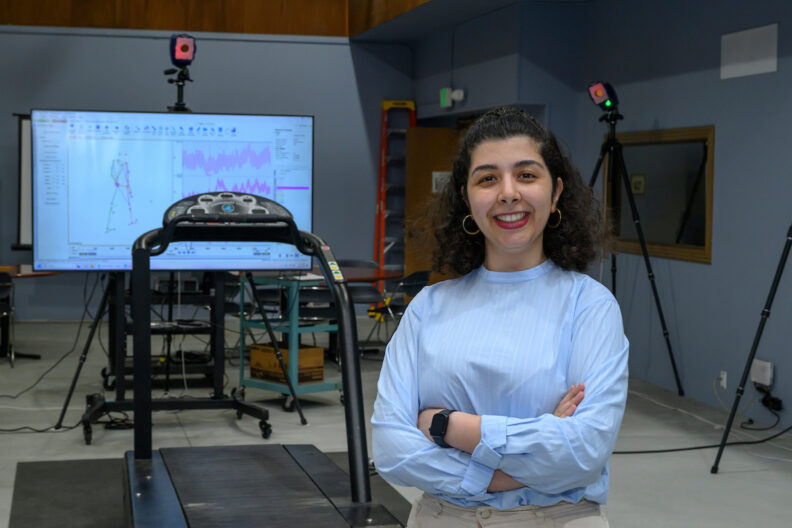
Originally from Iran, Zahra Abedzadehzavareh came to Washington State University’s College of Veterinary Medicine to explore a question she first encountered in a clinical setting: how pregnancy affects movement, balance, and safety for individuals using prosthetic limbs. Now a first-year PhD student in Integrative Physiology and Neuroscience, she is combining her background in prosthetics with interdisciplinary research to better understand mobility during pregnancy.
What inspired you to pursue your graduate studies at WSU?
My journey began during an undergraduate internship at a prosthetic center in Tehran, Iran. I worked with a pregnant client who required adjustments to her prosthetic limb, and I realized how little we truly understand about pregnancy biomechanics. This experience highlighted a significant gap in clinical knowledge regarding how to ensure safe gait and proper prosthetic fit for this population. This led me to WSU in August 2023 to join Dr. Robert Catena’s Maternal Orthopedics & Mechanics (M.O.M.) Lab, which is specifically dedicated to pregnancy research.
Can you describe your current research?
My doctoral research focuses on proprioception and trip-avoidance changes among pregnant individuals, including those with transtibial amputations. This work is highly interdisciplinary, allowing me to synthesize my clinical background in orthotics and prosthetics with kinesiology, physiology, and neuroscience. My goal is to understand how balance control and sensory perception shift during pregnancy to improve safety and mobility.
How has your mentor helped you in your journey?
Dr. Robert Catena has been instrumental in my development. Pursuing interdisciplinary work, combining physiology, O&P, and neuroscience, requires a strong support system, and Dr. Catena has consistently supported my unique research ideas. I feel very fortunate to work with a mentor who encourages this kind of synthesis and provides the guidance necessary to navigate complex, multi-faceted projects.
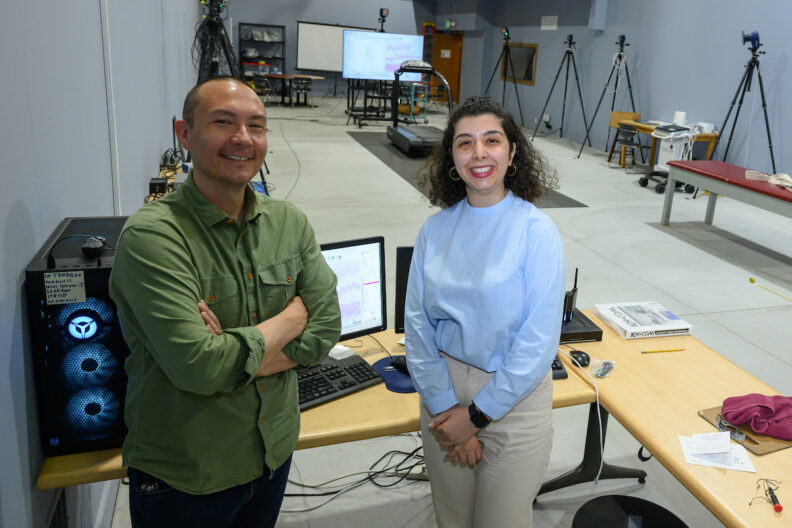
What are your long-term career goals, and how is your current research helping you achieve them?
My goal is to become a clinical researcher and translational scientist at the intersection of women’s health and prosthetic design. I aim to bridge the gap between clinical practice and research by developing evidence-based guidelines and driving innovation in wearable technologies to improve mobility for pregnant individuals with limb loss.