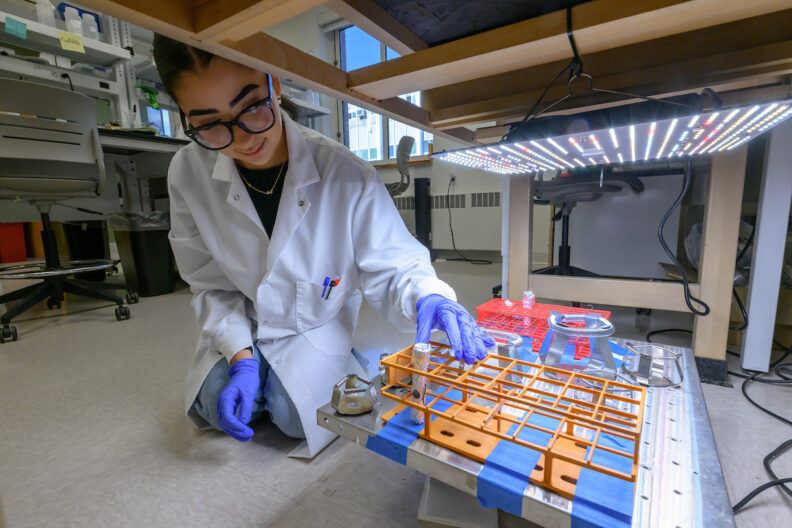
As a student researcher, Valentina Iturbe Fuentes has embraced opportunities across disciplines, from studying plant immunity in the laboratory to exploring the history of women science writers in Argentina. The biology and neuroscience double major from Richland, Washington, who was born in Caracas, Venezuela, has earned multiple scholarships and awards recognizing her academic achievements, including the George S. Allen Scholarship, Peter Zornes Memorial Neuroscience Scholarship and Emeritus Society Undergraduate Award.
Expected to graduate in spring 2027, she recently reflected on the research opportunities, mentorship and interdisciplinary learning that have shaped her undergraduate journey.
What initially drew you to your major?
I have always loved nature and the complexity of the natural world, especially plants and the way they interact with their environments. That curiosity initially drew me toward biology. At the same time, I became fascinated by neuroscience due to how something as complex as the brain can shape the way we experience the world, learn, and understand ourselves.
My interest in neuroscience also became personal. Experiences that gave me a different perspective on neurological health made me especially interested in understanding the brain and changed the way I think about life and science. Studying biology and neuroscience together has allowed me to explore both the world around us and the mechanisms that make our experiences possible.
Who has been the most influential mentor or professor during your time at WSU?
Professor Hana Zand Karimi has been one of the most influential mentors during my time at WSU. Working as a research assistant in her lab has given me the opportunity to experience what scientific research looks like beyond the classroom. She has been incredibly supportive and has helped me become more confident as a researcher, while also encouraging my curiosity and willingness to ask questions.
Dr. Sabrina González has also had a significant impact on my college experience. I had the opportunity to work with her on a literature and archive-based research project examining women science writers and educators in Argentina at the turn of the 20th century. Working with her showed me that research can extend far beyond the traditional boundaries of a single discipline. Both professors have encouraged me to explore my interests and have made my experience at WSU much more meaningful.
Have you had any opportunities to work in a lab or conduct research while at WSU?
Yes. I currently work as a research assistant in Professor Karimi’s lab, where our research focuses on plant immunity and the molecular interactions between plants and microbes. In particular, the lab studies plant extracellular RNAs and apoplastic components involved in plant defense.
Being part of a research lab has completely changed the way I approach science. In classes, you often learn about established discoveries and concepts, but research has taught me how much curiosity, patience, troubleshooting, and collaboration are involved in actually creating new knowledge. It has also helped me connect concepts from molecular biology, genetics, biochemistry, and plant biology in a much more meaningful way.
I have also had the opportunity to conduct research with Dr. Sabrina González on women science writers and educators in Argentina at the turn of the 20th century. That project allowed me to work with historical primary sources and contribute to a catalog documenting women’s participation in an important Argentine education journal. Having research experiences in both the sciences and humanities has helped me appreciate how different fields can ask different questions while ultimately contributing to a broader understanding of the world.
What advice would you give to someone thinking about majoring in a field within the College of Veterinary Medicine?
Be curious and don’t be afraid to explore outside of your major. Some of my most meaningful experiences at WSU have come from opportunities I didn’t initially expect, and they have helped me discover connections between different fields.
I would also encourage students to get involved in research, ask questions, and build relationships with their professors and mentors. You don’t have to know exactly what you want to do from the beginning. College is a time to explore your interests, and allowing yourself to do that can lead you to opportunities you never expected.
What’s your favorite thing about WSU?
My favorite thing about WSU is the people and the opportunities to explore different interests. I have been able to study biology, neuroscience, and psychology while also participating in research that crosses into the humanities. WSU has given me the freedom to pursue all of these interests and has connected me with professors and mentors who genuinely want to see their students grow.
What are your post-graduation plans?
After graduating in spring 2027, my plan is to further immerse myself in scientific research by applying to PhD programs, with the ultimate goal of pursuing an MD/PhD. My education at WSU, especially working in Professor Karimi’s lab studying plant immunity/molecular interactions, has given me a strong foundation in the sciences while teaching me how to think critically, troubleshoot, and approach complex questions from multiple perspectives. I plan to use these skills to help bridge the gap between patient care and biomedical research.
What hobbies or extracurricular activities have you enjoyed at WSU?
Outside of academics, I love spending time reading as well as practicing yoga. It helps me destress myself especially with the amount of workload I have. They have helped me enrich my time here by not stressing so much about academics itself, but rather being grateful to even have these opportunities
What’s a fun or surprising fact about you that most people wouldn’t guess?
I am endlessly fascinated by plants, which makes it all the more ironic that I struggle to keep real houseplants alive at home.