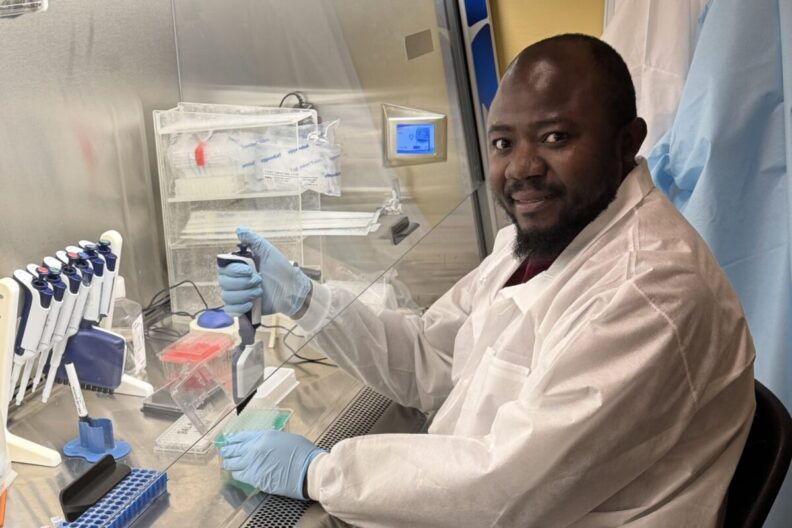
Growing up in rural Homa Bay County, Kenya, Charchil Ayodo saw firsthand the impact infectious diseases can have on vulnerable communities. Those experiences helped shape his commitment to education and inspired a career focused on using science to address global health challenges.
Ayodo earned a bachelor’s degree in Medical Laboratory Sciences with Information Technology and a master’s degree in Medical Microbiology from Maseno University in Kenya before joining Washington State University. He is now pursuing a PhD in the Multidisciplinary Program in Infectious Diseases through WSU’s College of Veterinary Medicine and the Paul G. Allen School for Global Health, where his research focuses on understanding how Middle East respiratory syndrome coronavirus (MERS-CoV) is transmitted from camels to humans in Africa.
Beyond his research, Ayodo has taken on numerous leadership, service and mentorship roles at WSU, including serving as a GPSA senator for the College of Veterinary Medicine, treasurer of the College of Veterinary Medicine Graduate Student Association, graduate student representative on the Faculty Senate Academic Affairs Committee, student peer mentor and coordinator of the Jan and Jack Creighton Global Health Seminars. His contributions have earned several honors, including the 2026 Distinguished Student Award, the 2026 GPSA Community Engagement Excellence Award and the 2025 ASM Future Leaders Mentorship Fellowship Award.
Mentored by Dr. Isaac Ngere and Professor Kariuki Njenga, Ayodo discusses his research, professional goals and experiences at WSU.
What inspired you to pursue your graduate studies at WSU?
I was inspired by WSU’s strong emphasis on infectious diseases, global health, and one health research. I wanted advanced training that would allow me to integrate laboratory science, epidemiology, field research, and animal-human health. WSU offered an environment where I could develop these skills while conducting research directly relevant to infectious-disease challenges in Africa and globally.
Can you describe your current research?
My PhD research focuses on Middle East respiratory syndrome coronavirus (MERS-CoV) and understanding its transmission from camels to humans in Africa. Although African camels show substantial evidence of MERS-CoV exposure, relatively few human infections have been documented. My research uses longitudinal surveillance, sensitive diagnostics, and a one health approach to improve detection of infections among highly exposed populations, including camel-owning communities, market and slaughterhouse workers, and patients in healthcare facilities.
What resources or facilities at WSU have been most valuable to your research?
The College of Veterinary Medicine and Paul G. Allen School for Global Health have been particularly valuable because they provide an interdisciplinary environment connecting infectious-disease research and global health. WSU has also provided access to scientific mentorship, research collaborations, and professional development opportunities which have allowed me to collaborate with researchers globally.
What are your long-term career goals?
My long-term goal is to become an independent global infectious-disease scientist, particularly focusing on zoonotic and emerging infectious diseases. My current research is preparing me for this by integrating field epidemiology, laboratory science, one health research, community engagement, multidisciplinary team coordination, and scientific leadership. Ultimately, I hope to lead research programs that improve early detection, surveillance, and preparedness for emerging infectious diseases, particularly in underserved settings.
What has been your favorite thing about WSU and the College of Veterinary Medicine?
My favorite thing has been the supportive and collaborative community. I have met faculty members and fellow students who are genuinely willing to share their knowledge, collaborate, and support one another. Most importantly, I have been fortunate to have very passionate, supportive, and accommodating PhD advisors, Dr. Isaac Ngere and Professor Kariuki Njenga, who have invested in my scientific and professional development and supported me as I navigate my doctoral training at WSU. This supportive environment has also enabled me to grow beyond research through leadership, mentorship, outreach, and service. WSU itself emphasizes mentoring and peer support as important components of graduate training.
What has surprised you most about WSU and the College of Veterinary Medicine?
What has surprised me most is the breadth of opportunities available beyond academic research. I came to WSU primarily to pursue a PhD, but I have had opportunities to participate in university governance, mentor students, conduct community outreach, coordinate seminars, advocate for WSU at the state level, and collaborate with researchers across institutions. These experiences have shown me that graduate education can develop not only a scientist, but also a mentor, leader, communicator, and community advocate.
What would you say to prospective graduate students considering the College of Veterinary Medicine?
I would tell prospective students that the College of Veterinary Medicine offers much more than excellent scientific training. It provides opportunities to develop as a researcher, leader, mentor, collaborator, and global citizen. My advice would be to come prepared to work hard, remain curious, seek mentorship, collaborate across disciplines, and take advantage of opportunities beyond your immediate research project. Your graduate experience can become much broader and more transformative when you actively engage with the WSU community.