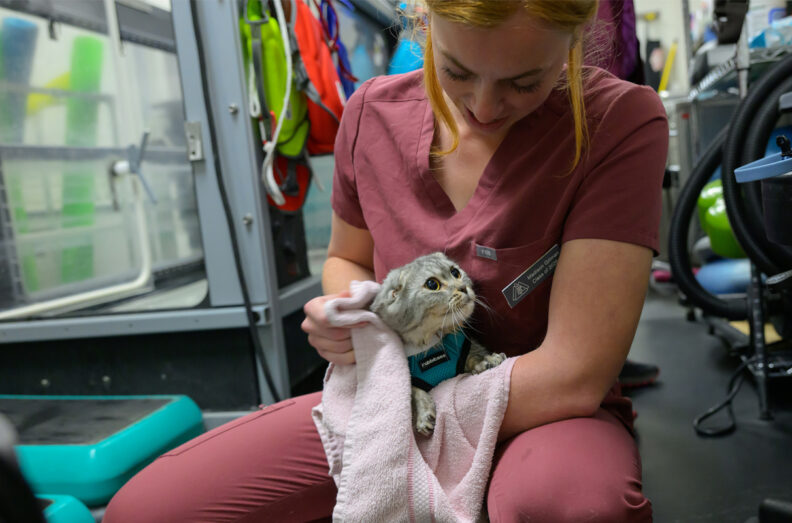
Mouse, a cat born blind that has suffered from arthritis since she was just a few months old, never had any interest in her cat wheel at home.
That changed immediately after an hour-long rehabilitation session with Dr. Jessica Bunch at Washington State University’s Veterinary Teaching Hospital.
“I could see an instant change in her after that,” Mouse’s owner, Jessie Lo, said. “That was the first time I saw her running on the cat wheel. She started sprinting and actually acting like a kitten.”
Mouse is just one of many animal patients using WSU’s Integrative Medicine and Rehabilitation service. The service, led by Bunch, provides laser therapy, Chinese herbal therapies, acupuncture, physical rehabilitation and more complimentary options to address arthritis and joint paint in animals.
While the majority of patients seen by the service are older dogs and cats suffering from osteoarthritis or are recovering from orthopedic or neurologic surgeries in the hospital, Mouse’s arthritis stems from a genetic mutation ailing her breed, the Scottish fold.
The condition, which causes the cartilage in the ear to fold and gives Scottish folds their name and distinct look, is called osteochondraldysplasia. The mutation also affects other cartilage throughout the body, causing long-term and severe arthritis, pain, lameness, stunted growth, tail and limb deformities, swollen paws, and misshapen toes.
Mouse, who’s become a student-favorite at WSU’s Veterinary Teaching Hospital, began her treatments with Bunch in January 2024 at 8 months old.
“We decided at that time to be proactive, knowing that this is a lifelong thing we need to manage in this breed,” Bunch said.
Initially, she prescribed anti-inflammatory drugs to ease Mouse’s pain.
“The goal, though, since she was so young, was to get her off any medications,” Bunch said. “So, we started acupuncture, and we also started Chinese herbs and joint supplements.”
Today, the seemingly fearless feline continues with her treatments weekly, with the regimen shifting from muscle building exercises like the underwater treadmill to more pain-easing therapies like laser and acupuncture.
Lo said it’s the laser that makes Mouse feel most comfortable.
“With the laser, I swear by it, I could see an instant change in her. It makes her feel significantly better right away,” Lo said.
Laser therapy, also known as photobiomodulation, works by employing lasers, light-emitting diodes, or broadband light within the visible and near-infrared spectrum to stimulate cellular activity. The therapy has demonstrated benefits, including reduced pain in arthritic patients.
After about three weeks, Lo said Mouse’s joints start to get stiff again, and it is time to visit Bunch.
“After seeing Dr. Bunch, she becomes her active self again,” Lo said.
Despite the genetic condition, Scottish folds are among the most popular cat breeds in Europe and the United States due to their appearance and ownership by celebrities.
While the designer cat breed is seemingly too cute to not be desired, Lo is clear she was never in search of a Scottish fold. Rather, Mouse found her while Lo was working as a veterinary assistant at Seattle Humane in Bellevue.
“She actually came in on my birthday. Her mom came in as a dystocia we knew that she had three stillbirths, and it is highly suspected that she still had a fetus stuck in her, so when mom came in, we opened the carrier and there was a singular live kitten,” Lo said.
Out of the whole five-kitten litter, Mouse was the only to survive.
That lone kitten is now one of Lo’s closest companions.
“I am lucky that I did get her at such a young age because it gives us the opportunity to train her now so that in the future these veterinary visits aren’t a stressful experience for her,” Lo said.
And there is no plan to stop the visits anytime soon.
“I believe in the care Dr. Bunch provides because I have seen changes in Mouse and they are night and day,” Lo said. “Nobody wants to see their animals in pain, and no one wants to load their animals up with drugs if they can help it, and that’s exactly what Dr. Bunch is able to provide for Mouse.”