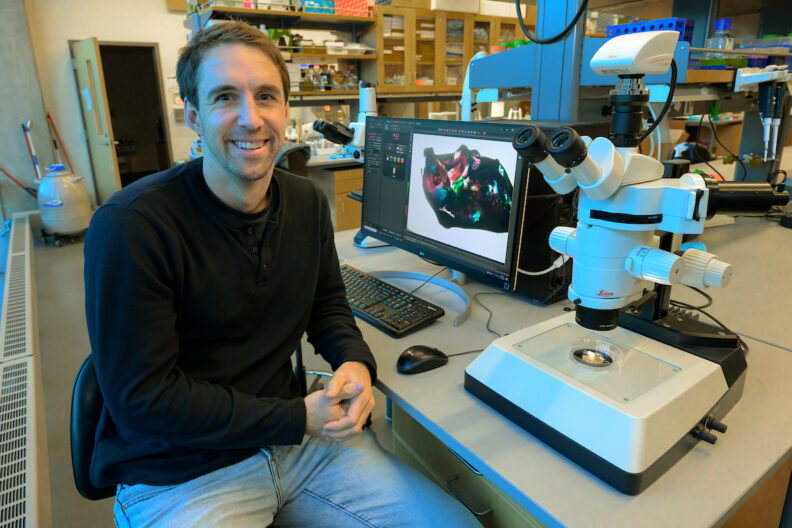
As part of our EschLEAD (Learn, Experience, Apply, Deliver) program, Dr. Nathan Law is giving WSU undergraduates opportunities to step out of the classroom and into the lab, where they gain the kind of hands-on research experience that sets them apart in graduate school, professional programs, and the workforce.
Designed to be open to students from all backgrounds, experiences, and academic disciplines, EschLEAD places undergraduates directly into the college’s leading labs, where they work side by side with faculty mentors on real-world problems. The program not only builds technical skills but also helps students develop confidence, critical thinking, and professional networks that carry them forward in their careers.
As an assistant professor in the School of Molecular Bioscience, Dr. Law’s research focuses on reproduction and stem cell biology. His work explores germline stem cell biology, gametogenesis, and paternal epigenetic inheritance, with the ultimate goal of uncovering the causes of infertility, embryo loss, and birth defects. By pairing this cutting-edge research with the EschLEAD experience, Dr. Law is helping prepare the next generation of scientists to make discoveries of their own.
What does it mean to you to be part of EschLEAD?
EschLEAD is an opportunity for me, as an educator and scientist, to extend the same opportunities to aspiring young scientists that launched my career here at WSU. As part of the EschLEAD program, we create internship opportunities for students to gain practical work skills that catapult students to the next stage of their career journey.
What are your current research interests?
My current research focuses on the understanding the underlying causes of infertility, miscarriage, and congenital birth defects in both humans and animals. Challenges with conceiving healthy children remains incredibly common despite often being a taboo topic among people. And from an animal standpoint, efficient reproduction is a common barrier that is influenced by a number of factors that we collectively don’t fully understand.
What do you ultimately hope to accomplish with your research?
As we understand the intricacies of human and animal reproduction, I hope to create predictive indicators of infertility, miscarriage, and congenital birth defects so that couples can make informed decisions about having children and for animal producers and breeders to optimize their reproductive practices in our ever-changing world. Someday, we may even create therapeutic approaches to correct these ailments.
What do you enjoy about working with students?
Helping others reach success, in whatever form that is, can be one of the most gratifying experiences as an educator and mentor. When you invest in people, their wins become your wins, which feels pretty amazing.
Why did you choose to come to WSU?
I first came to WSU as an undergraduate searching for the right combination of a top tier education at an R1 university and a community where I wouldn’t be just another face in the crowd. WSU provided that type of experience for me, and now, as a faculty, I extend that same experience and opportunity to all students at the university.
What advice would you give to younger people considering a career in science?
Science is a challenging and rewarding industry. It takes grit and determination, often in the face of skepticism. But the rewards, the sense of accomplishment, and the spark of discovery are what fuel me. Science is a wide field, so find what sparks you and what gives you that sense of accomplishment and run with it. You won’t regret it.
When your career is over, what do you want to be remembered for?
I hope to be remembered for the impact that I have on the next generation of scientists. Mentoring and teaching are some of the most valuable and rewarding aspects of my career. And if I can help the greater good along the way, that’s a win-win in my view.
Interested in joining the EschLEAD program? Learn more about how you can get involved and read stories about the students who are benefiting from the program.