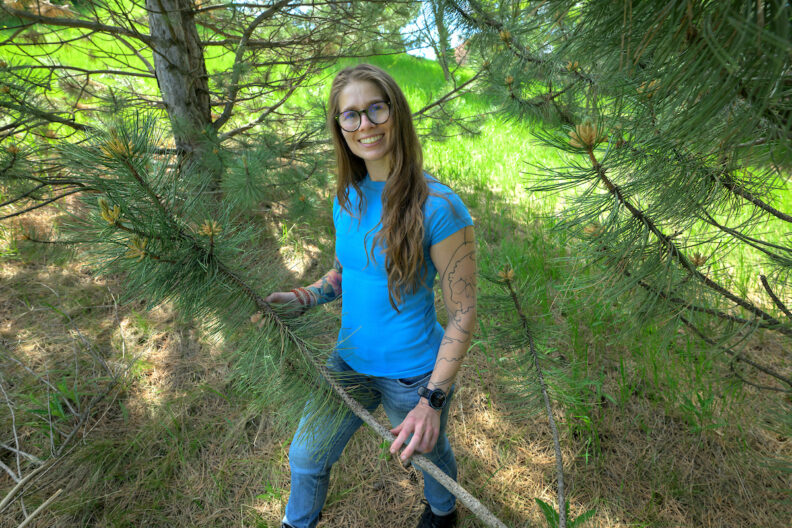
Through her work at WSU’s College of Veterinary Medicine Alyssa Maine is exploring how education and behavioral change can drive better outcomes in infectious disease prevention. A master’s student in the Multidisciplinary Program in Infectious Disease, she’s also collaborating on research that examines how undergraduates interpret and adapt to scientific information — work that could shape how science is taught and understood. Under the mentorship of Dr. Eric Lofgren, she is building on her background in disease ecology, which includes prior research on tick-borne disease. Originally from Aurora, Illinois, and Springfield, Missouri, she holds a B.S. in biology from Evangel University and an M.S. in applied ecology and conservation biology from Frostburg State University. She expects to complete her WSU degree in December.
What inspired you to pursue your graduate studies at WSU?
I was familiar with WSU because of an undergraduate professor I had who earned his PhD here in soil science. My master’s research was in the field of tick-borne disease, and I was interested in some of the research being done in the college. During interviews I felt that the professors here genuinely care about their students succeeding and reaching their goals not just in research but as whole individuals.
Can you describe your current research?
My current research is diverse but broadly focuses on the role of education and behavioral change to promote infection prevention. I also am collaborating with Dr. Shane Thomas in the School of Molecular Biosciences investigating how undergraduates understand the nature of science, evaluate sources of information for validity, and adapt to new, seemingly contradictory information from their prior understanding of scientific concepts.
What role does collaboration play in your research, and how have you worked with other students and faculty?
Collaboration plays a huge role in my research because it is interdisciplinary. My mentor, Dr. Lofgren, is incredibly supportive of my interest in educational research and science communication, so I have been able to explore those fields to bring into my research. There are also several labs in the Paul G. Allen School for Global Health studying disease ecology and epidemiology and we are very collaborative. We have group lab meetings every other week where we can get feedback on whatever we are currently working on.
How has your mentor helped you in your journey?
Eric is an incredibly supportive mentor. He gives me a lot of freedom and independence to explore my diverse interests but provides guidance when I am starting to feel lost in my program. When I am feeling discouraged or feel a lack of direction Eric not only provides encouragement but also actionable steps to help me refocus and find direction. As someone who has been an independent learner for a long time, having a mentor who gives me tools to learn the skills I need while allowing flexibility is important to me.
What are your long-term career goals, and how is your current research helping you achieve them?
For long-term career goals I am interested in being in education either as a professor or in public education in public health or conservation. My preference if I were to continue in academia would be to teach at a smaller university where I could focus on high quality teaching and research opportunities that don’t require a massive amount of funding. Students attending smaller schools may not have as many opportunities to get research experience to be competitive for graduate positions. I would love to be able to provide those opportunities to students who may feel more comfortable in a smaller school setting. My current and previous research have introduced me to tools that would be very adaptable to this kind of setting.
What has been your favorite thing about WSU and the College of Veterinary Medicine?
I would say that my favorite thing about WSU has been the connections I have made. I have a solid group of friends and colleagues that includes people both within and out of the college. I have been able to professionally connect with both students and faculty in many different fields, including Educational Psychology, Anthropology, Ecology, Entomology, and in the CVM Teaching Academy. I have a close group of friends in my program that play DnD every few weeks, and I have community outside the CVM through WazzuPL, the Powerlifting Sports Club at the UREC.
What would you say to prospective graduate students considering the College of Veterinary Medicine?
When I have had the opportunity to talk to prospective students during recruitment, I always have a few things I emphasize to them. There is so much opportunity to explore in the CVM. Even if you have a specific research field you want to stay in, there is a lot of diversity of mentorship styles in different labs. If you step out of your comfort zone and expectations, you might find yourself discovering something even better than you expected. The second thing is how much support you can find a variety of places here if you feel lost, stuck, or discouraged. My first week in the program I reached out to Anita Peralta (the former graduate education coordinator) because she seemed approachable, and I was already thinking about leaving. She invited me to get coffee and was so supportive and encouraging, but she also was definitely not the only person to provide that kind of support. Overall, the College of Veterinary Medicine at WSU provides so many opportunities to become a strong scientist while not neglecting the struggles that come along with both higher education and outside life.