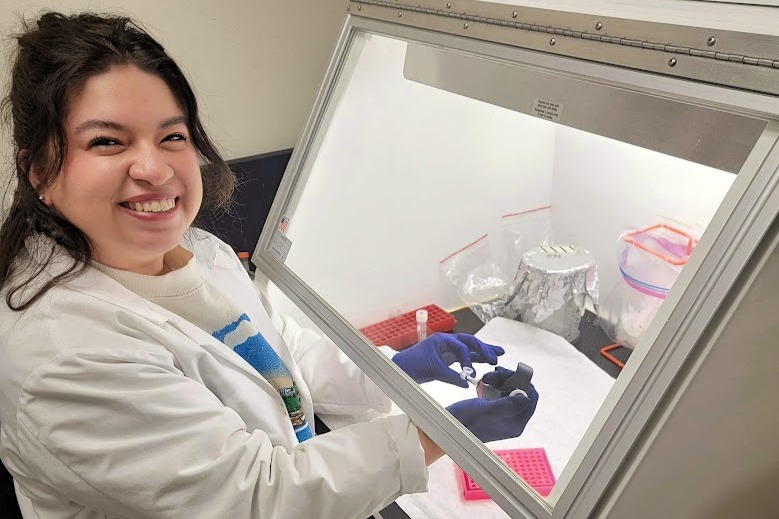
As a PhD candidate in the College of Veterinary Medicine’s Multidisciplinary Program in Infectious Diseases, Sadie Izaguirre is working to uncover new ways to combat bovine babesiosis, a tick-borne disease that poses a major threat to the cattle industry. Her research, conducted in the lab of Dr. Massaro Ueti, focuses on identifying and characterizing novel protein targets to help protect against the pathogen.
A Pasco, Washington, native and proud WSU alum, Sadie completed her undergraduate degree in biochemistry — focusing on molecular biology with a minor in genetics and cell biology — before diving into her graduate research.
She recently took some time to discuss her research and experiences at WSU.
What inspired you to pursue your graduate studies at WSU?
I first learned about this program while attending the commencement ceremony for one of my friends. I thought it sounded really cool, and I kept it in the back of my mind for when I was ready to apply to programs. Once I had decided to pursue graduate school, I realized that at WSU I would have the opportunity to explore a variety of research fields that I was interested in. After recruitment weekend I was very excited to continue at WSU. I was able to meet so many of the PIs and learn about their research. It was really exciting.
Can you describe your current research?
In our lab we study Babesia bovis, one of the causative agents of bovine babesiosis, which is a tick-borne parasitic disease that is responsible for large economic losses in agricultural industries. My current research is focused on identifying and characterizing novel protein targets to help protect against bovine babesiosis. I am specifically interested in proteins that are implicated in vector-pathogen interactions.
What resources or facilities at WSU have been most valuable to your research?
The Ueti Lab has the unique opportunity to work with the USDA Animal Disease Research Unit that is located here in Pullman as well. This partnership with the USDA has been instrumental in my research by allowing me to not only continue my research with Babesia and vector-borne disease but also allowing me the opportunity to work with other USDA scientists and personnel. These other incredible researchers have provided me with guidance, insight and help throughout my time here.
What role does collaboration play in your research, and how have you worked with other students and faculty?
Collaboration is incredibly important to research. It takes a village! I would not be nearly as far as I am if I had to work completely alone. Other faculty and students have helped me in so many ways. Some small, like allowing me to borrow reagents we were low on or helping me prepare presentations. In other ways, I have collaborated on projects with other faculty and their labs, been able to use their equipment for my projects and have been able to work through larger scale experiments with the help of others. It has been great being able to work with so many other people.
How has your mentor helped you in your journey?
Massaro has been an incredible mentor to me during my PhD. He has always shown support for my ideas and has pushed me to think creatively when it comes to problem solving. He also encourages me to have a life outside of the lab! Our lab is a very supportive environment and that has helped so much during grad school.
What are your long-term career goals?
I hope to continue pursuing research as a career with a continued focus on infectious disease and host-pathogen interactions. My current research project has provided a great foundation of skills and knowledge in studying disease and pathogen interactions that can be applied to a variety of pathogens and how they impact other hosts or vectors.
What has been your favorite thing about WSU and the College of Veterinary Medicine?
My favorite thing about WSU CVM has actually been my experience with the other students in my cohort and even other students outside my cohort. The friendships and camaraderie that have been built in this program are one of the many reasons I have enjoyed my time here. WSU CVM really emphasizes building a support system and the events that are put on by organizations like CVMGSA really help foster that too.
What has surprised you the most about WSU and the College of Veterinary Medicine?
When I was applying to graduate schools, I was pleasantly surprised to learn about how diverse and expansive the infectious disease research program is. Even though I had attended WSU as an undergrad, I did not realize how incredible and high caliber the research being done here was. It was like a little hidden gem that I hope more people become aware of!
What would you say to prospective graduate students considering the College of Veterinary Medicine?
Doing my PhD here at WSU in the CVM has overall been a really great experience. There are so many labs that are doing a variety of research that are focused on important infectious diseases in today’s world. Pullman provides a small town feel and maybe that is not for everyone, but the community here at WSU and specifically in this program has been wonderful.