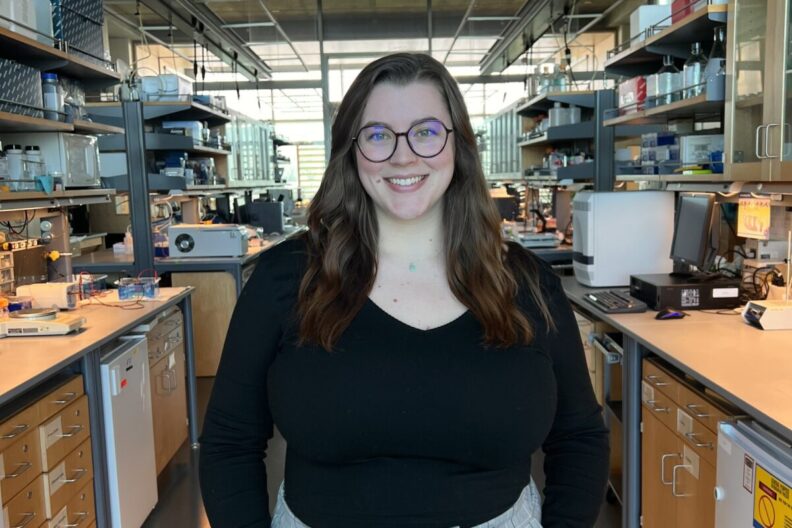
Caitlin Ritchey is investigating the neural circuitry that controls feeding behavior — work that could ultimately inform better treatment approaches for obesity. A PhD student in neuroscience in the Department of Integrative Physiology and Neuroscience, Caitlin is studying how regions of the brainstem, cerebellum, and reward system interact to influence food intake. Originally from Lancaster, Pennsylvania, she earned her B.S. in biology with a minor in chemistry from Lebanon Valley College. Now co-mentored by Drs. James Peters and David Rossi, she expects to complete her degree in December 2025 and hopes to one day lead a neuroscience research lab at a teaching-focused university.
What inspired you to pursue your graduate studies at WSU?
I had lived and studied in Pennsylvania all my life, so my undergraduate research advisor was the one who really pushed me to pursue graduate school away from PA. When I came across WSU during my search for graduate programs it seemed like a no-brainer. The community of students, faculty, and staff were immediately welcoming, and the impressive research and facilities gave me the confidence that I would develop into a great scientist here.
Can you describe your current research?
My research is aimed at identifying and characterizing key regions in the hindbrain that control appetitive behaviors. More specifically, my work focuses on studying connections between the brainstem, cerebellum, and the brain’s reward system to ultimately understand how these pathways may be involved in controlling food intake. This work will be crucial for understanding the neural controls of feeding behaviors and has the potential to influence the development of more comprehensive treatment approaches for obesity.
What resources or facilities at WSU have been most valuable to your research?
The College’s extensive collection of departmental equipment and core research facilities have been incredibly helpful in completing my research. We regularly utilize the departmental microscopy and molecular equipment as well as the Laboratory for Biotechnology and Bioanalysis. WSU, and particularly IPN, also provide ample opportunities for student grants and fellowships that have made my research possible.
How has your mentor helped you in your journey?
My mentors have been invaluable in helping me grow as both a person and a scientist. From day one both Jim and David have been nothing but supportive of my learning in the classroom and the lab – by explaining complex concepts I need help with, giving constructive feedback on writing and experiments, and including me in all the essential non-research aspects of working in academia. They always push me to be the best I can be, especially when I’m hit with intense imposter syndrome. Jim and David have shown me what being a careful scientist and supportive mentor looks like, which is something that I will carry with me into my own career.
What are your long-term career goals?
My ultimate career goal is to obtain a faculty position at a four-year, non-traditional research university where I can recruit a diverse group of undergraduate students into my lab to conduct innovative neuroscience research. My research and time at WSU have been pivotal in preparing me for a future career in academia. I have learned how to keep up with and think critically about relevant literature, conduct high-quality and thoughtful research, and be a good scientific mentor and communicator. I have been fortunate to mentor several undergraduate students in our lab with their own projects, and with my own projects I have been involved with every aspect of experimental design, research, and the non-science tasks needed to run a lab, all of which will prepare me for the future.
What has been your favorite thing about WSU and the College of Veterinary Medicine?
My favorite part of WSU has been finding a home away from home in my lab and in IPN. The people here have given me the support system I needed during my time here, and I know that will make leaving WSU very difficult. I am also a huge fan of the bear center and the close proximity of our building to Ferdinand’s! Nothing cheers me up more than ice cream and a visit to the bears.
What has surprised you the most about WSU and the College of Veterinary Medicine?
I think I’ve been most surprised about the teaching and outreach opportunities you can find within CVM and how much I’ve enjoyed them. Previously I was on the fence about a career in teaching, but my experiences as a TA for both neuroscience and veterinary classes, as well as my mentoring of undergraduates in the lab, have helped solidify my choice and prepare me for a career in academia. Being a part of CVM also means you have plenty of opportunities for outreach, including student recruitment, local STEM nights, and Palouse Kids Judge, which have been quite a fun part of my time at WSU.