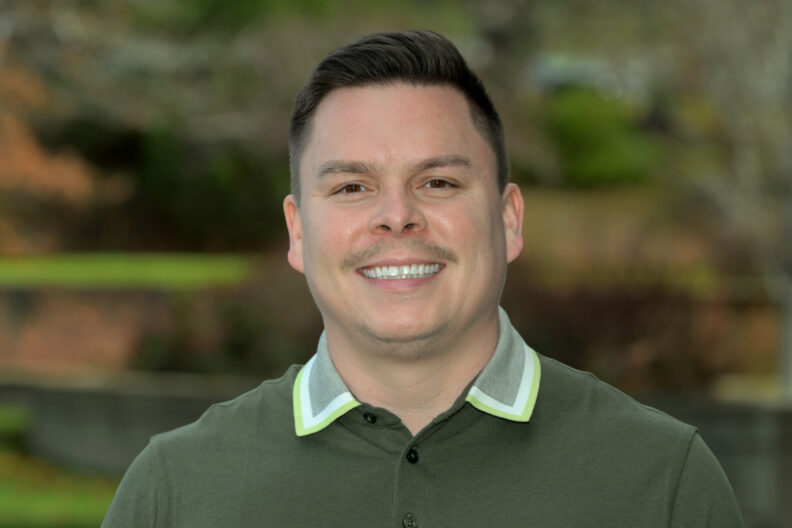
As a community health researcher and citizen of the Turtle Mountain Band of Chippewa Indians, Dr. Cole Allick’s interest in public health is both personal and professional. He’s witnessed the deep impacts of public health on his own community and wants to inspire change. His research focuses primarily on public health systems and policies that impact American Indian and Alaska Native communities, particularly around cancer prevention, aging, and access to culturally grounded care. Formerly with WSU, Allick will remain affiliated with the Institute for Research and Education to Advance Community Health (IREACH). Allick is now an assistant professor in the Paul G Allen School for Global Health and one of the latest additions to the WSU College of Veterinary Medicine.
What has been your academic/career path leading up to WSU?
I earned my Master of Health Administration from the University of Washington, followed by a brief stint in health care consulting, where I was able to really see Washington’s rural communities from a health data perspective. I later obtained my PhD in Indigenous health from the University of North Dakota, where I was part of the first cohort in the world’s first Indigenous health PhD program. My new role at the Allen School represents a move from the Elson S. Floyd College of Medicine where I worked with the IREACH program on community-based research focused on health equity, Indigenous health policy, and systems-level interventions to address health disparities.
What drew you to WSU’s College of Veterinary Medicine?
While it might seem unexpected, the College of Veterinary Medicine houses impactful public health and One Health work that aligns with my focus on systems-level health equity. I was drawn to the collaborative and interdisciplinary environment here — especially the emphasis on community-engaged research and support for Indigenous health scholarships.
What is your area of expertise?
My expertise is in tribal health policy, Indigenous health disparities, and community-engaged research. I focus on how public health systems and policies impact American Indian and Alaska Native communities, particularly around cancer prevention, aging, and access to culturally grounded care.
Did any specific experiences, mentors, influences that helped guide you?
Mentors like Dr. Donald Warne and the late Dr. Kaʻimi Sinclair have played pivotal roles in shaping my approach to research that is not only rigorous but also grounded in accountability, respect, and cultural humility.
What about your research work are you most excited for/proud of and why?
I’m most proud of the partnerships I’ve built with tribal communities. Whether it’s improving lung cancer screening access or increasing research readiness around Alzheimer’s and dementia, the work is impactful because it’s done with communities, not on them. Seeing tangible change from our collaborations — like new screening protocols or community trainings — makes this work incredibly fulfilling.
What’s something most people don’t know about you?
Most people don’t know that I coach volleyball! I’ve coached the University of Washington Women’s Club Volleyball Team in various capacities since 2015 and have worked with athletes of all ages over the years. It’s a huge part of how I stay grounded and connected outside of academia. In between coaching, I also continue to play in adult volleyball leagues locally and in tournaments across the country!