By Ryan Kerubo, Joy Wanja Muraya, and Josphat Muema
His journey into veterinary medicine was inspired by a deep love for animal health, rooted in transformative childhood experiences in the Kaproret in the Rift Valley.
As a primary school student, young Wyckliff Ng’etich witnessed a pregnant cow struggling with a difficult delivery. The sight stirred something profound within him, and he eagerly volunteered to assist the visiting veterinary officer. That moment planted the seed of a lifelong passion.’
Years later, during his high school days, another incident reinforced his calling. A cow in the school was gravely ill after ingesting nylon papers. Once again, the same veterinary officer arrived to save the animal through a delicate operation. He closely observed every step of the procedure, captivated by his skills and determination. He stepped in to help without hesitation, feeling an unmistakable conviction that this was his future.
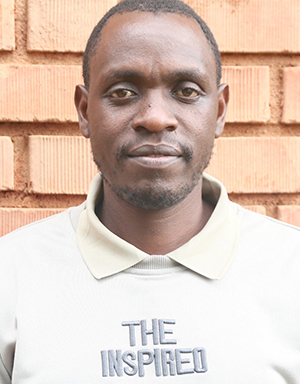
These pivotal experiences shaped Dr. Ng’etich’s unwavering dedication to becoming a veterinary doctor. His work embodies the compassion and commitment to animal welfare that ignited his dream.
His formative years were challenging for him. You see, Ng’etich grew up in a simple background. He had to walk to school each day and even attended a day high school near his home until his parents managed to secure a boarding slot for him in Form 3 to help him focus on his studies.
“I grew up in a small village, where I developed a deep love for learning and excelled in all my classes, earning the highest marks in primary and high school. It was a dream come true when I was admitted to study veterinary medicine in Nairobi, the big city I had always aspired to experience,” he says with a proud smile.
Dr Ng’etich joined the University of Nairobi in 2010 to pursue a Bachelor of Veterinary Medicine. However, he soon discovered that it would not be easy.
He says many people who had joined the course before him tried to dissuade him from joining, saying many people had dropped out, and true to their words, many students dropped out in their first year.
Passion, his driving force, kept him afloat. He even emerged as the best student in that class, which led to his getting a scholarship to do his master’s. He began his master’s in Veterinary Medicine which he completed in 2017 and later enrolled for a PhD which he graduated in September this year under the Feed The Future Innovation Lab for Animal Health at the University of Nairobi.
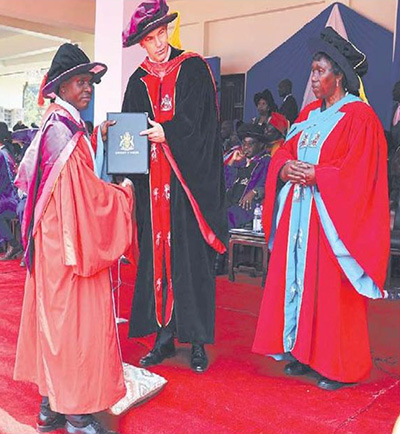
Animal health PhD graduand Wyclkliff Ngetich (left) receives his papers from the University of Nairobi Chancellor Prof Patrick Verkooijen as Vice Chancellor Prof Jesang Margaret Hutchinson looks on, during the 71st graduation. [Elivis Ogina, Standard]
For his doctoral research in Narok County, he studied the disease pattern of a killer cattle disease, East Coast Fever, focusing on the cause of the disease, how it is spread from one animal to another, the clinical signs, the risk factors that increase the chances of the animals coming down, and the intervention measures.
East Coast Fever (ECF) is one of the biggest killers of cattle in sub-Saharan Africa, with various studies estimating that over one million cows die annually from the deadly tick-borne disease. Such loss of livestock, especially for pastoralist communities, has devastating effects, including loss of livelihoods, food insecurity, and a heightened malnutrition risk, particularly among children.
In Narok County, where he worked alongside other researchers, he focused on different aspects of East Coast Fever, a fatal disease that affects cattle, spreads by ticks, and leads to substantial economic losses.
The disease is fatal if not treated in its early stages of infection, with a fatality rate of 44 percent, meaning that almost half of the infected animals die if not treated early.
In Narok, Dr Ng’etich notes that the Maasai refer to the disease as ‘malaria of the cows’ because the signs are almost similar to malaria in people, such as fever, body weakness, a rough hair coat, and swollen lymph nodes.
For signs to manifest, the disease develops for seven to 12 days from infection and within two to three weeks, the animals will have full-blown signs, and if not well treated, the animal may die within three weeks.
“The challenge with East Coast Fever is not only in the death of the animal but in the production as some pregnant animals may abort. It is an expensive disease to treat because farmers spend almost KES 10,000 per animal, and since the pastoral communities keep large herds of cattle, treating them will be quite expensive,” says Dr. Ngetich.
According to him, the production systems in Narok affect the spread of the disease. Some practiced mixed farming with both livestock and crops, others practiced agro-pastoral farming by planting crops but also keeping large herds of cattle, and others only kept cattle in the pastoral system and moved from one place to another in search of feed and water.
In his study, he found out that the cattle under the pastoral system were more exposed to East Coast Fever as movement significantly contributed to the spread of the disease.
“We advised the livestock owners to reduce movement and, where not possible, to reduce the interaction of different herds and control ticks. If infected, they only need a tick that can move from one herd, and then the disease spreads,” he explains.
Further, Dr.Ngetich and his team have established a 44.4 percent mortality rate for infected animals, which he notes is very high for indigenous breeds, which are generally more resilient than exotic ones. According to Ngetich, the mortality rate of exotic cattle breeds affected by the disease can be as high as 80 percent.
His study also showed that improper tick control measures contributed to the spread of the disease. Some farmers only sprayed specific parts of their animals with acaricides, while those who dipped their animals or sprayed the entire body of the animal with acaricides had a lower risk of infections. One way of controlling ticks is by rotational grazing, which allows the ticks to die.
Also, the age of the animals contributed to the infection rate, as older animals were at a higher risk of getting the disease than younger ones.
The preventive measures include giving the animals a vaccine that gives them life-long immunity against the disease. Still, according to Dr Ng’etich, this was not being adopted in Narok due to a lack of awareness.
“The calves under one year are given the injection that protects them even when bitten by ticks,” he explains.
They have been creating awareness through the local veterinary officers in Narok that the vaccine is safe and available for their animals.
According to him, working with the veterinary officers in Narok ensured sustainability by training them to diagnose the disease, treat it, and administer the vaccine.
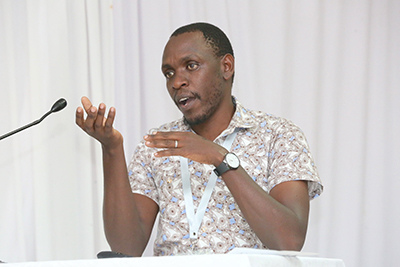
Dr Ng’etich, a lecturer at Egerton University, loves crop farming. He has planted tea, peas, and maize and keeps a few animals. He loves reading books of different genres and might be lucky to have one of his children follow in his footsteps. He also credits his academic mentors, Prof. Goerge Gitau, Dr. Abuom, and Dr. Aboge, for their support throughout the PhD journey. “Were it not for the regular meetings and advice from my supervisors, I would not have managed to complete my PhD in three years,” Ngetich says. He says that a committed, dedicated, and compatible supervision team is paramount for the successful completion of post-graduate studies.
“When I come home, my son is always quite curious about my work. He loves asking questions like what is the work of this syringe, or what does this drug do to the animal, and I feel that among my children, he may be the one to take up my trade,” he says with a smile on his face.
Dr Ng’etich is one of the ten fully sponsored PhD fellows under the Feed the Future Innovation Lab for Animal Health (AHIL) program. This program is being implemented in 600 households in Narok County in Kenya to improve human nutrition, economic welfare, and resilience by removing cattle health and production constraints in Kenya and the East Africa region.
Washington State University leads the AHIL consortium with Kenya-based partners, including the University of Nairobi, the International Livestock Research Institute, and Scientists from the Kenya Medical Research Institute and Kenya Agricultural and Livestock Research Organization.
The five-year program combines laboratory and field intervention studies to improve the uptake of animal health interventions and measure the impact on household well-being and the nutritional status of women and children.
The Feed the Future Innovation Lab for Animal Health is a five-year cooperative agreement funded by the USAID Bureau for Resilience, Environment, and Food Security.
Dr. Ng’etich’s unwavering dedication to improving cattle health and production across 600 households in Narok County, Kenya, goes beyond addressing immediate challenges—it uplifts the community’s economic and nutritional welfare while setting a powerful example for future generations.
Driven by a passion for solving real-world problems, he is deeply committed to nurturing his son’s inquisitive nature and inspiring younger generations to embrace knowledge and innovation to create lasting solutions for their communities.