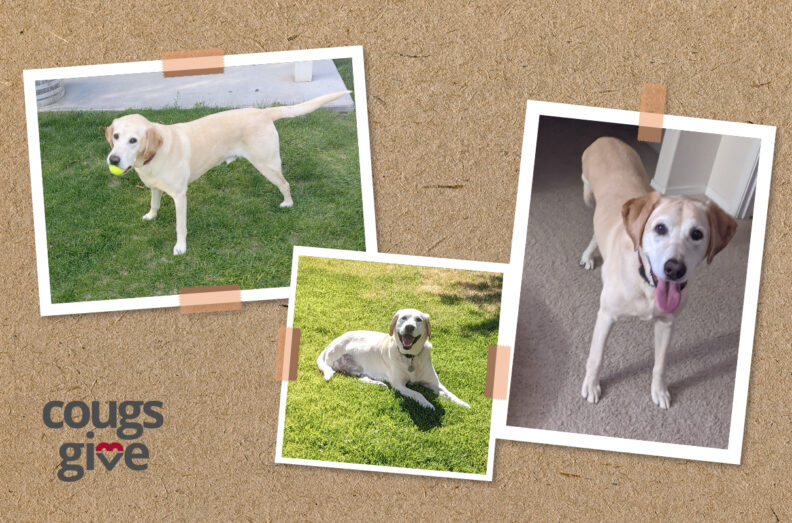
This story is one of three in a series promoting the college’s Grateful Client Fund, which provides Veterinary Teaching Hospital clients an opportunity to honor their veterinarian with a monetary donation. It also ensures the hospital is equipped with the most advanced equipment. This year the Grateful Client Fund is one of five college fundraising priorities for #CougsGive — WSU’s 24-hour annual giving day.
Following his dog’s osteosarcoma diagnosis on his right rear leg in June 2019, Jeff Doty was referred to Washington State University’s Veterinary Teaching Hospital for palliative care. His dog, Duke, was given just a three- to six-month prognosis.
But during Duke’s initial visit to WSU, veterinarians suggested the yellow lab was a prime candidate for amputation, and with chemotherapy, thought it could extend his life.
Coming up on six years since the surgery, Doty is still happy to share each day with Duke.
That extra time together and the exceptional care he and Duke received is why Doty supports WSU’s Grateful Client Fund — a way for grateful hospital clients to honor WSU veterinarians or hospital staff for their care.
“Part of it was just being grateful for the excellent treatment and service that we had there, not just the doctors, but the students as well,” Doty said. “I want them to know what a great service that they do, and how impactful the treatment that they do for folks is, and how much of a benefit that is on people’s lives.”
After a surgery with no complications to remove Duke’s rear right leg and five chemotherapy treatments, Duke didn’t take long to adjust to life on three legs.
In about two weeks not only was he walking, but he was also able to run and play fetch.
“He really had no problems moving around,” Doty said.
Initially when weighing whether to amputate or not, Doty said he wasn’t sure Duke could have a quality life with three legs.
It isn’t something he questions now.
“He was 8 years old at the time, so I kind of felt like he had more life to live,” Doty said. “And that was ultimately why I made the decision to go through with it. It was tough the first couple weeks when he didn’t really want to move around, but he recovered and made it past the prognosis dates, and I didn’t have to wonder anymore if I made the right choice.”