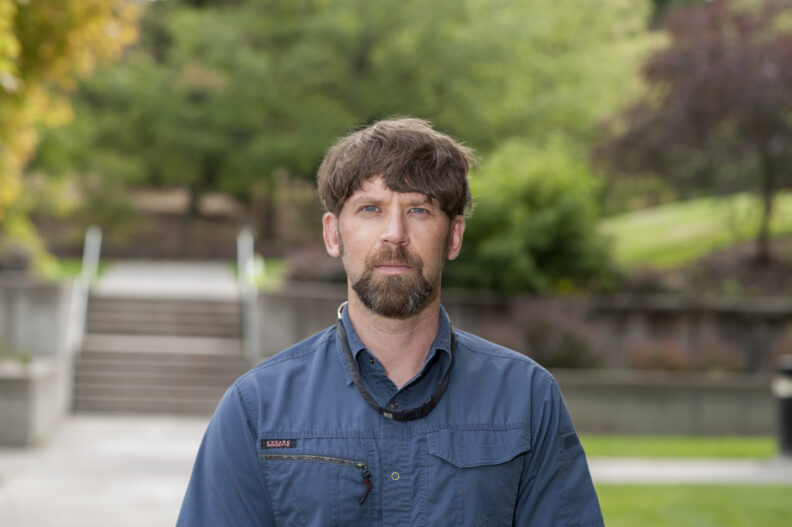
Fascinated with anatomy and physiology at a young age, associate professor and pathologist Kyle Taylor hasn’t forgotten his early dissections in biology class. Little did he know, science would lead him to another found passion – training students to be respected veterinarians and veterinary specialists. Dr. Taylor teaches gross pathology and histopathology to veterinary residents who already have a Doctor of Veterinary Medicine and are training to become specialists in the field of veterinary anatomic pathology. He also teaches general pathology to first-year veterinary students at Washington State University and sees those students again in their fourth-year diagnostic block where they learn to necropsy a wide variety of animal species. Seeing that transformation from students to doctors is one of his favorite parts about teaching.
What has been your academic/career path leading up to WSU?
I graduated from WSU with a Bachelor of Science degree in zoology. After a two-year hiatus, which included a year of teaching English under the Ministry of Japan’s JET Program where I began my career in teaching, I followed up with a Doctor of Veterinary Medicine degree from WSU as well. During all those years and even after getting my veterinary license, I continued to work seasonally, often on studies into wildlife diseases and mortality.
Eventually, that developed into a particular interest in infectious diseases of wildlife, and I went to Hokkaido University in Japan for a PhD studying just that while I continued to take teaching roles as a graduate student.
After that, completely hooked on causes and mechanisms of death, I went to the University of Florida for an anatomic pathology residency, where residents share in teaching veterinary students. I finished out my training with a pathology fellowship at Disney’s Animal Kingdom, and then returned as faculty to WSU where I can pursue my interests in teaching and veterinary diagnostics and research into infectious diseases of wildlife.
What drew you to WSU’s College of Veterinary Medicine?
I studied to be a veterinarian in this very program, so I knew that it was full of good people and attracts good students and is a great environment for people of all walks of life to learn and grow.
What is your favorite part about being an educator?
Overall, I enjoy watching the students and residents grow into their knowledge and roles, but on a day-to-day basis, it’s watching them make connections between what they already know and some bit of knowledge that I’ve just shared with them that suddenly opens up a whole new level of understanding. It may be trite, but those “lightbulb” moments.
What’s something most people don’t know about you?
I typically don’t share much, so this list could be very long. Restricting it to pathology though, I have multiple congenital lesions, including mild pectus excavatum, hypodontia (which my younger son also has), and ankyloglossia (which both of my sons were born with). One thing my veterinary students will learn is that an animal—or person—with one congenital anomaly often has others. All are “incidental” lesions since they are abnormal but create no issues.