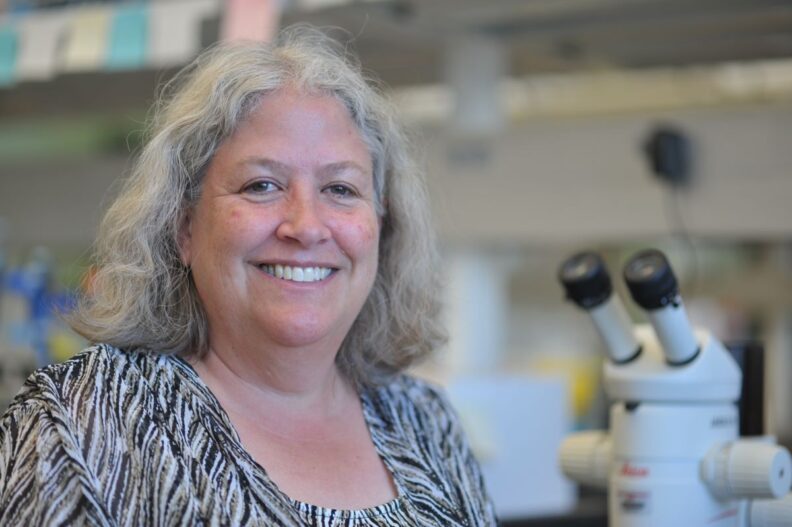
Using roundworms to study fat metabolism and cell death, Dr. Jennifer Watts is leading research in the College of Veterinary Medicine that could one day improve cancer treatments in humans. In addition to her groundbreaking research, Dr. Watts is dedicated to mentoring and teaching both undergraduate and graduate students.
Dr. Watts earned her doctorate from Cornell University, performed postdoctoral studies at Washington State University in the Institute of Biological Chemistry, and currently holds the rank of professor in the School of Molecular Biosciences.
In this Q&A, she shares insights into her research, its real-world applications, and her passion for training the next generation of scientists.
What are your current research interests and what attracted you to that area?
My research interests are how polyunsaturated fats function in animal physiology and development. Our studies of fat synthesis and function led us recently to focus on a type of cell death, called ferroptosis. Ferroptosis is unique among other forms of cell death in that it is driven by uncontrolled peroxidation of polyunsaturated fats in cell membranes. Work in various labs has shown that this relatively newly characterized form of cell death occurs during diseases states such as neurodegenerative, heart, and liver diseases. On the other hand, this type of cell death could be used to kill cancer cells, leading to possible therapies. In our studies we use a simple animal model, the roundworm Caenorhabditis elegans. These worms synthesize many types of polyunsaturated fats, and their fast development and short lifespan make them amenable to genetic, genomic, behavioral, and biochemical studies.
While ferroptosis is generally associated with diseases of aging, we found that in young, healthy worms, certain dietary conditions lead to the death of germ cells. This experimental system allows us to interrogate the fundamental cellular mechanisms of ferroptosis induction and protection, and in the long run this work will provide insight into how to prevent cellular damage in human disease states or how to harness cell death to help treat cancer.
When your career is over, what do you want to be remembered for?
I want to be remembered for the originality of my research program and for contributing to the scientific community through collaborative work. I also want to be remembered as a team player for my service contributions to the School of Molecular Biosciences, the College of Veterinary Medicine, WSU, and the worldwide scientific community.
How can your research help people and animals?
My research contributes to fundamental knowledge of cellular mechanisms of animal development and disease. Treatments for diseases rely on basic research. Great advances in biomedical research have been made by people working on fundamental biological questions in simple model organisms that lead to unexpected discoveries about how cells function within organisms.
What do you enjoy about working with students?
I love how students blossom as they progress through their university studies. The undergraduates leave with enthusiasm for science and their careers take them many places. The graduate students come to us as open books, and by the time they leave, they are the experts. Their creativity and hard work contribute substantially to the growth of knowledge. It is my honor to serve as a mentor to these students.
What are you most proud of in your career to this point?
I’m proud of the impact my research has had on others in the scientific field, as measured by citations of my work in other research studies. The C. elegans mutant strains that were isolated in my lab are available for distribution and are currently being used in dozens of other labs who are studying the effects of fat composition changes on innate immune responses, neuronal function and cognition, neuronal degeneration, aging, embryonic development, reproduction, and responses to stress.
What advice would you give to younger people considering a career in science?
Curiosity, resilience, and enthusiasm are required attributes in scientists. It’s not how smart you are (although that helps!), it’s your work ethic and commitment to lifelong learning that set you up for a successful career.