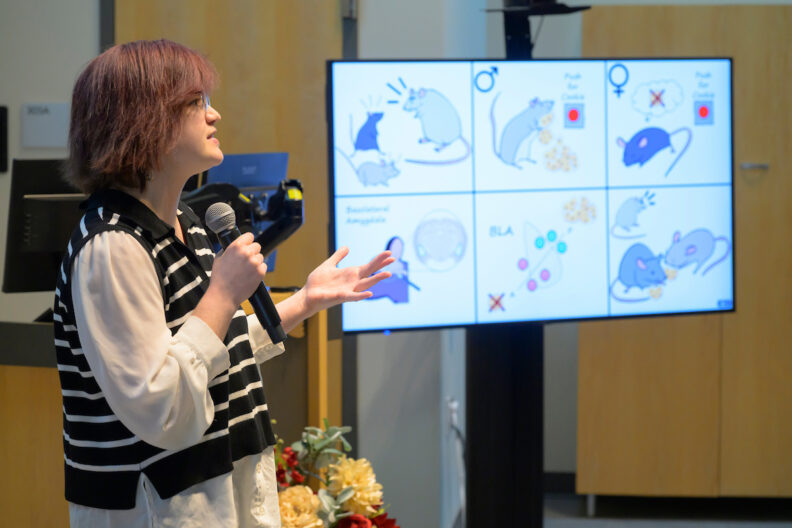
Originally from Huntsville, Alabama, Megan McGraw is a PhD student in neuroscience in WSU’s College of Veterinary Medicine, where she studies how stress affects brain activity and behavior. McGraw earned a dual bachelor’s and master’s degree in neuroscience from the University of Alabama at Birmingham before joining WSU and the laboratory of Dr. Emily Qualls-Creekmore. Through her research, she seeks to better understand how chronic social stress alters neural circuits linked to motivation, work that could help advance understanding of depression, substance use disorders, and eating disorders.
Expected to complete her doctorate in December 2027, McGraw recently shared more about her research, mentorship experiences, and why she chose WSU.
What inspired you to pursue your graduate studies at WSU?
When I interviewed at WSU I enjoyed the feeling of community within the department, especially within the graduate students. It really felt like WSU would provide a good environment to be able to focus on and be successful as a PhD student through hands-on mentorship from both professors and peers. I was particularly interested in the iPBS peer mentor program for incoming students that was ultimately very beneficial for me as a first year.
Can you describe your current research?
Overall, I study how stress affects motivated behaviors which are implicated in depression, substance use disorder, and eating disorders. My project specifically focuses on understanding the effects social stress has on neuronal activity and whether or not changes in specific subpopulations of neurons lead to our observed changes in motivated behaviors during chronic stress exposure.
What resources or facilities at WSU have been most valuable to your research?
I have utilized the machine shop many times to customize and design equipment that allowed me to improve the quality and efficiency of my research protocols. Additionally, the CVM vivarium facility, staff, and veterinarians are critical to my research. They help maintain the health and safety of our animals, which ensures ethical and rigorous research.
How has your mentor helped you in your journey?
Dr. Qualls-Creekmore has been a great champion for me, keeping me focused on my goals and helping me build confidence as an independent researcher. She also ensures that I am learning about and participating in systems like grant applications that are critical skills for me after graduate school to be successful in academia. Overall, she has really provided a scaffold for me to be as successful as possible, while still allowing me the space to grow and learn independently.
What are your long-term career goals, and how is your current research helping you achieve them?
I want to continue to do research on the impact of stress on behavior. In the future, I hope to shift toward understanding how early life stress can lead to long term changes in neuronal activity and ultimately motivated behaviors. Thus, in my current lab I am able to learn a lot of the foundational systems neuroscience techniques within the context of stress that I will hopefully continue to use for the rest of my career.
What would you say to prospective graduate students considering the College of Veterinary Medicine?
The CVM is a welcoming college that is doing a lot of really innovative and important research for both humans and animals. It really is unique in the breadth of the research done within one college and has a lot of great opportunities for students to learn, grow, and prepare for life after graduate school.