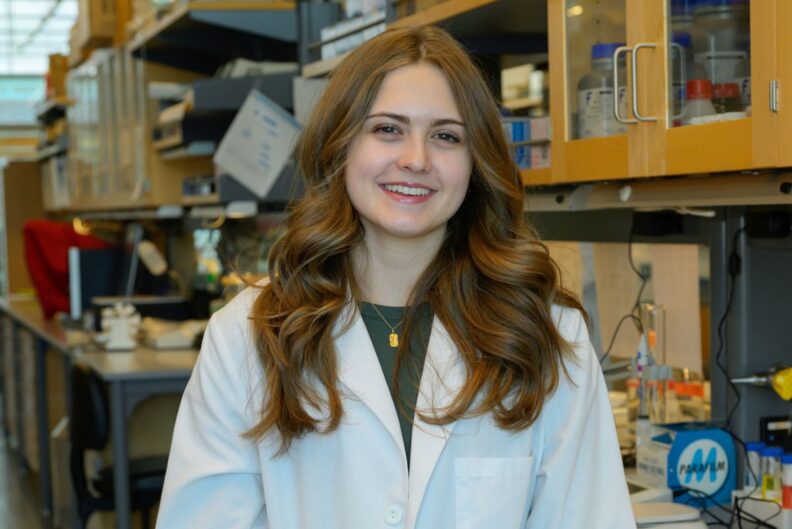
As a neuroscience major, Maya Nash spends her days investigating the brain mechanisms that drive addiction and drug-seeking behavior. The Aurora, Colorado, native is expected to graduate in May 2027 and has distinguished herself through her research in the laboratory of Dr. Giuseppe Giannotti, earning a Society for Neuroscience Trainee Development Award and the Peter Zornes Memorial Scholarship.
She recently shared how research, mentorship and the WSU community have shaped her undergraduate experience and future plans to pursue a PhD in neuroscience.
What initially drew you to your major?
I was always a curious person; from the earliest ages I was a student. Even as a young child I loved school and learning, so as I began to look forward to a career, I knew something in science would be the choice for me. In my junior year, I was given an assignment to research Eye Movement Desensitization and Reprocessing (EMDR) therapy. That night I went home and began to look through literature on EMDR, but the search didn’t stop at a quick Google search. I spent weeks looking through case studies, literature, reviews, and lectures by the founder learning about the therapy itself and the mystery behind why it works. It seems kind of funny now considering my work in neuroscience mostly focused on addiction and neuronal circuits, which has almost nothing to do with EMDR, but this was really the beginning of my obsession with understanding the brain. While my academic focus may look different now, I am still just as enamored by the nervous system as I was when I first encountered it here.
Who has been the most influential mentor or professor during your time at WSU?
The most influential mentor during my time at WSU has been my principal investor, Dr. Giuseppe Giannotti. Dr. Giannotti has made me the scientist I am today; his guidance and support have been an integral part of my neuroscience education and research career. Not only does he have an enormous knowledge base and understanding in this field, but he is also a clear and patient teacher. He is always working to challenge his students and somehow knows exactly how much you can handle. From helping me make career changing decisions to submitting scholarship applications to learning new skills in the lab, Dr. Giannotti has been a tremendous support system the whole way. Thank you, Dr. Giannotti!
Have you had any opportunities to work in a lab or conduct research while at WSU?
I work in Dr. Giuseppe Giannotti’s research lab. We focus on drug seeking behavior related to addiction, more specifically opiate use. Working with my current mentor, a renowned faculty member whose work focuses on the PVT, I have gained specialized experience in my field that I can expand later in my career. I have learned much about the neuronal circuitry around addiction and utilizing behavior methodologies like optogenetics and immunohistochemistry/IHC. My most recent work has focused on understanding spine morphology in the PL—>PVT pathway, this work is currently under review as a first author publication. This experience has given me an essential foundation for the rest of my career as a researcher to build upon.
What advice would you give to someone thinking about majoring in a field within the College of Veterinary Medicine?
Your mentors are everything! The best thing you can do is getting to know your professors and faculty mentors. Going into a university, I think many students are afraid to approach faculty or think that faculty is unapproachable. Our faculty members are some of the best in the industry and have an insane surplus of knowledge. Not only are they knowledgeable, but they also love to teach and support you as long as you are willing to learn; therefore, make sure you utilize their expertise while it is available to you!
What’s your favorite thing about WSU?
My favorite thing about WSU is the community here. WSU Pullman really feels like a true college town that is very supportive of its students. Not only does this community exist at WSU, it extends globally with alum and other students shouting “Go Cougs!” at one another anywhere and everywhere. The opportunities and experiences I have had during my time at WSU are unparalleled to any other place. It is truly a one-of-a-kind experience!
What are your post-graduation plans?
I initially came to WSU as a pre-medicine student, but my first experience working in a research lab quickly convinced me to switch trajectories. I vividly remember the first experiment I got to watch and participate in and watching the other researchers looking at a simple microscope image. Watching the physiology right in front of me, I knew this was the feeling I was missing in my attempt to study medicine. Therefore, after my time in undergrad at WSU, I plan on applying to graduate school and earning a PhD in neuroscience and neuropharmacology. Regardless of where I end up, I want to continue studying neuronal mechanisms in the context of drugs of abuse and misuse related to abstinence.
What hobbies or extracurricular activities have you enjoyed at WSU?
While at WSU, I have been an active member of the Country Swing and Line Dance club. I grew up dancing competitively and currently teach dance part-time in Moscow. This club has been a great opportunity for me to meet new people and keep dancing while earning my degree. I am also involved in the performing arts community in the area as a member of the Palouse Choral Society and a dance instructor at Festival Dance Academy.
What’s a fun or surprising fact about you that most people wouldn’t guess?
A fun fact about me is I have been studying the French language for close to a decade.