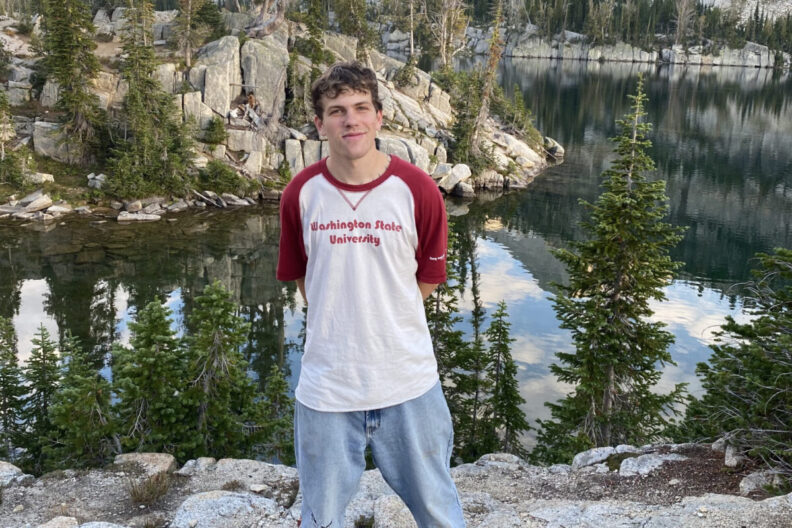
Bodhi Hirsch’s fascination with the brain has grown into a passion for research and discovery at WSU and in the College of Veterinary Medicine. The neuroscience major, who is also pursuing minors in chemistry and biochemistry, has gained hands-on experience in both computational and laboratory research while exploring questions about the brain, behavior, and disease. Originally from Oakland, California, Hirsch is on track to graduate in May 2027 and is now preparing for the next step in his academic journey as he applies to PhD programs across the country.
What initially drew you to your major?
I have always been fascinated by the inner workings of our brains and what goes into our decision-making and thought processes. Studying neuroscience has given me tools to start asking those questions rigorously rather than just wondering about them.
Who has been the most influential mentor or professor during your time at WSU?
The most influential mentor for me has been Dr. Elissa Schwartz. I had my first research experience in her lab, and it helped me evolve into a better researcher and student. She trusted me with real problems early on and taught me how to sit with a question that doesn’t resolve quickly, which changed how I approach my coursework and research. Her mentorship is a large part of why I decided to pursue research as a career.
Have you had any opportunities to work in a lab or conduct research while at WSU?
I currently work in both Dr. Schwartz’s lab, and Dr. McLaughlin’s lab. I have been able to gain dry lab experience in the Schwartz lab with mathematical modeling of viral infections and in the McLaughlin lab I have gained wet lab experience studying the effects of cannabis in rats. These experiences have allowed me to contextualize the content that I have learned in my classes. For example, when doing immunohistochemistry, I was able to recognize structures I had studied in Neuroanatomy (404).
What advice would you give to someone thinking about majoring in a field within the College of Veterinary Medicine?
My biggest piece of advice would be to gain research experience and challenge yourself with hard courses that have smaller class sizes. I have found that it is much easier to build relationships with professors this way. Smaller, more intensive classes also force you to focus and engage rather than blend into the back row.
What’s your favorite thing about WSU?
My favorite thing about WSU is the fact that it’s in a college town. I love being surrounded by people my age who are all going through somewhat similar experiences, which creates a real sense of community and makes conversation easy. Coming from a bigger city, I found it was a stark contrast, but I came to appreciate it quickly.
What are your post-graduation plans?
I am currently applying to PhD programs at graduate schools across the country. WSU has given me a broad range of experience to carry into this next chapter, along with connections that can help me take that step. Having worked in two labs with very different methodologies, I feel prepared for the demands of graduate-level research. I’m excited to find a program where I can keep asking questions about the brain and behavior.
What hobbies or extracurricular activities have you enjoyed at WSU?
I have enjoyed the nature around Pullman, especially hiking and backpacking in Idaho and Washington. After a long week, it feels great to be able to drive out into the wilderness to relax and reflect with friends. It’s pretty amazing being surrounded by the Palouse and the mountains in Idaho.
What’s a fun or surprising fact about you that most people wouldn’t guess?
A fun fact about me is that I have worked as a stagehand setting up concerts for some amazing artists such as Rufus Du Sol, Zach Top, Janet Jackson, Creed, and The Cure.