Hometown: Gig Harbor, WA
Undergraduate degree: Animal Science/Chemistry Minor (WSU)
Area of interest: Small Animal Specialty – Radiology
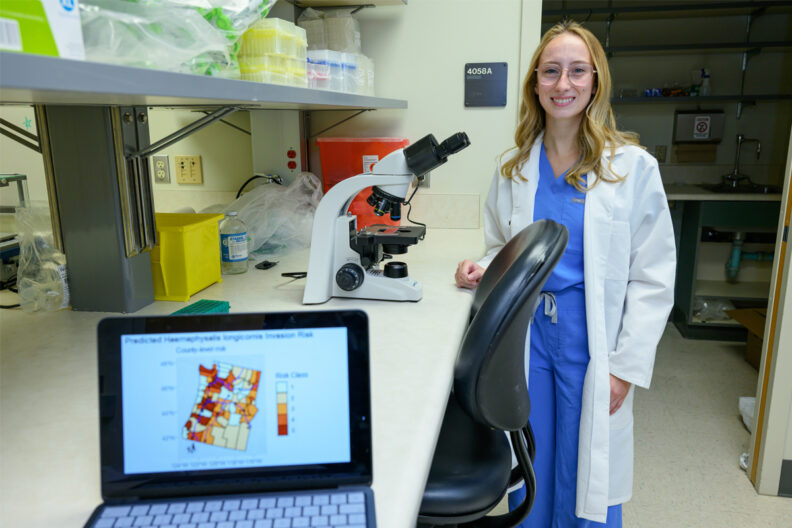
Caroline Cave, a member of the Class of 2028, is using her summer research fellowship to help prepare Washington for a potential emerging threat: the Asian longhorned tick (ALT), an invasive species that has rapidly spread across the eastern United States.
Working with Dr. Andreas Eleftheriou, Cave’s project focuses on identifying which counties across Washington may be most at risk should the tick reach the West Coast. The Asian longhorned tick poses serious concerns for animal and public health due to its ability to reproduce asexually, infest a wide range of hosts and transmit disease.
Cave’s study will integrate ecological and social data — including livestock density, wildlife presence, land use, transportation routes and community vulnerability — to build a county-level risk map.
Using weighted spatial modeling, she will analyze how these factors combine to influence the likelihood of invasion, helping pinpoint where surveillance and prevention efforts should be prioritized.
The findings are intended to support early detection and strengthen biosecurity strategies, particularly in rural and agricultural communities that may face the greatest risk.
Cave says the opportunity aligns closely with her interest in public health and building practical research skills.
“The aspect that I look forward to the most during this program is the ability to gain hands on research experience,” she said. “The skills and insights I take away will help establish a foundation for a career committed to advancing science, public health and animal medicine.”