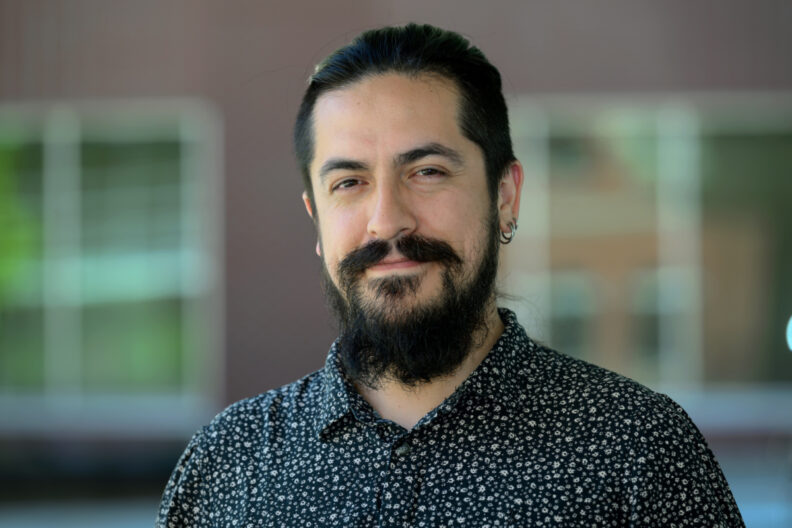
With a career spanning Chile, the United Kingdom, and the United States, assistant professor Dr. Sergio Hidalgo Sotelo brings a rich background in neuroscience and biological rhythms to Washington State University’s College of Veterinary Medicine. After earning a biochemistry degree at the Pontifical Catholic University of Chile, Dr. Hidalgo began research in Dr. Jorge Campusano’s lab, where early work in neurochemistry led to both a master’s and PhD.
A collaboration with Dr. James Hodge at the University of Bristol grew into a dual-degree program and an invaluable international experience, where exposure to new techniques and scientific approaches broadened Dr. Hidalgo’s perspective and helped shape his future research direction. Following completion of his PhD, Dr. Hidalgo pursued postdoctoral research in Dr. Joanna Chiu’s lab at the University of California, Davis, where an interest in biological rhythms developed into a central focus of his work today.
What drew you to WSU’s College of Veterinary Medicine?
WSU has one of the leading vet schools in the country. I truly believe that this stems from the fact we have amazing professors and researchers who are working on amazing topics. This, in turn, draws great students who make this a leading college. Also, the diversity in the research questions and the different approaches from basic to clinical science make WSU’s College of Veterinary Medicine a great place to work.
What is your area of expertise?
My areas of expertise are in genetics, molecular biology, and neurophysiology in the context of biological rhythms. Our lab uses the fly Drosophila melanogaster as an animal model to understand how organisms integrate environmental cues and how they use this information to adapt to seasons. Particularly, we focus on how the structure and function of the brain are modified by seasonal environmental cues like the length of the days or temperature, and how this affects health and disease. We place particular emphasis on understanding the role of the circadian clock, the mechanism that allows the modulation of physiology and behavior to day and night cycles, in seasonality.
What drew you into this area?
When I started my academic journey, I was really interested in the neurobiology of diseases and the physiology of the brain. Working with Drs. Campusano and Hodge was a super enlightening experience. Their way of looking at scientific problems through a biomedical lens was a great example of translational biology and an invaluable experience for my scientific formation. I learned a lot from them on the physiological and molecular basis of diseases such as Parkinson’s, Alzheimer’s, and schizophrenia. It was at this stage that I became intrigued by the commonality of circadian and sleep disruptions in people with the disorders I was working on, as well as the great seasonal components of their symptomatology.
Working in Dr. Chiu’s lab was perfect to fill this gap in my scientific curiosity. She not only allowed me to work on my previous interest but also allowed me to explore other aspects that were completely unknown to me. Her ways of looking at scientific questions not only focus on biomedical research but also put it all in other contexts such as ecology, evolution, and agriculture. It was an amazing learning experience for me.
I’ve had the fortune to have these and other amazing mentors who have shaped my scientific curiosity and ways of looking at my questions from a truly holistic perspective.
What about your research work are you most excited for?
Many things! If I have to pick one, I am really looking forward to understanding how seasonal environmental cues shape alternative splicing, the mechanism by which different molecules of messenger RNAs can be produced from the same precursor molecule. We have shown that this process is affecting the core molecular clock architecture, generating an entirely different “winter clock.” Understanding how this clock is ticking and how it is helping to keep seasonal timing would be amazing.
What’s something most people don’t know about you?
I love horror movies!! I’ve been obsessed with this film genre since watching the 1973 masterpiece “The Exorcist” when I was 7.