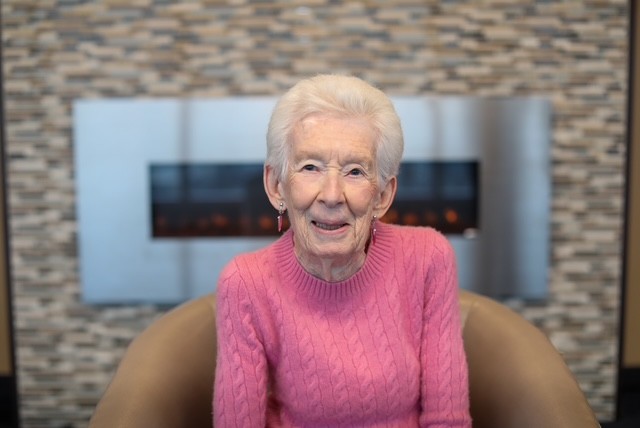
When 95-year-old Mary Body decided to give back to Washington State University, she wanted her gift to make a difference where and when it’s needed most.
That’s why her gift of $50,000 was directed to the College of Veterinary Medicine Margin of Excellence Fund, which provides flexible support for innovation, research and student success.
“The education I received at WSU really changed my life and opened up so many opportunities,” Body said. “I want to help make sure those opportunities are there for others, too.”
Body graduated from WSU in 1953 with a degree in bacteriology and public health – which was then a program under the School of Molecular Biosciences – establishing a foundation that ultimately led to a three-decade career teaching biological sciences in Seattle area public schools.
She left Pullman with more than a degree – she and her first husband, Ralph Body, met there as students and married during their junior year. Only months after Mary’s graduation, the couple welcomed their daughter while they still lived on the Palouse.
Mary, who grew up in Seattle, remembers her time in Pullman and at WSU fondly.
“I thought it was great to be independent. I lived in the dorm, and it was just a great experience to be part of a large community,” she said. “I also found the classes interesting, intriguing and difficult. I learned more than I thought I ever could.”
Her time in Pullman came during a period in history when women were often steered away from careers in medicine and science, however, Mary said she experienced only support from her fellow students, staff and faculty at WSU.
“You grew up thinking you couldn’t do those things,” she said. “It was just the culture of the time that from when girls were very, very young, you would say, ‘I want to do this or that,’ and parents and teachers would all say, ‘Oh, you can’t, you’re a girl.’ At WSU, it wasn’t like that. Fortunately, society is different now. It’s accepted that girls can do whatever they want. It’s up to them.”
Mary’s experience at WSU prepared her for a career in science and educating youth. After working in a clinic laboratory in Grandview, she took a leadership role with Camp Fire Girls, igniting a passion for working with youth. She eventually went back to school to earn her teaching certificate, setting the stage for a 30-year teaching career that culminated with her retirement in 1998.
“I just loved it,” she said. “There’s so much energy in the students. They’re eager to learn, even when they have a lot of things working against them.”
Through the years, Mary has maintained her relationship with WSU, supporting various departments and efforts.
Mary wanted her most recent donation to help the college respond to needs as they arise, which is why she chose to provide discretionary support. The unrestricted funds allow the dean to invest in new ideas, sustain promising projects or bridge funding gaps when traditional sources fall short, which can be especially important in a time when other funding sources are uncertain.
“There always seems to be something an organization wants to do that they don’t have the funds to do,” she said. “If they had discretionary money, it could make a difference. There are no strings attached – just using it where it’s needed.”
However the money is used, she is proud to support the college’s efforts.
“I think the things happening in the College of Veterinary Medicine are outstanding,” she said. “There are a lot of exciting programs, and more people are realizing how connected animal and human health can be.”
Now living in the Seattle area with her husband, Al Raymond, Mary said that as she has gotten older, giving back has become more important. For her, it is about supporting institutions that shaped her life while helping ensure the same opportunities exist for future generations.
“I was fortunate in my own experience, and I want others to have those same chances,” she said. “That’s why I’ve given back.”
Support the College of Veterinary Medicine Margin of Excellence Fund.