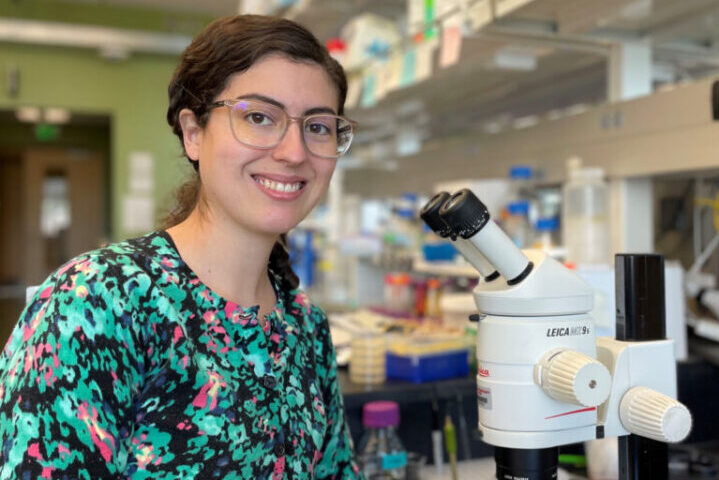
Congratulations to EschLEAD scholar Eliza Merlin for graduating this December with a Bachelor of Science in genetics and cell biology.
Eliza excelled as an EschLEAD scholar, most recently working in Dr. Arden Baylink’s lab where researchers are investigating the world’s deadliest gastrointestinal bacteria.
Established through a generous donation by Robert Esch (’75 BS, ’78 MS) and Katherine Esch, the EschLEAD (Learn, Experience, Apply, Deliver) program is pioneering initiative — open to WSU undergraduate students from all backgrounds, experiences, and academic disciplines — designed to provide undergraduates with immersive, hands-on learning in real-world research environments in the college’s leading labs. EschLEAD combines skill-building, real-world applications, and mentorship to empower students to explore, grow, and create their own paths to success.
Eliza recently took some time to discuss her experiences as an EschLEAD scholar.
Which lab or labs have you worked with and what sort of projects and research have you been involved with?
I have shadowed in a plant science lab and protein engineering lab. I worked in Dr. Jennifer Watts’ lab studying nematodes (Caenorhabditis elegans) as a model for ferroptosis, an iron-dependent form of cells death. Currently, I work in the Baylink lab where we study bacterial chemotaxis proteins for the purpose of designing antibacterial drugs. I have been training as a lab tech focused on safety in the BSL-2 environment.
How is the EschLEAD program influencing your undergraduate career?
I realized that my creativity in arts could apply to protein modeling and proposed a protein domain sculpture as one of my deliverables. In the future I will be involved in science outreach as an artist, and so this is a great portfolio item. Since my other LEAD task is creating an easy-to-follow safety manual, I am understanding science communication from a different perspective.
What has been the most valuable experience in the EschLEAD program so far?
The freedom to contribute to the lab in a creative way has given me confidence in my ability to use all my skills in support of scientific research. My creativity has value, and that’s important to remember.
How has your involvement in the program connected you with other students, faculty, alumni, or professionals in the field?
I’m working with Chris Lavoie at the SPARK design lab to 3D print elements of my protein sculpture. I was introduced to Chris during my virology course when we had to 3D print a model of a virus. When I reached out for the LEAD project, he explained the whole process and my different options in a clear way. The cost of these services isn’t a real barrier to anyone wanting to get into 3D printing.
What are your plans after graduation, and how is the program helping you prepare for them?
I plan to work as a lab technician or assistant in biotech while completing creative projects on my own time. Creating the safety manual for our lab not only reinforced my safety practice knowledge, but also serves as an example to future employers of my commitment to safety.
What advice would you give to future students interested in undergraduate research and/or joining the EschLEAD program?
I advise undergraduates to take on these projects even if they are nervous about balancing schoolwork. The labs on campus know that completing your undergrad is top priority and will work with you to find the right balance. I thought I wouldn’t have time for research or outside projects this semester with six classes, but I was afforded flexibility in my schedule and workload so that I could succeed all around.